Breen Michael S, Tao Ran, Yang Andy, Wang Xuran, Amini Pardis, de Los Santos Miguel Rodriguez, Brandtjen Anna C, Deep-Soboslay Amy, Kaye Walter H, Hyde Thomas M, Kleinman Joel E, Buxbaum Joseph D, Grice Dorothy E
Seaver Autism Center for Research and Treatment, Icahn School of Medicine at Mount Sinai, New York, NY, USA.
Department of Psychiatry, Icahn School of Medicine at Mount Sinai, New York, NY, USA.
medRxiv. 2024 Nov 28:2024.11.27.24318078. doi: 10.1101/2024.11.27.24318078.
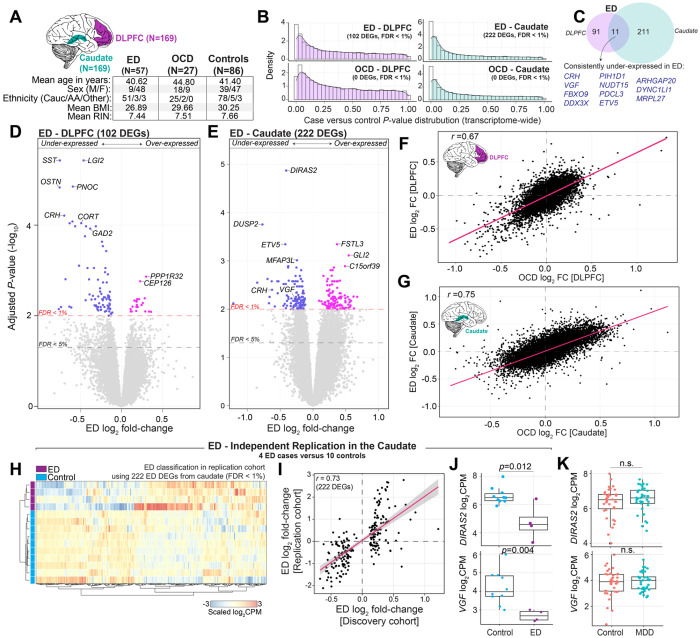
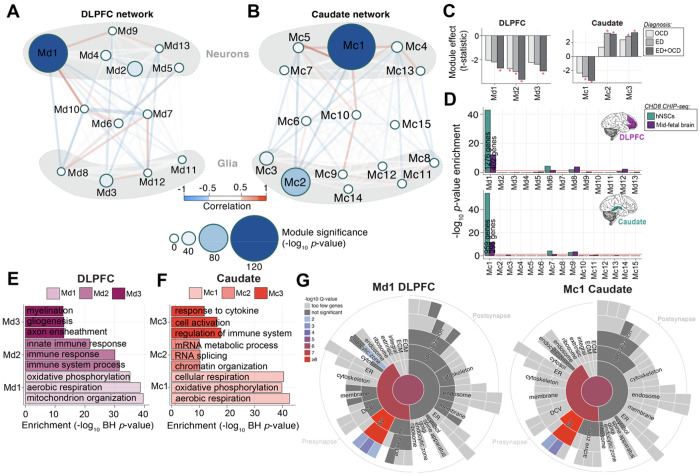
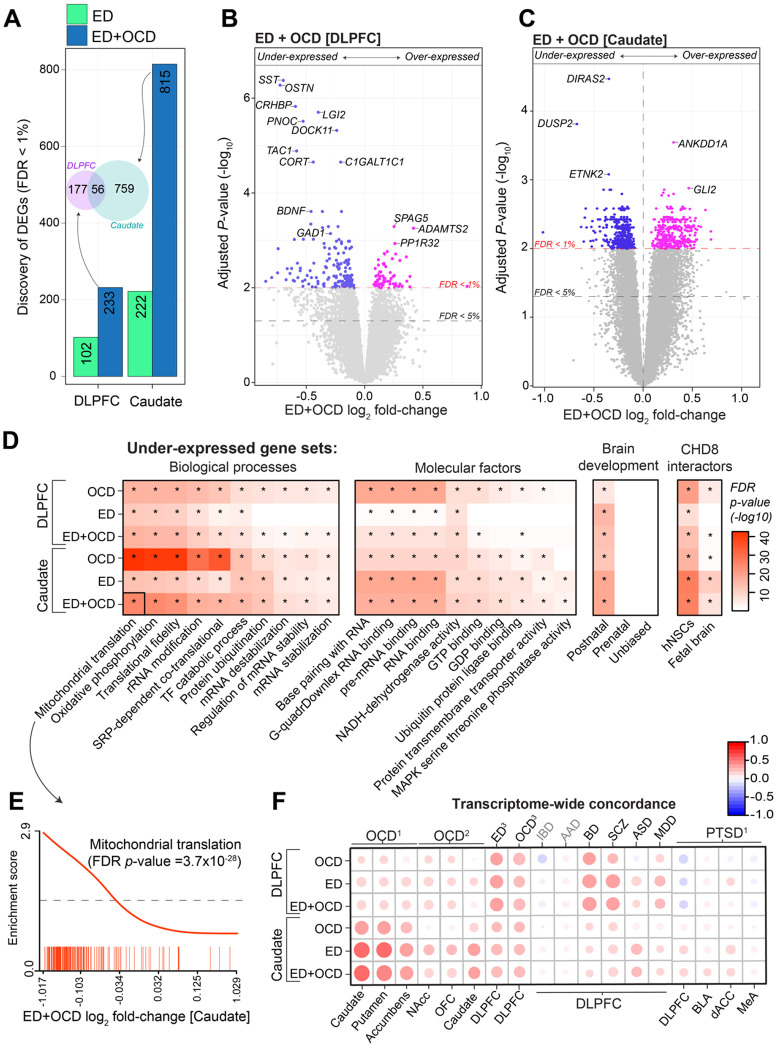
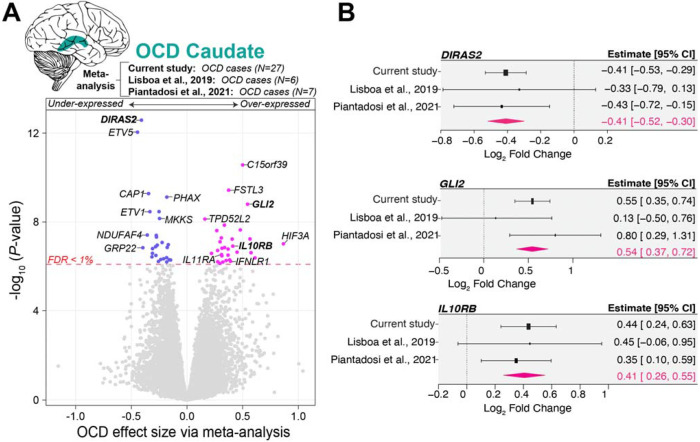
Eating disorders (ED) and obsessive-compulsive disorder (OCD) exhibit significant clinical and genetic overlap, yet their shared molecular mechanisms remain unclear. We conducted a transcriptomic investigation of the dorsolateral prefrontal cortex (DLPFC) and caudate from 86 controls, 57 ED, and 27 OCD cases. ED was associated with robust differentially expressed genes (DEGs): 102 DEGs the DLPFC and 222 in the caudate (FDR < 1%) and replicated in an independent cohort. For OCD, no DEGs reached significance; however, meta-analysis with extant data identified 57 DEGs in the caudate. High concordance in transcriptomic changes was observed between ED and OCD in both regions (DLPFC =0.67, caudate =0.75). A combined ED+OCD analysis uncovered 233 DEGs in the DLPFC and 816 in the caudate, implicating disrupted GABAergic neuron function, neuroendocrine pathways, metabolism, and synaptic processes. Genetically regulated expression analysis identified nine genes with strong evidence for increasing ED risk, further validating these pathways. These findings reveal a shared molecular basis for ED and OCD, offering new insights into their pathobiology and potential therapeutic targets.
饮食失调(ED)和强迫症(OCD)在临床和遗传方面存在显著重叠,但其共同的分子机制仍不清楚。我们对86名对照者、57名饮食失调患者和27名强迫症患者的背外侧前额叶皮质(DLPFC)和尾状核进行了转录组学研究。饮食失调与大量差异表达基因(DEGs)相关:背外侧前额叶皮质中有102个差异表达基因,尾状核中有222个(错误发现率<1%),并在一个独立队列中得到重复验证。对于强迫症,没有差异表达基因达到显著水平;然而,与现有数据的荟萃分析在尾状核中确定了57个差异表达基因。在这两个区域中,饮食失调和强迫症在转录组变化方面观察到高度一致性(背外侧前额叶皮质=0.67,尾状核=0.75)。饮食失调+强迫症的联合分析在背外侧前额叶皮质中发现了233个差异表达基因,在尾状核中发现了816个,这表明γ-氨基丁酸能神经元功能、神经内分泌途径、代谢和突触过程受到破坏。基因调控表达分析确定了9个有充分证据表明会增加饮食失调风险的基因,进一步验证了这些途径。这些发现揭示了饮食失调和强迫症的共同分子基础,为它们的病理生物学和潜在治疗靶点提供了新的见解。