
荷斯坦奶牛犊中血源性支原体经胎盘传播的表观患病率。
Apparent prevalence of transplacental transmission of hemotropic mycoplasmas in Holstein dairy calves.
作者信息
de Souza Ferreira L, Bolin S, Abuelo A, Norby B, Ruegg P L
机构信息
Department of Large Animal Clinical Sciences, College of Veterinary Medicine, Michigan State University, East Lansing, MI 48824.
Veterinary Diagnostic Laboratory, Michigan State University, Lansing, MI 48910.
出版信息
JDS Commun. 2024 Mar 8;5(6):587-591. doi: 10.3168/jdsc.2023-0518. eCollection 2024 Nov.
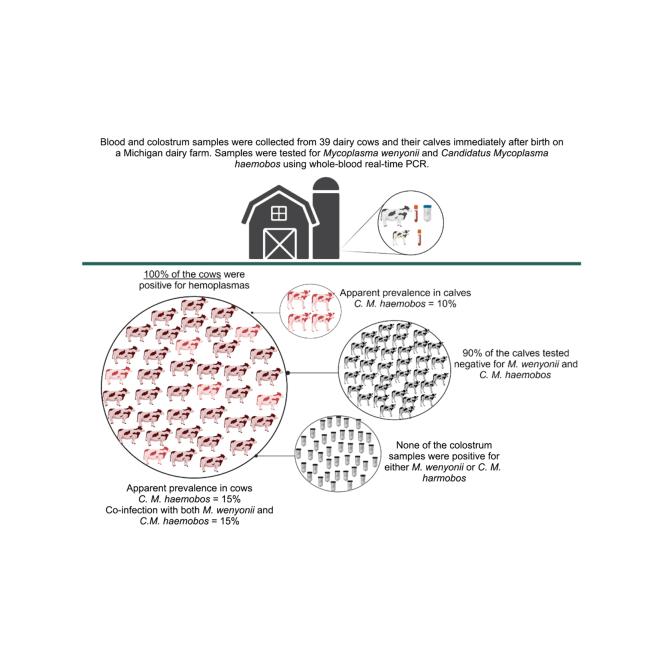
Hemotropic mycoplasmas are unculturable bacteria that infect the surface of red blood cells of several mammalian species including cattle. The importance of hemoplasmas in cattle remains unclear and limited information is available about biological routes of transmission. The objective of this cross-sectional study was to determine the prevalence of transplacental transmission of hemoplasmas and to determine if colostrum of infected cows contained DNA from hemoplasma organisms. In March 2023, researchers collected colostrum and peripheral blood samples from 39 dairy cows and their newborn calves (before ingestion of colostrum) at a single dairy farm in Michigan. Detection of and was performed using real-time PCR. The apparent prevalence of hemoplasma infection in dams was 100%, with 84.6% (33/39) co-infected with both and , whereas the remaining 15.3% (6/39) were infected solely with . The prevalence of newborn calves infected with was 10.2% (4/39), and none were infected with . No colostrum samples tested positive for either or . This is the first report of vertical transmission of hemoplasmas in a dairy herd located in the United States. However, the relatively low prevalence of infected newborn calves suggests that transplacental transmission is not the predominant pathway of infection. The absence of positive tests in colostrum may indicate ingestion of colostrum contaminated with hemoplasmas is not common. The clinical importance of fetal infection remains known.
血源性支原体是一类无法培养的细菌,可感染包括牛在内的多种哺乳动物的红细胞表面。血支原体在牛群中的重要性尚不清楚,关于其传播生物学途径的信息也有限。这项横断面研究的目的是确定血支原体经胎盘传播的发生率,并确定感染母牛的初乳中是否含有血支原体生物的DNA。2023年3月,研究人员在密歇根州的一个奶牛场采集了39头奶牛及其新生犊牛(在摄入初乳之前)的初乳和外周血样本。使用实时PCR检测 和 。母畜中血支原体感染的表观发生率为100%,其中84.6%(33/39)同时感染了 和 ,而其余15.3%(6/39)仅感染了 。感染 的新生犊牛的发生率为10.2%(4/39),且无一感染 。初乳样本中 或 均未检测呈阳性。这是美国一个奶牛群中血支原体垂直传播的首次报告。然而,感染新生犊牛的发生率相对较低,这表明经胎盘传播不是主要的感染途径。初乳检测呈阴性可能表明摄入受血支原体污染的初乳并不常见。胎儿感染的临床重要性仍然未知。
 Zotero 插件