Schambow R A, Poulsen K, Bolin S, Krahn D, Norby B, Sockett D, Ruegg P L
Center for Animal Health and Food Safety, University of Minnesota School of Veterinary Medicine, St. Paul 55108.
Wisconsin Veterinary Diagnostic Lab, Madison 53705.
JDS Commun. 2021 Jan 22;2(2):61-66. doi: 10.3168/jdsc.2020-0033. eCollection 2021 Mar.
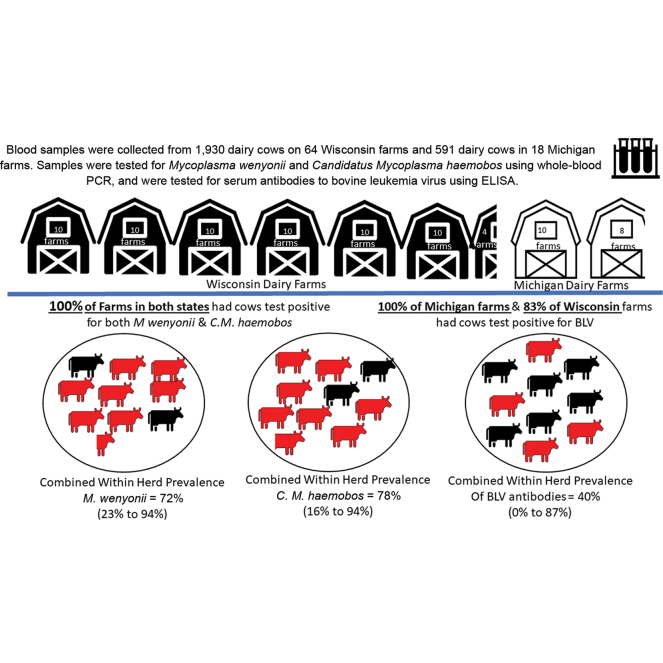
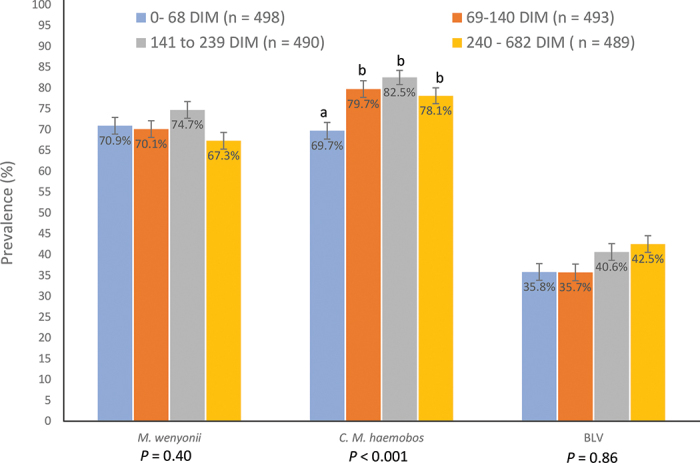
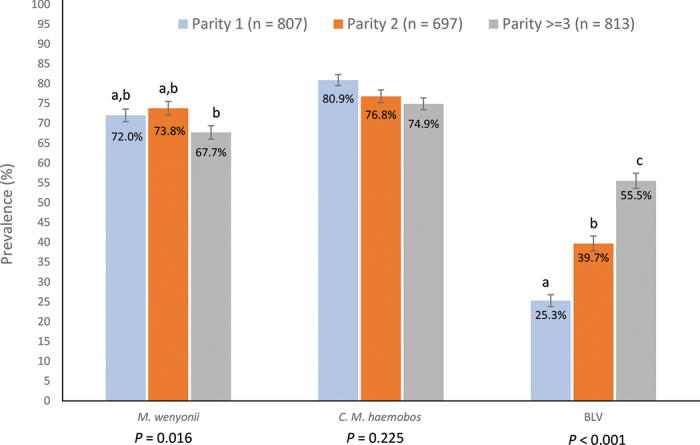
(formerly ) is a hemotrophic, epicellular bacterial parasite of cattle that has been associated with clinical disorders, including hemolytic anemia, decreased milk yield, and peripheral edema. and a related organism, , have been detected in both ill and apparently healthy cattle, but little is known about their prevalence in US dairy cattle. The objective of this prospective, cross-sectional study was to determine herd-level apparent prevalence of and in dairy cattle located in Wisconsin and Michigan compared with seroprevalence of bovine leukemia virus (BLV) in the same herds. In summer 2018, researchers collected blood samples from 30 lactating cows per herd from randomly recruited farms in selected dairy-intensive counties in each state. During the farm visit, a brief survey was used to collect herd management information. Detection of and were based on PCR testing, and ELISA was used to test for antibodies to BLV. Blood samples were collected from lactating cows located in 64 Wisconsin herds (n = 1,930 samples) and 18 Michigan herds (n = 591 samples). Herd-level apparent prevalence was 100% for both and . Herd-level seroprevalence for BLV was 83 and 100% for Wisconsin and Michigan herds, respectively. Estimated within-herd apparent prevalence of was 71.7% ± 1.0% (ranging from 23.3 to 93.5%) and for was 77.3% ± 1.0% (ranging from 16.7 to 100%). Within-herd prevalence of BLV positive samples was 39.8% ± 1.0% and ranged from 0 to 86.7%. About 22% of cows were concurrently positive for all 3 organisms. Parity and stage of lactation were recorded for 2,317 cows. Prevalence of positive cows for parity groups 1, 2, and ≥3 were 72.0, 73.8, and 67.7% for ; 80.9, 76.8, and 74.9% for ; and 25.3, 39.7, and 55.5% for BLV, respectively. None or only minor differences in apparent prevalence were observed based on stage of lactation. This is the first report of the prevalence of hemotrophic mycoplasmas in Wisconsin and Michigan dairy herds and indicates that infection with these organisms is endemic. The impact of infection on cattle health and productivity remains unknown, and risk factors associated with infection warrant further study.
(以前称为 )是一种寄生于牛血液中的上皮细胞外细菌寄生虫,与包括溶血性贫血、产奶量下降和外周水肿在内的临床病症有关。 在患病和看似健康的牛中均检测到 以及一种相关微生物 ,但对于它们在美国奶牛中的流行情况知之甚少。这项前瞻性横断面研究的目的是确定威斯康星州和密歇根州奶牛群中 和 的群体表观患病率,并与同一牛群中牛白血病病毒(BLV)的血清阳性率进行比较。2018年夏季,研究人员从每个州选定的奶牛养殖密集县中随机招募的农场中,每群采集30头泌乳奶牛的血样。在农场走访期间,通过简短调查收集牛群管理信息。 和 的检测基于聚合酶链反应(PCR)测试,酶联免疫吸附测定(ELISA)用于检测BLV抗体。从威斯康星州的64个牛群(n = 1930份样本)和密歇根州的18个牛群(n = 591份样本)中的泌乳奶牛采集血样。 和 的群体表观患病率均为100%。威斯康星州和密歇根州牛群中BLV的群体血清阳性率分别为83%和100%。估计牛群内 的表观患病率为71.7%±1.0%(范围为23.3%至93.5%), 的表观患病率为77.3%±1.0%(范围为16.7%至100%)。牛群内BLV阳性样本的患病率为39.8%±1.0%,范围为0至86.7%。约22%的奶牛同时对这三种微生物呈阳性。记录了2317头奶牛的胎次和泌乳阶段。第1、2和≥3胎次组的阳性奶牛患病率, 分别为72.0%、73.8%和67.7%; 分别为80.9%、76.8%和74.9%;BLV分别为25.3%、39.7%和55.5%。基于泌乳阶段未观察到表观患病率有差异或仅有微小差异。这是威斯康星州和密歇根州奶牛群中血营养支原体患病率的首次报告,表明这些微生物的感染呈地方性流行。感染对牛健康和生产力的影响尚不清楚,与感染相关的风险因素值得进一步研究。