Department of Horse/Companion and Wild Animals, College of Ecology and Environmental Science, Kyungpook National University, Sangju, 37224, Republic of Korea.
Department of Animal Hospital, Hanwoo (Korean Indigenous Cattle) Genetic Improvement Center, National Agricultural Cooperative Federation, Seosan, 31948, Republic of Korea.
BMC Vet Res. 2024 Oct 30;20(1):497. doi: 10.1186/s12917-024-04343-x.
Hemoplasma infections in cattle are caused by Mycoplasma wenyonii and Candidatus Mycoplasma haemobos and induce asymptomatic or chronic infections but occasionally lead to life-threatening hemolytic anemia. Despite the global distribution of bovine hemoplasmas, information regarding their transmission vectors and prevalence is still lacking in the Republic of Korea. Therefore, this study aims to investigate the infection rate of bovine hemoplasma in cattle and houseflies and to assess the risk factors associated with hemoplasma infection in cattle.
Overall, 376 blood samples were collected from Korean indigenous cattle (male, 10-13 months old), along with 2,690 houseflies (Musca domestica) from the same farm where the cattle were raised. PCR assays targeting the 16S rRNA gene were performed to detect hemoplasmas, and positive samples were sequenced.
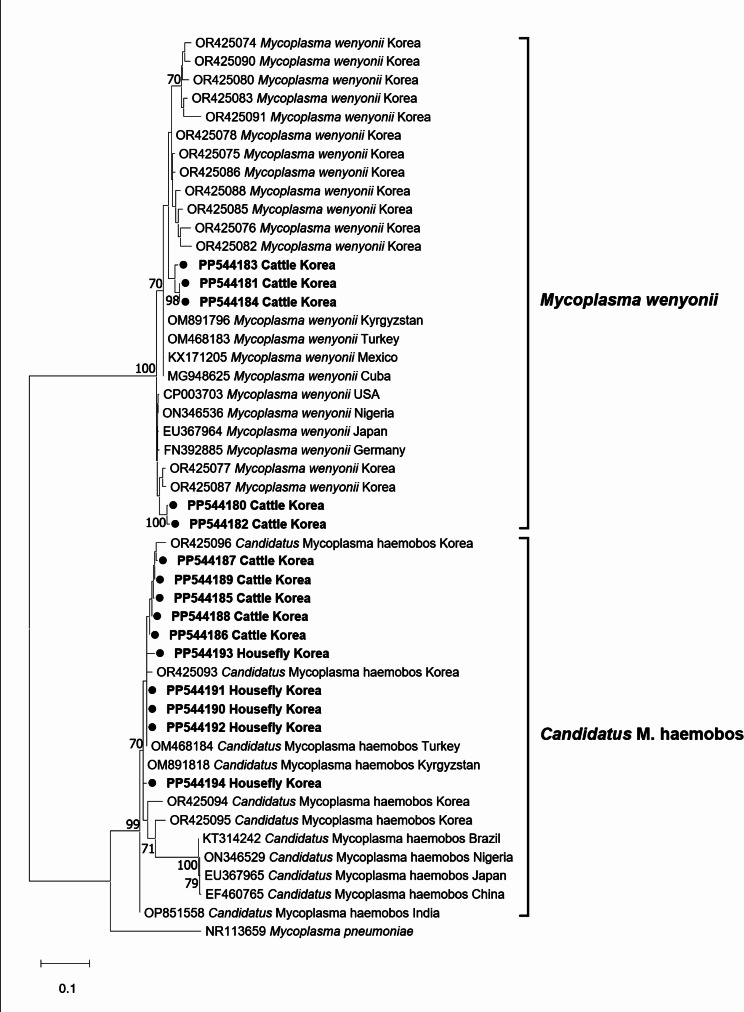
The infection rate of bovine hemoplasmas was 50.8% (191/376) in cattle and 7.4% in pooled houseflies. Among cattle, 18.6% (70/376) and 20.0% (75/376) tested positive for M. wenyonii and Candidatus M. haemobos, respectively. Conversely, in houseflies, Candidatus M. haemobos was more frequently detected (5.9%) than M. wenyonii (0.7%). Co-infection was 12.2% (46/376) in cattle and 0.7% in flies. Furthermore, hemoplasma infection was significantly associated with the grazing experience of their dams. Cattle born to cows with grazing experience exhibited a higher risk for M. wenyonii infection (odds ratio [OR] = 1.62; 95% confidence interval [CI]: 1.03-2.55; P = 0.045), whereas these cattle had a lower risk for Candidatus M. haemobos infection (OR = 0.32, 95% CI: 0.19-0.74; P = 0.000) than animals born to cows without grazing experience. The sequences obtained from houseflies were confirmed as Candidatus M. haemobos, which displayed high similarity (98.2-100%) to those from cattle obtained in this study.
To our knowledge, this study represents the first report of bovine hemoplasmas identified in houseflies. This molecular evidence suggests that houseflies may be possible vectors for Candidatus M. haemobos.
牛的血原体感染是由支原体和候选支原体引起的,导致无症状或慢性感染,但偶尔也会导致危及生命的溶血性贫血。尽管牛血原体在全球范围内分布,但关于其传播媒介和流行情况的信息在韩国仍然缺乏。因此,本研究旨在调查牛血原体在牛和家蝇中的感染率,并评估与牛血原体感染相关的危险因素。
从韩国本土牛(雄性,10-13 个月大)中采集了 376 份血液样本,并从同一农场饲养的 2690 只家蝇(家蝇)中采集了样本。使用针对 16S rRNA 基因的 PCR 检测方法检测血原体,对阳性样本进行测序。
牛的血原体感染率在牛中为 50.8%(191/376),在 pooled 家蝇中为 7.4%。在牛中,18.6%(70/376)和 20.0%(75/376)检测出支原体和候选支原体。相比之下,在家蝇中,候选支原体的检出率(5.9%)高于支原体(0.7%)。牛的 co-infection 率为 12.2%(46/376),而蝇类的 co-infection 率为 0.7%。此外,血原体感染与它们的母体的放牧经历显著相关。有放牧经验的母牛所生的牛感染支原体的风险更高(优势比[OR]=1.62;95%置信区间[CI]:1.03-2.55;P=0.045),而这些牛感染候选支原体的风险较低(OR=0.32,95%CI:0.19-0.74;P=0.000)比没有放牧经验的母牛所生的牛。从家蝇中获得的序列被确认为候选支原体,与本研究中从牛获得的序列高度相似(98.2-100%)。
据我们所知,本研究首次报道了在家蝇中发现的牛血原体。这些分子证据表明,家蝇可能是候选支原体的可能传播媒介。