Zhang Tian, Zhang Ruohua, Song Ting, Chen Fang, Wei Yuegang
Department of Dermatology, Affiliated Hospital of Nanjing University of Chinese Medicine, Jiangsu Province Hospital of Chinese Medicine, Nanjing, China.
Front Nutr. 2024 Nov 22;11:1470833. doi: 10.3389/fnut.2024.1470833. eCollection 2024.
The study aims to explore the associations of eczema, Composite Dietary Antioxidant Index (CDAI), with depression symptoms in adults based on the National Health and Nutrition Examination Surveys (NHANES) database.
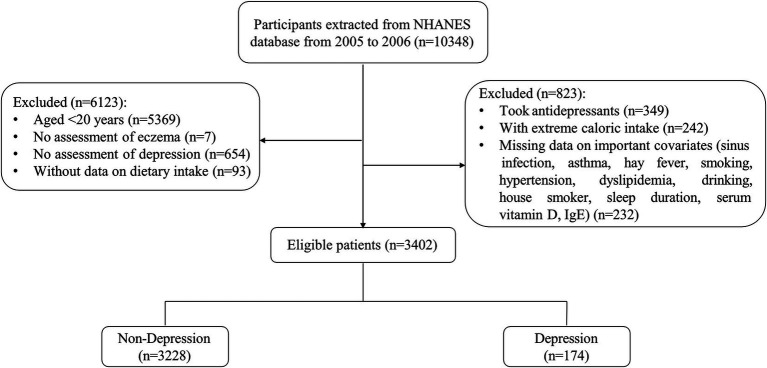
In total, 3,402 participant data were extracted from the NHANES 2005-2006. The relationship between eczema, CDAI, and depression symptoms was explored by utilizing weighted univariate and multivariate logistic regression models, presenting as odds ratios (ORs) and 95% confidence intervals (CIs). The additive interaction between eczema, CDAI, and depression symptoms was measured by relative excess risk due to interaction (RERI) and the attributable proportion of interaction (AP). Subsequently, the associations of eczema, CDAI, with depression were also explored in different gender, body mass index (BMI), and smoking subgroups.
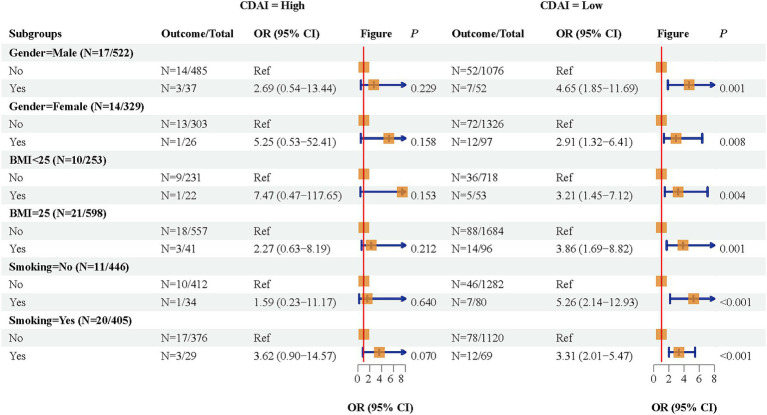
Of the 3,402 participants included, the mean age was 46.76 (0.83) years old, and 174 (5.11%) participants had depression symptoms. In the adjusted model, both eczema (OR = 3.60, 95%CI: 2.39-5.40) and CDAI (OR = 1.97, 95%CI: 1.19-3.27) were associated with a higher prevalence of depression symptoms. Compared to the participants with high CDAI and no eczema, those participants with low CDAI (eczema: OR = 7.30, 95%CI: 4.73-11.26; non-eczema: OR = 1.84, 95%CI: 1.06-3.19) have higher odds of depression symptoms, no matter have eczema or not. When under low CDAI levels, eczema was associated with increased odds of depression symptoms (OR = 3.76, 95%CI: 2.34-6.03). When under low CDAI level, eczema was also related to elevated odds of depression symptoms in those males, females, BMI <25, BMI ≥25, non-smoking, and smoking.
CDAI could modulate the association of eczema with depression symptoms in adults.
本研究旨在基于美国国家健康与营养检查调查(NHANES)数据库,探讨成人湿疹与复合膳食抗氧化指数(CDAI)和抑郁症状之间的关联。
共从NHANES 2005 - 2006中提取了3402名参与者的数据。利用加权单变量和多变量逻辑回归模型探讨湿疹、CDAI与抑郁症状之间的关系,以比值比(OR)和95%置信区间(CI)表示。通过交互作用导致的相对超额风险(RERI)和交互作用归因比例(AP)来衡量湿疹、CDAI与抑郁症状之间的相加交互作用。随后,还在不同性别、体重指数(BMI)和吸烟亚组中探讨了湿疹、CDAI与抑郁之间的关联。
在纳入的3402名参与者中,平均年龄为46.76(0.83)岁,174名(5.11%)参与者有抑郁症状。在调整模型中,湿疹(OR = 3.60,95%CI:2.39 - 5.40)和CDAI(OR = 1.97,95%CI:1.19 - 3.27)均与抑郁症状的较高患病率相关。与CDAI高且无湿疹的参与者相比,CDAI低的参与者(有湿疹:OR = 7.30,95%CI:4.73 - 11.26;无湿疹:OR = 1.84,95%CI:1.06 - 3.19)无论有无湿疹,抑郁症状的发生几率都更高。在CDAI水平低时,湿疹与抑郁症状发生几率增加相关(OR = 3.76,95%CI:2.34 - 6.03)。在CDAI水平低时,湿疹在男性、女性、BMI < 25、BMI≥25、不吸烟和吸烟人群中也与抑郁症状发生几率升高相关。
CDAI可调节成人湿疹与抑郁症状之间的关联。