Shen Li, Zheng Yawen, Wang Mengting, Pan Hong, Jian Wenqian, Yang Xudong, Wang Wei, Chen Li
Department of Psychiatry, The Third People's Hospital of Huzhou Municipal, The Affiliated Hospital of Huzhou University, Huzhou, Zhejiang, China.
Lishui Second Hospital, Wenzhou Medical University, Lishui, Zhejiang, China.
Front Public Health. 2024 Nov 22;12:1436525. doi: 10.3389/fpubh.2024.1436525. eCollection 2024.
The rapid growth of internet use among older adults in rural China offers a unique opportunity to examine its potential impact on their health. This study seeks to explore the relationship between internet use and the emotional, physical, and cognitive health of empty-nest older adults in rural China, while also considering the mediating role of social participation in this relationship.
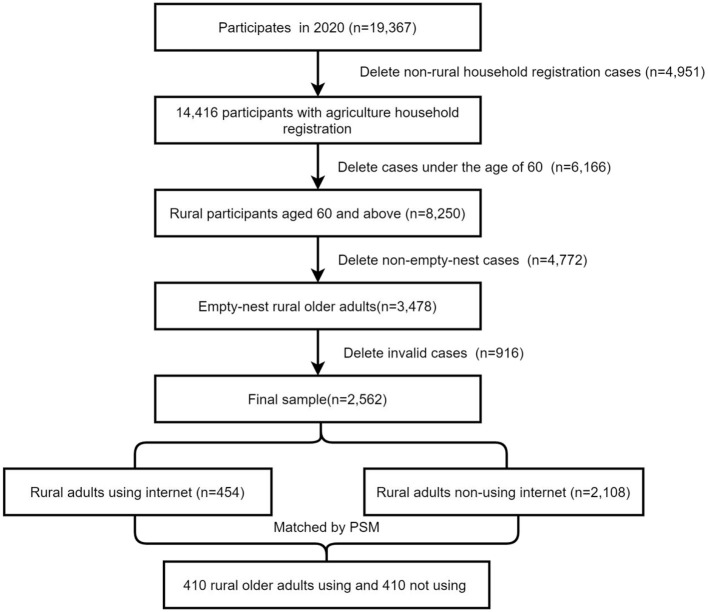
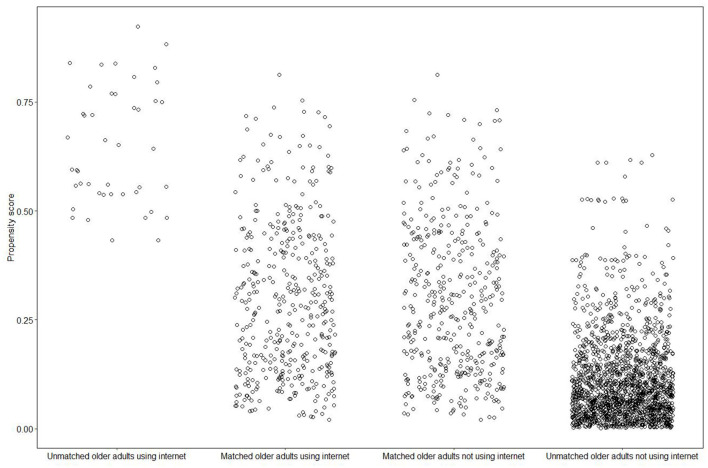
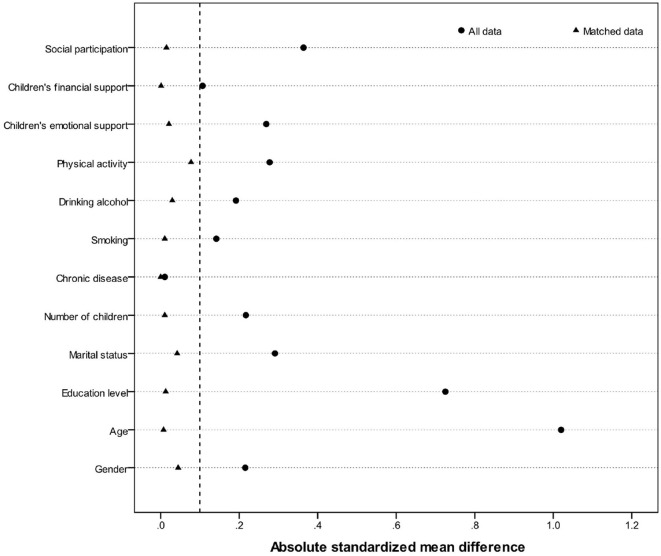
A total of 3,478 empty-nest older adults were selected from the China Health and Retirement Longitudinal Survey (CHARLS) in 2020. Among them, 820 individuals were included in the study using a propensity score matching (PSM) method to reduce the impact of selection bias. The participants' depression, physical health, and cognitive health were measured using the Center for Epidemiological Studies Depression Scale (CES-D), the Activities of Daily Living (ADL) scale, and a composite cognition score, respectively. Social participation was assessed based on engagement in various activities over the past month.
After controlling for confounding factors through PSM, it was found that older adults who used the internet exhibited significantly lower level of depression and higher physical health compared to older adults who did not use the internet. However, there was no significant difference in cognitive health between the two groups. The mediating effect analysis revealed that social participation partially mediated the relationship between internet use and physical health, but not emotional health.
The study suggests that internet use can improve emotional and physical health of older adults living in rural China without children at home, with social participation being a mediator in the relationship between internet use and physical health. Future research should explore the underlying mechanisms and develop targeted interventions to promote internet use and social engagement in this population.
中国农村老年人互联网使用的快速增长为研究其对健康的潜在影响提供了独特契机。本研究旨在探讨互联网使用与中国农村空巢老年人的情绪、身体和认知健康之间的关系,同时考察社会参与在这一关系中的中介作用。
2020年从中国健康与养老追踪调查(CHARLS)中选取了3478名空巢老年人。其中,采用倾向得分匹配(PSM)方法纳入820名个体以减少选择偏倚的影响。分别使用流行病学研究中心抑郁量表(CES-D)、日常生活活动(ADL)量表和综合认知得分来测量参与者的抑郁、身体健康和认知健康。基于过去一个月参与各种活动的情况评估社会参与度。
通过PSM控制混杂因素后,发现使用互联网的老年人与未使用互联网的老年人相比,抑郁水平显著更低,身体健康状况更好。然而,两组在认知健康方面没有显著差异。中介效应分析表明,社会参与部分中介了互联网使用与身体健康之间的关系,但未中介情绪健康。
该研究表明,互联网使用可以改善中国农村无子女在家的老年人的情绪和身体健康,社会参与是互联网使用与身体健康之间关系的中介。未来的研究应探索潜在机制,并制定有针对性的干预措施,以促进该人群对互联网的使用和社会参与。