Dushfunian David, Maroun Anthony, Berhan Haben, Baraboo Justin, Johnson Ethan M, Jarvis Kelly, Allen Bradley D, Markl Michael
Department of Radiology, Feinberg School of Medicine, Northwestern University, Chicago, IL, USA.
Department of Biomedical Engineering, McCormick School of Engineering, Northwestern University, Evanston, IL, USA.
Int J Cardiovasc Imaging. 2025 Jan;41(1):137-149. doi: 10.1007/s10554-024-03299-1. Epub 2024 Dec 9.
To evaluate the reproducibility of important biomarkers like wall shear stress (WSS), pulse wave velocity (PWV), and net flow across two 4D flow MRI imaging protocols with different coverages: aorta-targeted 4D flow MRI (AT4D) and whole-heart 4D flow (WH4D) protocols.
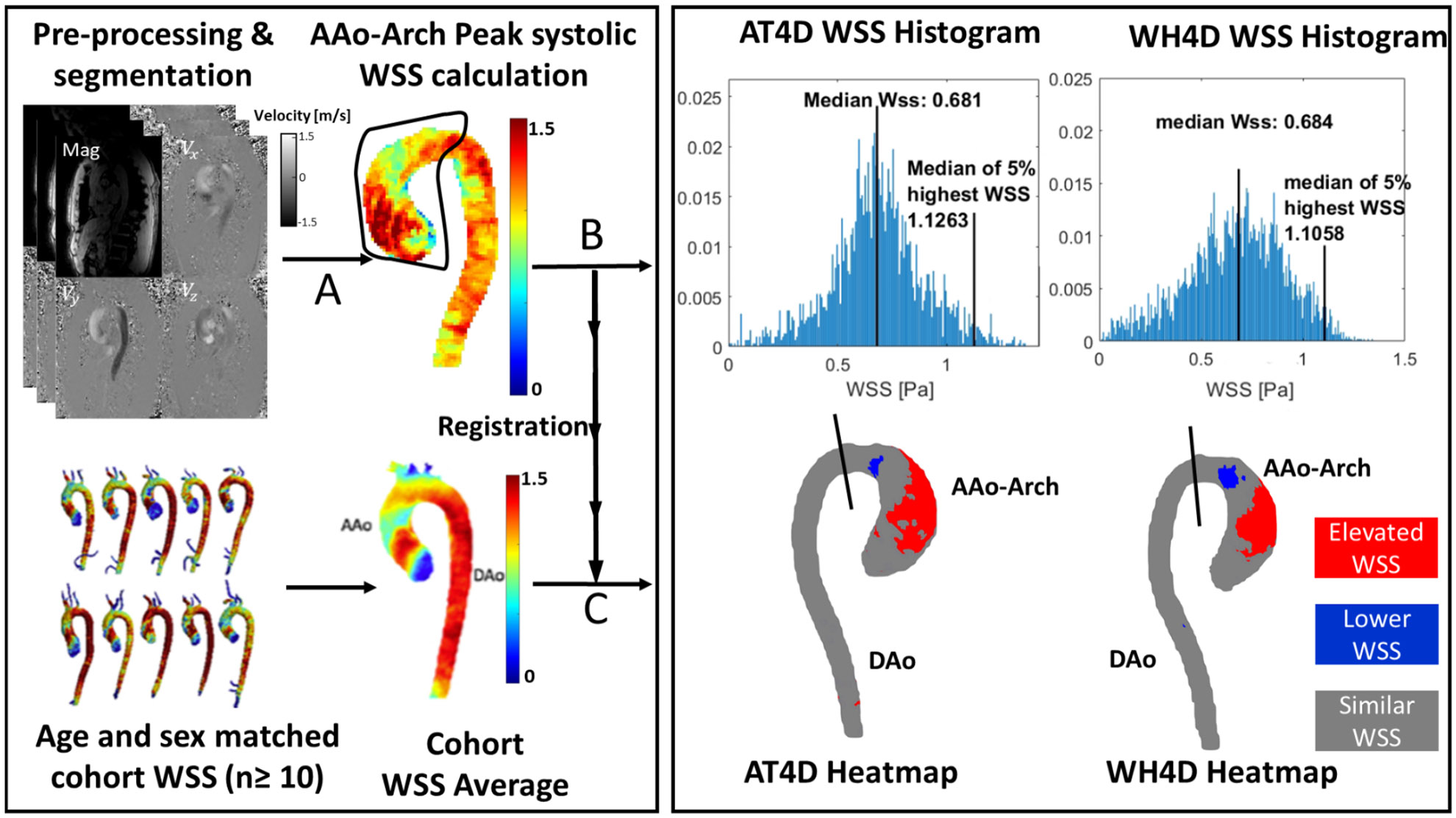
Thirty-eight control subjects (43.2 ± 10.1 years old; 22 males) and ten patients (45.7 ± 8.9 years old; 7 males) with bicuspid aortic valve (BAV) were included. Each subject underwent AT4D and WH4D scans. Absolute WSS, PWV, and net flow were assessed for each patient across both protocols and compared using Bland-Altman analysis. Areas of elevated WSS were assessed for BAV patients across different WSS thresholds that define WSS to be elevated compared to a normal population average. A sensitivity analysis was conducted to determine the best WSS threshold at which WH4D-derived areas most closely resemble AT4D-derived areas. Inter-rater reproducibility was evaluated in twenty-four subjects.
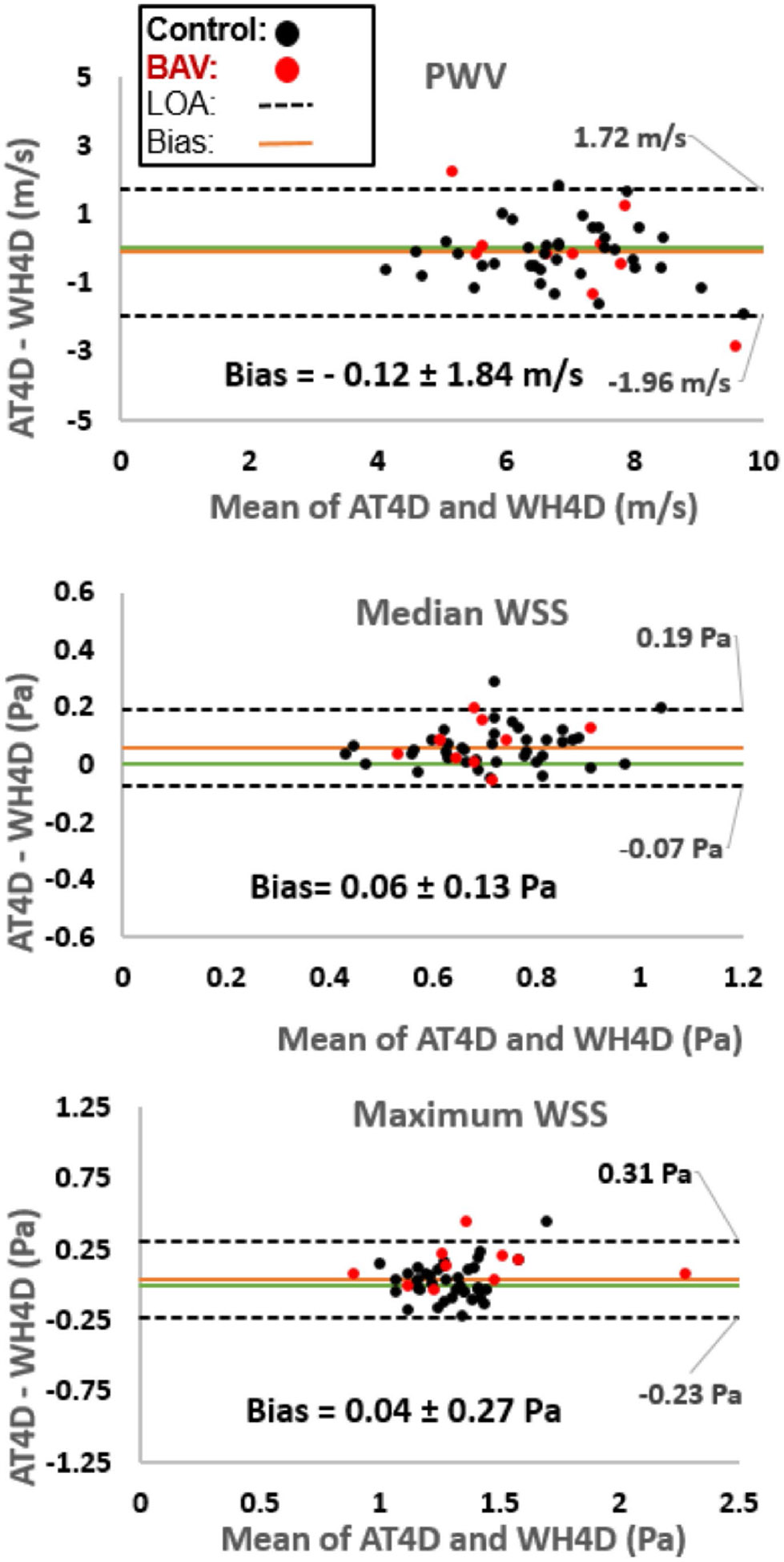
AT4D and WH4D PWV and WSS estimates demonstrated good agreement (PWV: -0.12 ± 1.84 m/s, p = 0.4; Median WSS: 0.06 ± 0.13 Pa, p < 0.01; Maximum WSS: 0.04 ± 0.27 Pa, p = 0.07). Good agreement was also found for AAo net flow (8.14 ± 24.86 mL/cycle, p < 0.01). PWV correlated with age across protocols (AT4D: r = 0.68, p < 0.01; WH4D: r = 0.72, p < 0.01). Sensitivity analysis identified a WSS threshold where WH4D-derived areas of elevated WSS most closely resembled AT4D-derived areas. Inter-rater assessment of the tested parameters resulted in a small mean difference percentage of < 3%.
PWV, WSS, and net flow demonstrated good agreement across protocols. The WSS threshold should be adjusted for WH4D estimates to optimally match AT4D-derived output. Reproducibility analysis showed good test-retest agreement. This study demonstrates the reproducibility of certain hemodynamic parameters across two 4D flow MRI protocol.
通过两种不同覆盖范围的4D流MRI成像协议,即主动脉靶向4D流MRI(AT4D)和全心4D流(WH4D)协议,评估壁面剪应力(WSS)、脉搏波速度(PWV)和净流量等重要生物标志物的可重复性。
纳入38名对照受试者(43.2±10.1岁;22名男性)和10名患有二叶式主动脉瓣(BAV)的患者(45.7±8.9岁;7名男性)。每位受试者均接受了AT4D和WH4D扫描。对每位患者在两种协议下的绝对WSS、PWV和净流量进行评估,并使用布兰德-奥特曼分析进行比较。针对BAV患者,在不同的WSS阈值下评估WSS升高区域,这些阈值定义了与正常人群平均值相比升高的WSS。进行敏感性分析以确定最佳WSS阈值,在该阈值下WH4D得出的区域与AT4D得出的区域最为相似。在24名受试者中评估了评分者间的可重复性。
AT4D和WH4D的PWV和WSS估计值显示出良好的一致性(PWV:-0.12±1.84m/s,p = 0.4;中位WSS:0.06±0.13Pa,p < 0.01;最大WSS:0.04±0.27Pa,p = 0.07)。升主动脉净流量也显示出良好的一致性(8.14±24.86mL/周期,p < 0.01)。跨协议的PWV与年龄相关(AT4D:r = 0.68,p < 0.01;WH4D:r = 0.72,p < 0.01)。敏感性分析确定了一个WSS阈值,在该阈值下WH4D得出的WSS升高区域与AT4D得出的区域最为相似。对测试参数的评分者间评估导致平均差异百分比小于3%。
PWV、WSS和净流量在各协议间显示出良好的一致性。对于WH4D估计值,应调整WSS阈值以使其与AT4D得出的输出最佳匹配。可重复性分析显示了良好的重测一致性。本研究证明了某些血流动力学参数在两种4D流MRI协议间的可重复性。