Department of Cardiology, Leiden University Medical Center, Albinusdreef 2, 2333 ZA, Leiden, The Netherlands.
Department of Radiology, Leiden University Medical Center, Albinusdreef 2, 2333 ZA, Leiden, The Netherlands.
J Cardiovasc Magn Reson. 2021 Apr 19;23(1):46. doi: 10.1186/s12968-021-00739-y.
Aortic stiffness, assessed through pulse wave velocity (PWV), is an independent predictor for cardiovascular disease risk. However, the scarce availability of normal and reference values for cardiovascular magnetic resonance imaging (CMR) based PWV is limiting clinical implementation. The aim of this study was to determine normal and reference values for CMR assessed PWV in the general population.
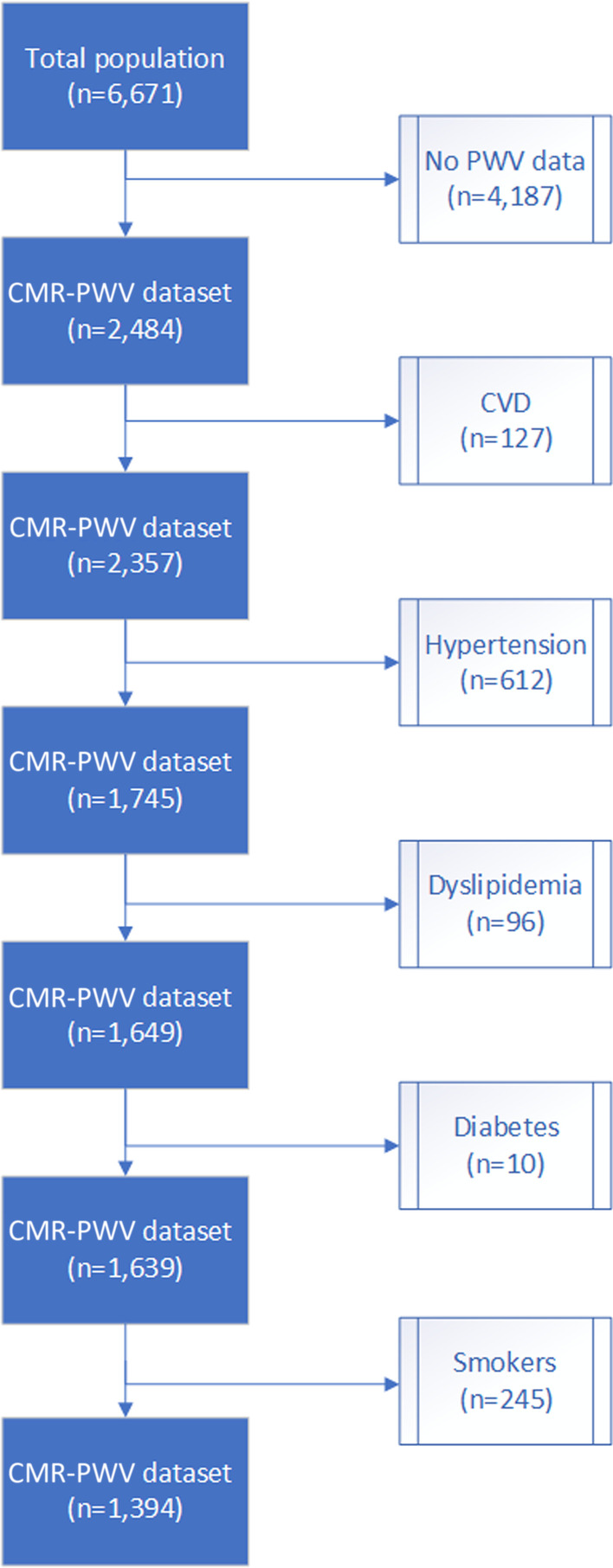
From the 2,484 participants of the Netherlands Epidemiology of Obesity (NEO) study that have available CMR-PWV data, 1,394 participants free from cardiovasculard disease, smokers or treatment for diabetes, hypertension or dyslipidaemia were selected (45-65 years, 51% female). Participants were divided into sex, age and blood pressure (BP) subgroups. Normal values were specified for participants with a BP < 130/80 mmHg and reference values for elevated BP subgroups (≥ 130/80 and < 140/90 mmHg; and ≥ 140/90 mmHg). Differences between groups were tested with independent samples t-test or ANOVA. Due to an oversampling of obese individuals in this study, PWV values are based on a weighted analysis making them representative of the general population.
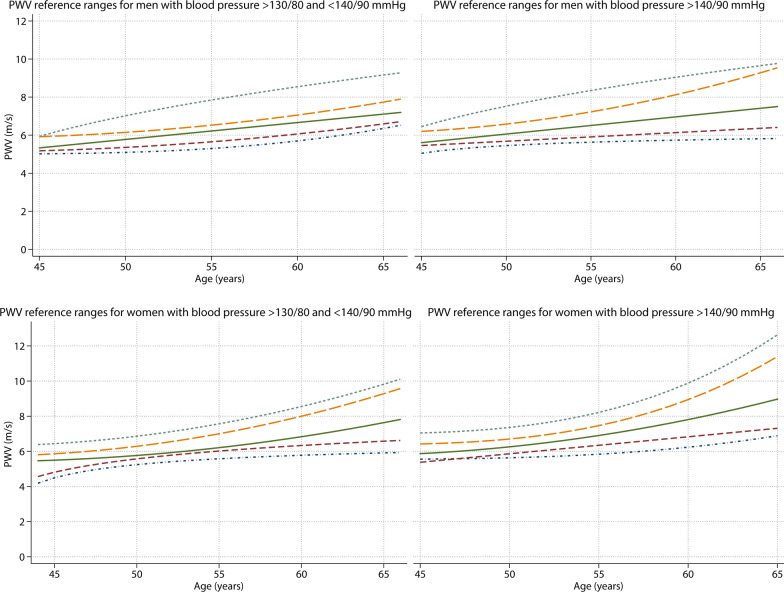
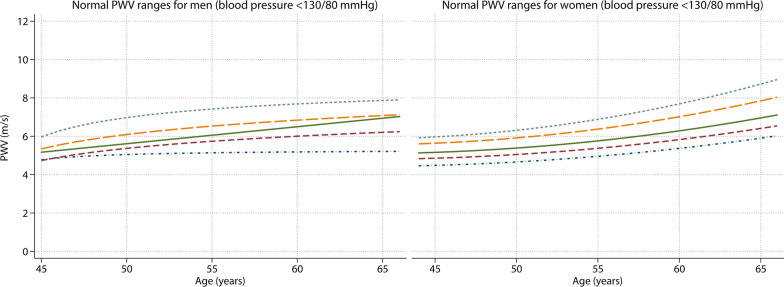
Normal mean PWV was 6.0 m/s [95% CI 5.8-6.1]. PWV increased with advancing age and BP categories (both p < 0.001). There was no difference between sex in normal PWV, however in the BP > 140/90 mmHg women had a higher PWV (p = 0.005). The interpercentile ranges were smaller for participants < 55 years old compared to participants ≥ 55 years, indicating an increasing variability of PWV with age. PWV upper limits were particularly elevated in participants ≥ 55 years old in the high blood pressure subgroups.
This study provides normal and reference values for CMR-assessed PWV per sex, age and blood pressure category in the general population.
通过脉搏波速度(PWV)评估的动脉僵硬度是心血管疾病风险的独立预测因子。然而,基于心血管磁共振成像(CMR)的 PWV 的正常和参考值的稀缺性限制了其临床应用。本研究的目的是确定一般人群中 CMR 评估的 PWV 的正常和参考值。
从荷兰肥胖症流行病学研究(NEO)中获得 CMR-PWV 数据的 2484 名参与者中,选择了 1394 名无心血管疾病、不吸烟或未接受糖尿病、高血压或血脂异常治疗的参与者(45-65 岁,51%为女性)。参与者按性别、年龄和血压(BP)分组。BP<130/80mmHg 的参与者有正常值,BP≥130/80mmHg 且<140/90mmHg 和 BP≥140/90mmHg 的亚组有参考值。采用独立样本 t 检验或方差分析比较组间差异。由于该研究中肥胖个体的抽样过多,PWV 值基于加权分析,使其具有代表性。
正常平均 PWV 为 6.0m/s[95%CI 5.8-6.1]。PWV 随年龄和 BP 类别增加而增加(均 p<0.001)。正常 PWV 性别之间无差异,但在 BP>140/90mmHg 女性中 PWV 较高(p=0.005)。年龄<55 岁的参与者与年龄≥55 岁的参与者相比,PWV 的百分位范围较小,表明 PWV 的变异性随年龄增加而增加。在高血压亚组中,年龄≥55 岁的参与者的 PWV 上限尤其升高。
本研究提供了一般人群中按性别、年龄和血压分类的 CMR 评估的 PWV 的正常和参考值。