Schwarz Gabriele Leonie, Skaar Elisabeth, Miljeteig Ingrid, Hufthammer Karl Ove, Burns Karen E A, Kvåle Reidar, Flaatten Hans, Schaufel Margrethe A
Department of Surgical Services, Haukeland University Hospital, Bergen, Norway.
Department of Clinical Medicine, University of Bergen, Bergen, Norway.
Crit Care Explor. 2024 Dec 9;6(12):e1185. doi: 10.1097/CCE.0000000000001185. eCollection 2024 Dec 1.
To explore older patients' ICU admission preferences and their next-of-kins' ability to predict these preferences.
Self-administered survey.
Three outpatient clinics, urban tertiary teaching hospital, Norway.
Purposive sample of outpatients 80 years old or older regarded as potential ICU candidates and their next-of-kins.
None.
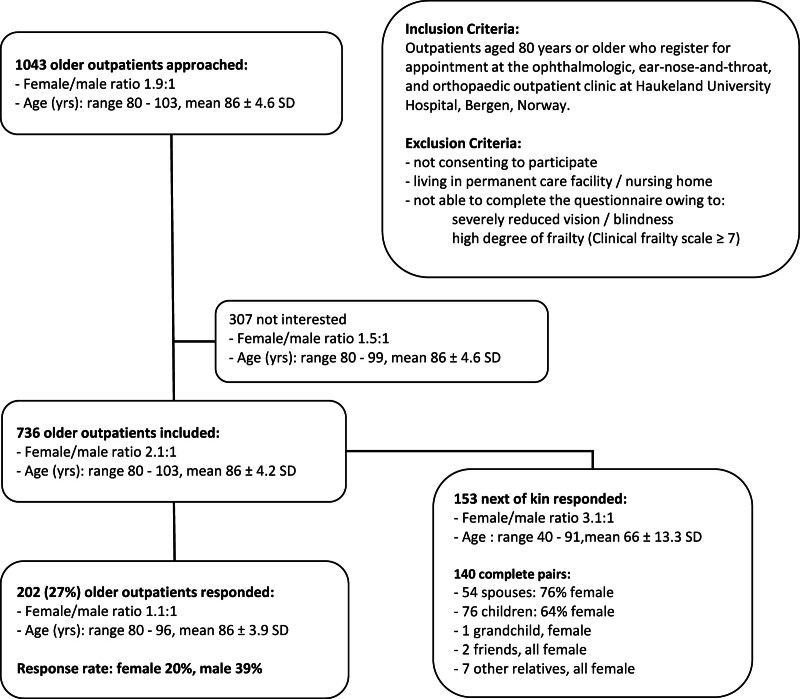
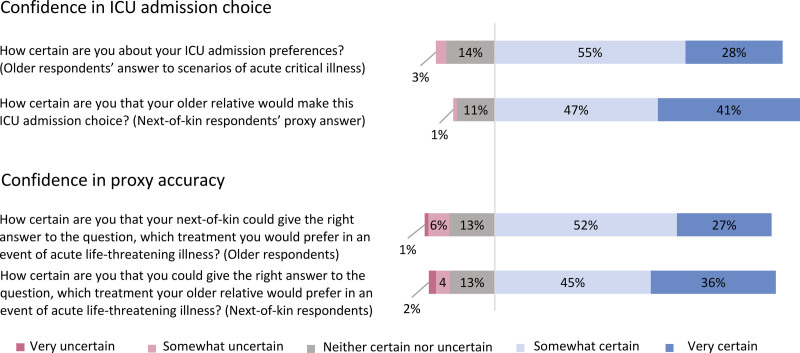
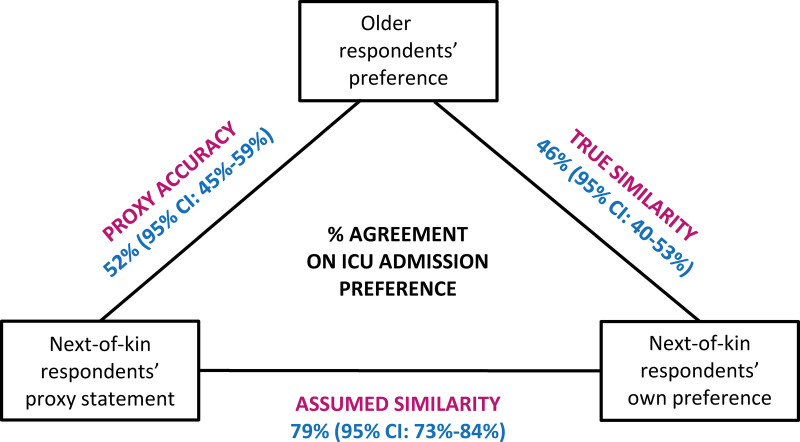
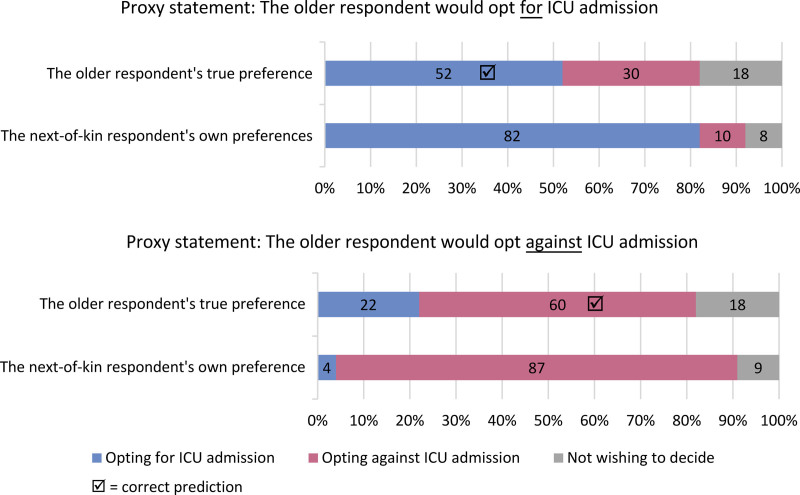
We asked about the patients' ICU admission preferences in three hypothetical scenarios of acute critical illness. Next-of-kin respondents were asked to make a proxy statement regarding the older respondents' wishes regarding ICU admission. For each treatment choice, all respondents could provide their level of confidence. Additionally, we sought to identify demographic and healthcare-related characteristics that potentially influenced ICU admission preferences and proxy accuracy. Of 202 outpatients 80 years old or older, equal proportions opted for (39%; CI, 33-45%) and against (40%; CI, 34-46%) ICU admission, and one in five (21%; CI, 17-26%) did not wish to engage decision-making. Male gender, religiosity, and prior ICU experience increased the likelihood of older respondents opting for ICU admission. Although next-of-kins' proxy statements only weakly agreed with the older respondents' true ICU admission preferences (52%; CI, 45-59%), they agreed with the next-of-kins' own ICU admission preferences (79%; CI, 73-84%) to a significantly higher degree. Decisional confidence was high for both the older and the next-of-kin respondents.
In this purposive sample of Norwegian potential ICU candidates 80 years old or older, we found substantial variation in the ICU admission preferences of very old patients. The next-of-kins' proxy statements did not align with the ICU admission preferences of the older respondents in half of the pairs, but next-of-kins' and older respondents' confidence levels in rendering these judgments were high.
探讨老年患者入住重症监护病房(ICU)的偏好以及其近亲预测这些偏好的能力。
自行管理的调查。
挪威城市三级教学医院的三家门诊诊所。
将80岁及以上被视为潜在ICU候选者的门诊患者及其近亲作为有目的的样本。
无。
我们询问了患者在三种急性危重病假设情景下的ICU入住偏好。近亲受访者被要求就老年受访者关于ICU入住的意愿做出代理陈述。对于每种治疗选择,所有受访者都可以表明其信心水平。此外,我们试图确定可能影响ICU入住偏好和代理准确性的人口统计学和医疗保健相关特征。在202名80岁及以上的门诊患者中,选择入住ICU(39%;可信区间,33 - 45%)和反对入住ICU(40%;可信区间,34 - 46%)的比例相当,五分之一(21%;可信区间,17 - 26%)的患者不想参与决策。男性、宗教信仰和既往ICU经历增加了老年受访者选择入住ICU的可能性。尽管近亲的代理陈述与老年受访者真正的ICU入住偏好仅有微弱的一致性(52%;可信区间,45 - 59%),但它们与近亲自己的ICU入住偏好(79%;可信区间,73 - 84%)的一致性程度要高得多。老年和近亲受访者的决策信心都很高。
在这个挪威80岁及以上潜在ICU候选者的有目的样本中,我们发现高龄患者的ICU入住偏好存在很大差异。在一半的配对中,近亲的代理陈述与老年受访者的ICU入住偏好不一致,但近亲与老年受访者做出这些判断的信心水平很高。