Carr Stuart, Pratt Rebecca, White Fred, Watson Wade
Snö Asthma & Allergy, Abu Dhabi, United Arab Emirates.
Division of Allergy and Immunology, McMaster University, Hamilton, Ontario, Aviva Medical Specialist Clinic, St. Catharines, Ontario, Canada.
Allergy Asthma Clin Immunol. 2024 Dec 9;20(Suppl 3):63. doi: 10.1186/s13223-024-00927-2.
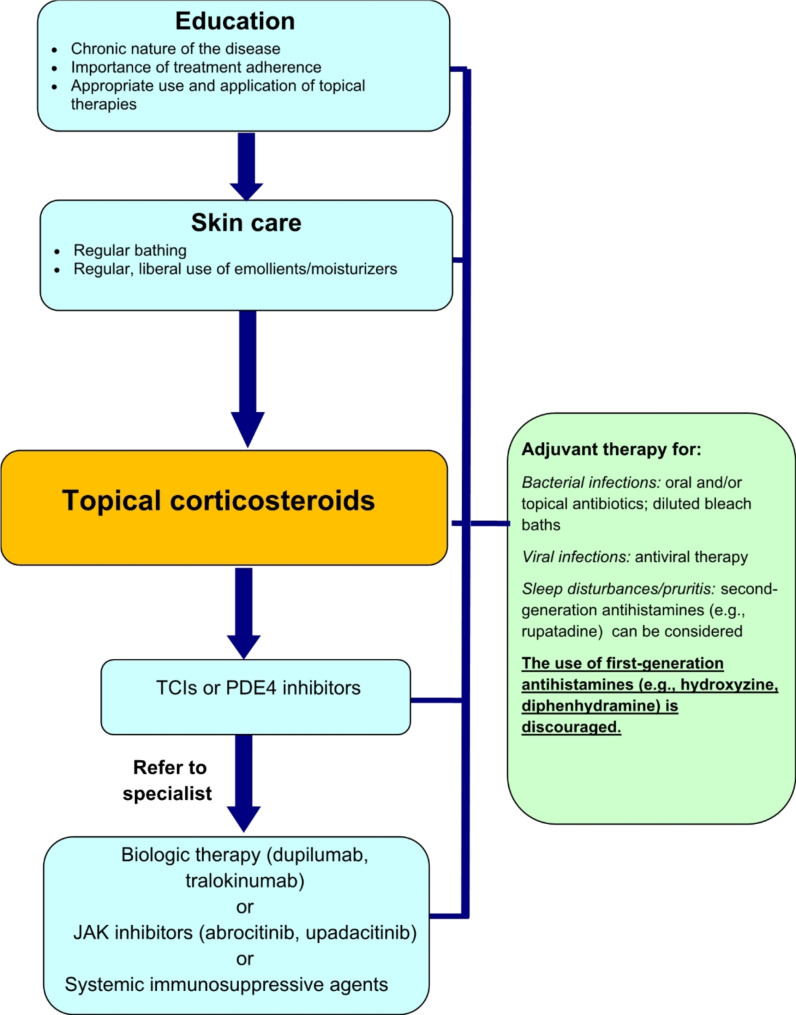
Atopic dermatitis (AD) is a common, chronic skin disorder that can significantly impact the quality of life (QoL) of affected individuals as well as their families. Although the pathogenesis of the disorder is not yet completely understood, it appears to result from the complex interplay between defects in skin barrier function, environmental and infectious agents, and immune dysregulation. There are no diagnostic tests for AD; therefore, the diagnosis is based on specific clinical criteria that take into account the patient's history and clinical manifestations. Successful management of the disorder requires a multifaceted approach that involves education, optimal skin care practices, anti-inflammatory treatment with topical corticosteroids, topical calcineurin inhibitors (TCIs) and/or phosphodiesterase-4 (PDE-4) inhibitors, the management of pruritus, and the treatment of skin infections. Systemic immunosuppressive agents may also be used, but are generally reserved for severe flare-ups or more difficult-to-control disease. Newer systemic agents, such as Janus Kinase (JAK) inhibitors and biologics, have a more favourable safety and efficacy profile than the older, traditional systemic immunosuppressives. Topical corticosteroids are the first-line pharmacologic treatments for AD, and evidence suggests that these agents may also be beneficial for the prophylaxis of disease flare-ups. Although the prognosis for patients with AD is generally favourable, those patients with severe, widespread disease and concomitant atopic conditions, such as asthma and allergic rhinitis, are likely to experience poorer outcomes. Newer systemic agents have been approved which are greatly improving the QoL of these patients.
特应性皮炎(AD)是一种常见的慢性皮肤疾病,会对患者及其家庭的生活质量(QoL)产生重大影响。尽管该疾病的发病机制尚未完全明确,但似乎是由皮肤屏障功能缺陷、环境和感染因素以及免疫失调之间的复杂相互作用导致的。目前尚无针对AD的诊断测试;因此,诊断基于考虑患者病史和临床表现的特定临床标准。成功管理该疾病需要多方面的方法,包括教育、优化皮肤护理措施、使用外用糖皮质激素、外用钙调神经磷酸酶抑制剂(TCIs)和/或磷酸二酯酶-4(PDE-4)抑制剂进行抗炎治疗、瘙痒管理以及皮肤感染治疗。也可能会使用全身性免疫抑制剂,但通常仅用于严重发作或更难控制的疾病。新型全身性药物,如 Janus激酶(JAK)抑制剂和生物制剂,与较旧的传统全身性免疫抑制剂相比,具有更有利的安全性和疗效。外用糖皮质激素是AD的一线药物治疗,证据表明这些药物也可能有助于预防疾病发作。尽管AD患者的预后总体良好,但那些患有严重、广泛疾病并伴有特应性疾病(如哮喘和过敏性鼻炎)的患者可能预后较差。已批准的新型全身性药物正在极大地改善这些患者的生活质量。