Departments of Dermatology and Pediatrics, Northwestern University Feinberg School of Medicine, Chicago, Illinois.
Department of Paediatric Dermatology, St John's Institute of Dermatology, Guy's and St Thomas' NHS Foundation Trust, King's College London, London, England, United Kingdom.
JAMA Dermatol. 2023 Jun 1;159(6):596-605. doi: 10.1001/jamadermatol.2023.0627.
Safe and effective long-term treatments for adolescents with moderate to severe atopic dermatitis (AD) are limited.
To evaluate the efficacy and safety of interleukin-13-targeted treatment with tralokinumab monotherapy in adolescents with AD.
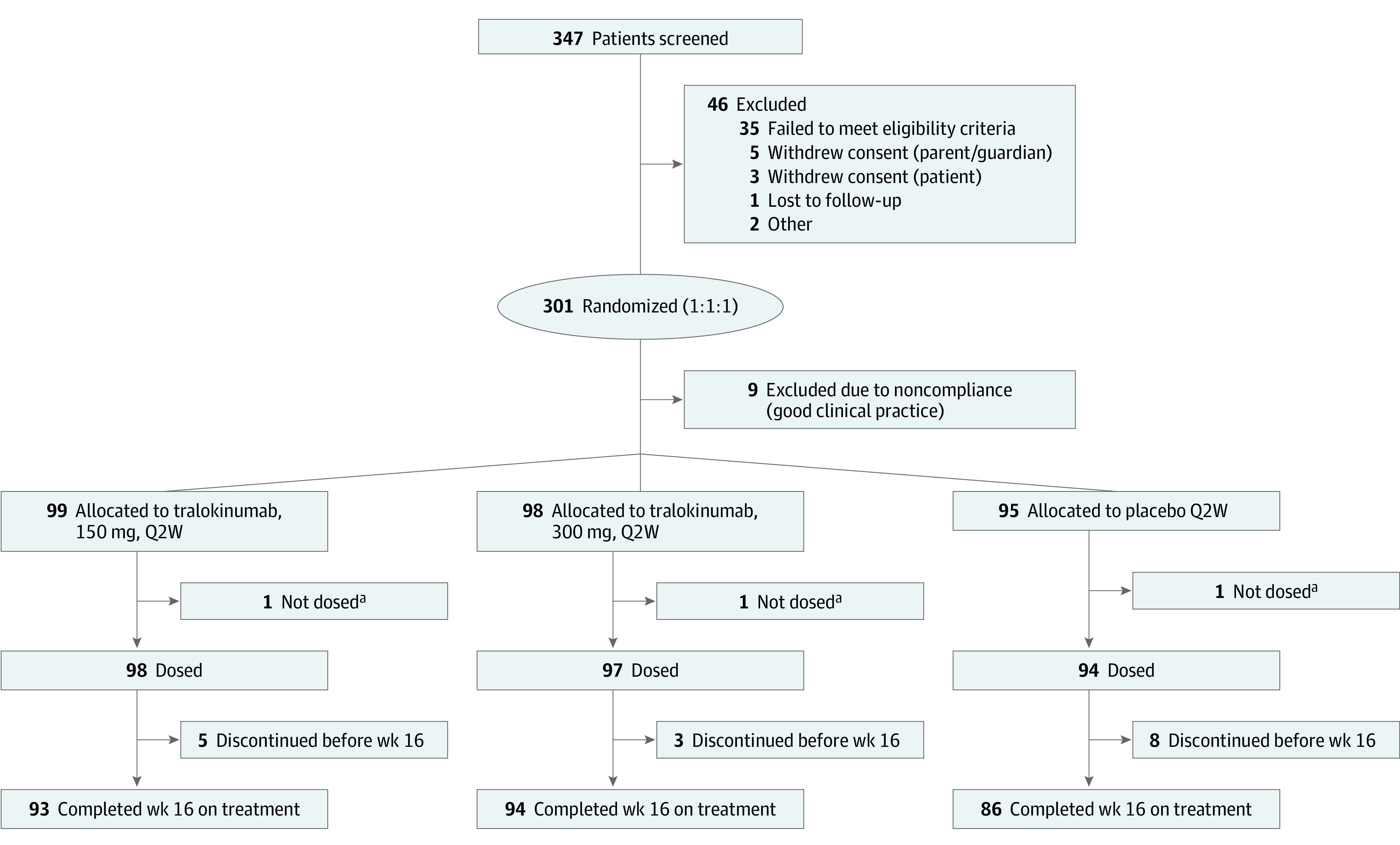
DESIGN, SETTING, AND PARTICIPANTS: The 52-week, randomized, double-blinded, placebo-controlled, phase 3 ECZTRA 6 trial was conducted from July 17, 2018, through March 16, 2021, at 72 centers across 10 countries in North America, Europe, Asia, and Australia. Enrolled patients were 12 to 17 years old with moderate to severe AD (Investigator's Global Assessment [IGA] score ≥3; Eczema Area and Severity Index [EASI] ≥16).
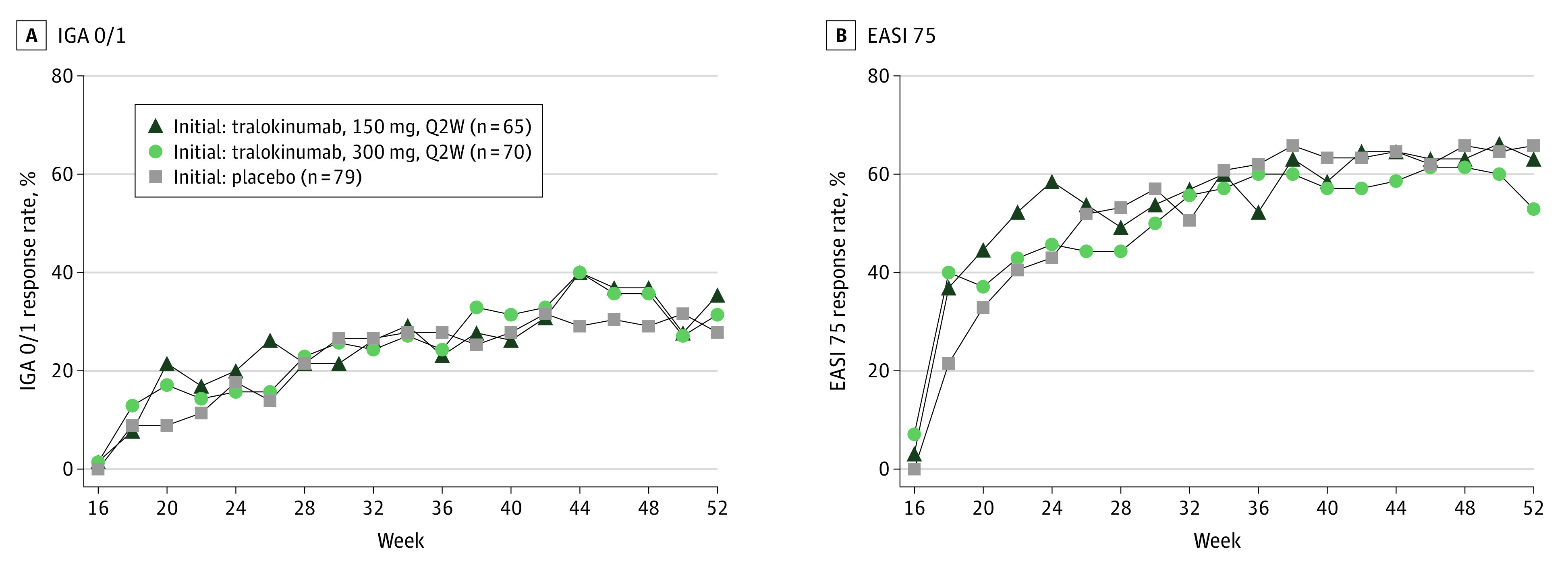
Patients were randomized (1:1:1) to tralokinumab (150 or 300 mg) or placebo every 2 weeks for 16 weeks. Patients with an IGA score of 0 (clear) or 1 (almost clear) and/or 75% or higher improvement in EASI (EASI 75) at week 16 without rescue medication received maintenance treatment; other patients switched to open-label tralokinumab, 300 mg, every 2 weeks.
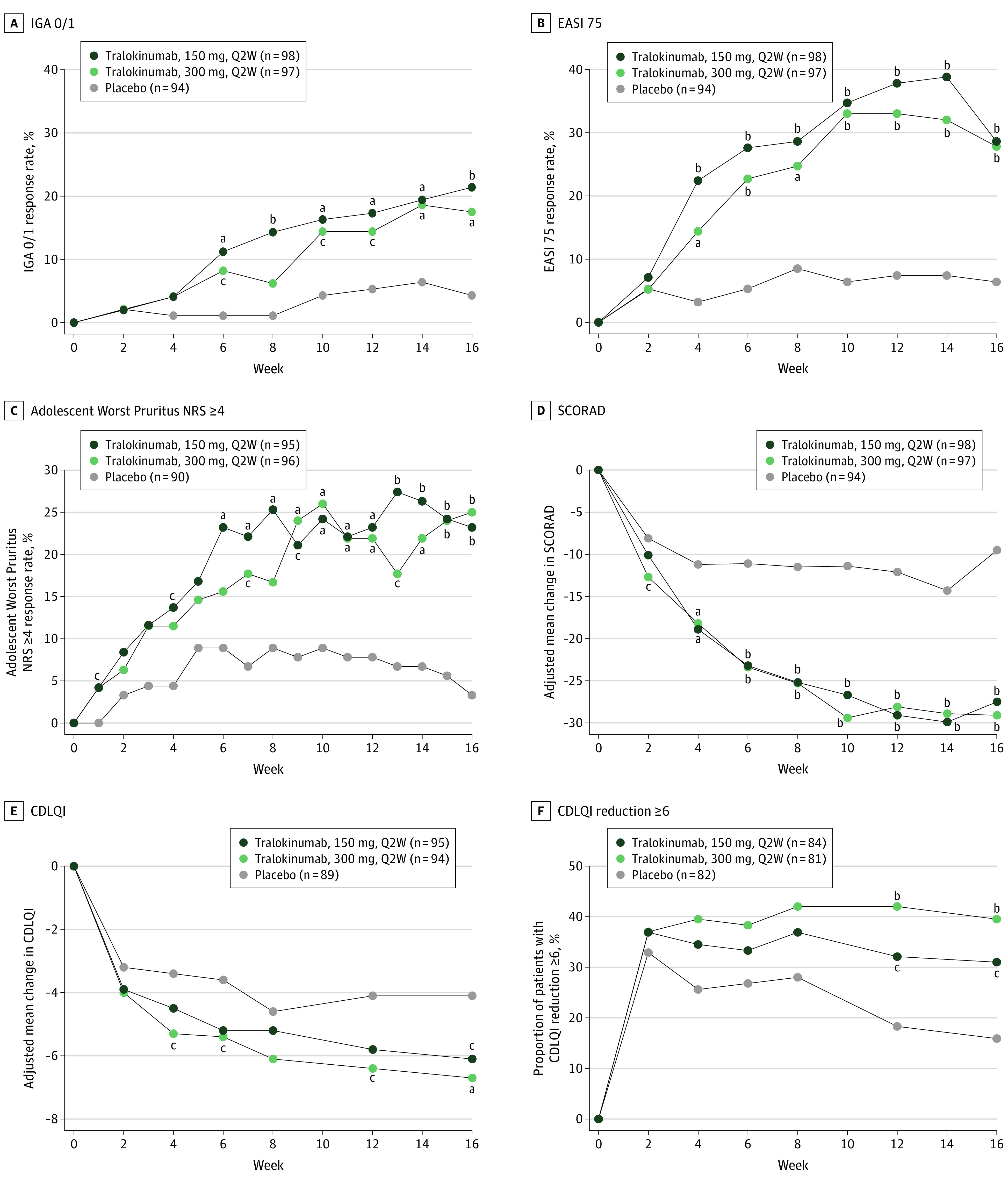
Primary end points at week 16 were an IGA score of 0 or 1 and/or achieving EASI 75. Key secondary end points were a reduction of Adolescent Worst Pruritus Numeric Rating Scale of 4 or more, change in SCORing AD, and change in Children's Dermatology Life Quality Index from baseline to week 16. Safety end points were the number of adverse events and serious adverse events.
Of 301 patients randomized, 289 comprised the full analysis set (median [IQR] age, 15.0 [13.0-16.0] years; 149 [51.6%] male). More patients receiving tralokinumab, 150 mg, (n = 98), and tralokinumab, 300 mg (n = 97), achieved an IGA score of 0 or 1 without rescue medication at week 16 (21 [21.4%] and 17 [17.5%], respectively) vs placebo (n = 94; 4 [4.3%]) (adjusted difference, 17.5% [95% CI, 8.4%-26.6%]; P < .001 and 13.8% [95% CI, 5.3%-22.3%]; P = .002, respectively). More patients receiving tralokinumab, 150 mg (28 [28.6%]), and tralokinumab, 300 mg, (27 [27.8%]) vs placebo (6 [6.4%]) achieved EASI 75 without rescue at week 16 (adjusted difference, 22.5% [95% CI, 12.4%-32.6%]; P < .001 and 22.0% [95% CI, 12.0%-32.0%]; P < .001, respectively). Proportions of patients with Adolescent Worst Pruritus Numeric Rating Scale reduction of 4 or more from baseline were greater with tralokinumab, 150 mg (23.2%), and tralokinumab, 300 (25.0%), vs placebo (3.3%), and adjusted mean changes were greater in SCORing AD with tralokinumab, 150 mg (-27.5), and tralokinumab, 300 mg (-29.1), vs placebo (-9.5) and in Children's Dermatology Life Quality Index with tralokinumab, 150 mg (-6.1), and tralokinumab, 300 mg (-6.7), vs placebo (-4.1) at week 16. At week 52, tralokinumab efficacy was maintained without rescue in more than 50% of patients meeting primary end point(s) at week 16. In the open-label phase, IGA score of 0 or 1 and EASI 75 were achieved in 33.3% and 57.8%, respectively, at week 52. Tralokinumab was well tolerated, without frequency of conjunctivitis increasing through week 52.
In this randomized clinical trial, tralokinumab was efficacious and well tolerated, supporting its value for treating adolescents with moderate to severe AD.
ClinicalTrials.gov Identifier: NCT03526861.
对于患有中重度特应性皮炎(AD)的青少年,安全有效的长期治疗方法有限。
评估白细胞介素-13 靶向治疗药物特利鲁单抗单药治疗 AD 青少年的疗效和安全性。
设计、地点和参与者:这项为期 52 周、随机、双盲、安慰剂对照、III 期 ECZTRA 6 试验于 2018 年 7 月 17 日至 2021 年 3 月 16 日在北美、欧洲、亚洲和澳大利亚的 72 个中心进行。纳入的患者年龄在 12 至 17 岁,患有中重度 AD(研究者全球评估[IGA]评分≥3;湿疹面积和严重程度指数[EASI]≥16)。
患者按 1:1:1 的比例随机分为特利鲁单抗(150 或 300 mg)或安慰剂,每 2 周给药 1 次,共 16 周。在第 16 周时 IGA 评分达到 0(清除)或 1(几乎清除)和/或 EASI 改善≥75%(EASI 75)且未使用抢救药物的患者接受维持治疗;其他患者转换为开放标签特利鲁单抗,300 mg,每 2 周 1 次。
第 16 周的主要终点是 IGA 评分达到 0 或 1,和/或达到 EASI 75。关键次要终点是青少年最严重瘙痒数字评定量表(Adolescent Worst Pruritus Numeric Rating Scale)降低 4 分或更多,SCORing AD 变化,以及从基线到第 16 周儿童皮肤病生活质量指数(Children's Dermatology Life Quality Index)的变化。安全性终点是不良事件和严重不良事件的发生次数。
在 301 名随机患者中,289 名患者纳入全分析集(中位数[IQR]年龄,15.0[13.0-16.0]岁;149[51.6%]为男性)。更多接受特利鲁单抗 150 mg(n=98)和特利鲁单抗 300 mg(n=97)治疗的患者在第 16 周时未使用抢救药物即达到 IGA 评分 0 或 1(分别为 21[21.4%]和 17[17.5%]),而安慰剂组(n=94;4[4.3%])(调整差异,17.5%[95%CI,8.4%-26.6%];P<0.001和 13.8%[95%CI,5.3%-22.3%];P=0.002)。更多接受特利鲁单抗 150 mg(n=28)和特利鲁单抗 300 mg(n=27)治疗的患者在第 16 周时达到 EASI 75,且未使用抢救药物,而安慰剂组(n=6)为 6.4%(调整差异,22.5%[95%CI,12.4%-32.6%];P<0.001和 22.0%[95%CI,12.0%-32.0%];P<0.001)。从基线到第 16 周,青少年最严重瘙痒数字评定量表(Adolescent Worst Pruritus Numeric Rating Scale)降低 4 分或更多的患者比例,接受特利鲁单抗 150 mg(23.2%)和特利鲁单抗 300 mg(25.0%)治疗的患者比例明显更高,而安慰剂组为 3.3%(调整差异,22.2%[95%CI,12.4%-32.6%];P<0.001和 22.0%[95%CI,12.0%-32.0%];P<0.001)。特利鲁单抗 150 mg(-27.5)和特利鲁单抗 300 mg(-29.1)与安慰剂(-9.5)相比,SCORing AD 评分的调整平均变化更大,特利鲁单抗 150 mg(-6.1)和特利鲁单抗 300 mg(-6.7)与安慰剂(-4.1)相比,儿童皮肤病生活质量指数(Children's Dermatology Life Quality Index)的调整平均变化更大,在第 16 周。在第 52 周时,在第 16 周时满足主要终点的患者中,超过 50%的患者在没有抢救药物的情况下维持了特利鲁单抗的疗效。在开放标签阶段,第 52 周时 IGA 评分达到 0 或 1 和 EASI 75 的患者比例分别为 33.3%和 57.8%。特利鲁单抗耐受性良好,在整个 52 周的研究期间,结膜炎的频率没有增加。
在这项随机临床试验中,特利鲁单抗治疗青少年中重度 AD 有效且耐受性良好,支持其用于治疗患有中重度 AD 的青少年患者。
ClinicalTrials.gov 标识符:NCT03526861。