Yükcü Bekir, Arslan Hilmi Furkan
Giresun Gynecology and Pediatrics Training and Research Hospital, Pediatric Cardiology, Giresun, Turkey.
Giresun Gynecology and Pediatrics Training and Research Hospital, Clinic Biochemistry, Giresun, Turkey.
Medicine (Baltimore). 2024 Dec 6;103(49):e40904. doi: 10.1097/MD.0000000000040904.
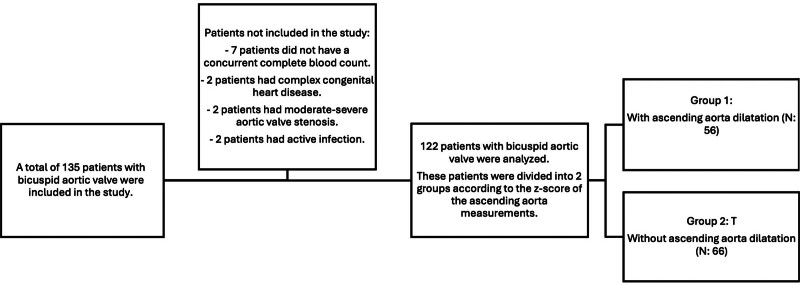
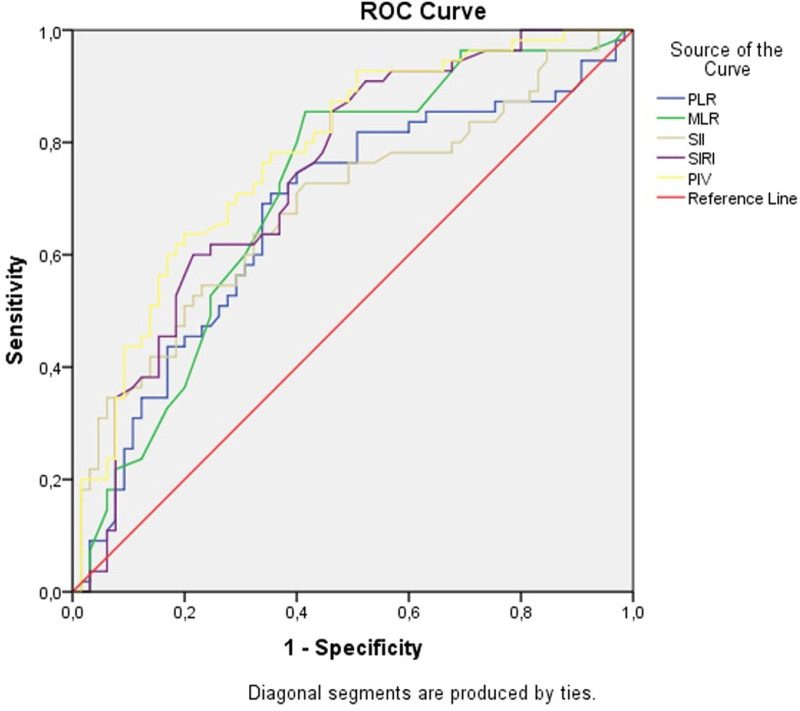
Systemic inflammatory indices, originally developed to predict the prognosis of cancer patients, have found increasing application in various medical areas, including cardiovascular research. This study aimed to investigate the relationship between ascending aortic dilatation in bicuspid aortic valve patients and systemic inflammatory indices. This retrospective cross-sectional study included 122 patients with bicuspid aortic valves. These patients were divided into 2 groups based on the presence or absence of dilatation according to ascending aorta z-scores. Complete blood counts were analyzed, focusing on leukocyte, neutrophil, lymphocyte, monocyte, and platelet counts. Additionally, systemic inflammatory indices including neutrophil-to-lymphocyte ratio, platelet-to-lymphocyte ratio (PLR), Systemic Immune-Inflammation Index (SII), Systemic Inflammatory Response Index (SIRI), and monocyte-to-lymphocyte ratio (MLR) and pan-immune-inflammation value (PIV) were calculated from these parameters. MLR, SIRI, and PIV demonstrated acceptable diagnostic power in detecting ascending aortic dilatation in bicuspid aortic valve patients, with area under the curve (AUC) values of 0.709, 0.741, and 0.779, respectively. PLR and SII exhibited fair diagnostic power, with AUC values of 0.673 and 0.688, respectively. According to the receiver operating characteristic analysis, PIV had the highest AUC value of 0.779 (95% confidence interval [CI] = 0.69-0.86), with a sensitivity of 70.9% and specificity of 70.8% at a cutoff value of 224.93. A relationship exists between PLR, MLR, SII, SIRI, PIV, and ascending aorta dilatation in pediatric patients with bicuspid aortic valves. These findings suggest that inflammation may play a role in the dilatation of the ascending aorta in bicuspid aortic valve patients.
全身炎症指标最初用于预测癌症患者的预后,如今在包括心血管研究在内的各种医学领域中应用越来越广泛。本研究旨在探讨二叶式主动脉瓣患者升主动脉扩张与全身炎症指标之间的关系。这项回顾性横断面研究纳入了122例二叶式主动脉瓣患者。根据升主动脉z评分是否存在扩张,将这些患者分为两组。分析全血细胞计数,重点关注白细胞、中性粒细胞、淋巴细胞、单核细胞和血小板计数。此外,根据这些参数计算全身炎症指标,包括中性粒细胞与淋巴细胞比值、血小板与淋巴细胞比值(PLR)、全身免疫炎症指数(SII)、全身炎症反应指数(SIRI)、单核细胞与淋巴细胞比值(MLR)和全免疫炎症值(PIV)。MLR、SIRI和PIV在检测二叶式主动脉瓣患者升主动脉扩张方面显示出可接受的诊断能力,曲线下面积(AUC)值分别为0.709、0.741和0.779。PLR和SII表现出中等的诊断能力,AUC值分别为0.673和0.688。根据受试者工作特征分析,PIV的AUC值最高,为0.779(95%置信区间[CI]=0.69 - 0.86),在临界值为224.93时,灵敏度为70.9%,特异性为70.8%。在患有二叶式主动脉瓣的儿科患者中,PLR、MLR、SII、SIRI、PIV与升主动脉扩张之间存在关联。这些发现表明,炎症可能在二叶式主动脉瓣患者升主动脉扩张中起作用。