Benschop Kimberley S M, Staines Harry, Mckloud Emily, McCulloch Elaine, Montgomery Dorothy, Sutton Greg, Donoso Mantke Oliver, van Loon Anton
Center for Infectious Disease Control, National Institute for Public Health and the Environment, Bilthoven, The Netherlands.
Sigma Statistical Services, Balmullo, UK.
J Med Virol. 2024 Dec;96(12):e70103. doi: 10.1002/jmv.70103.
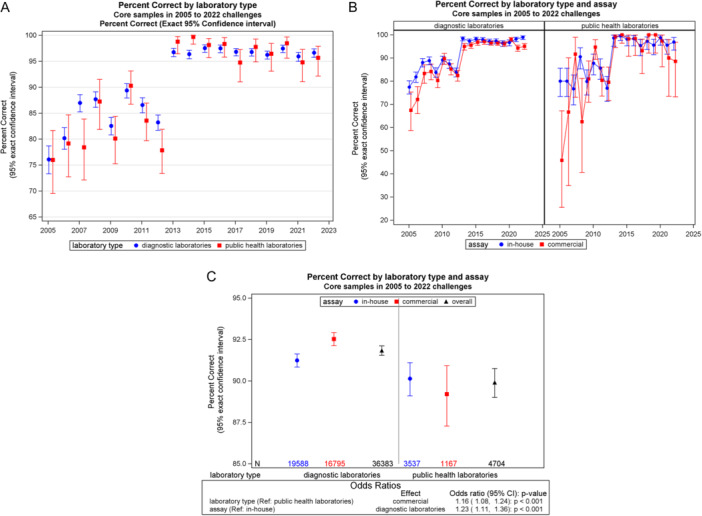
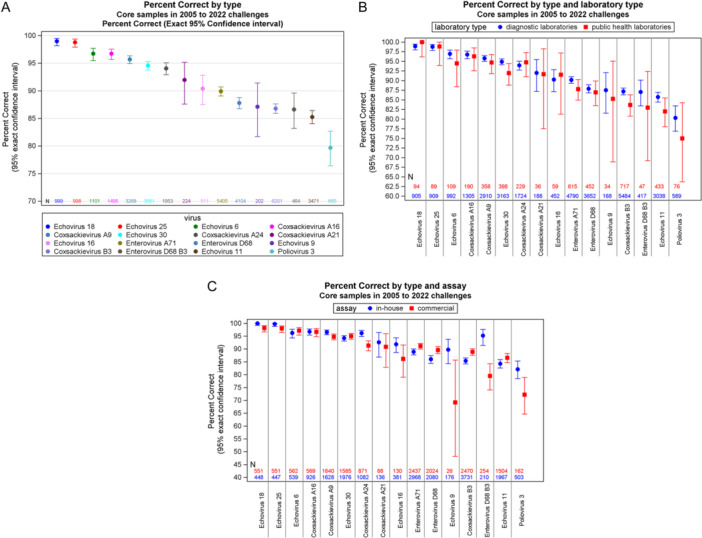
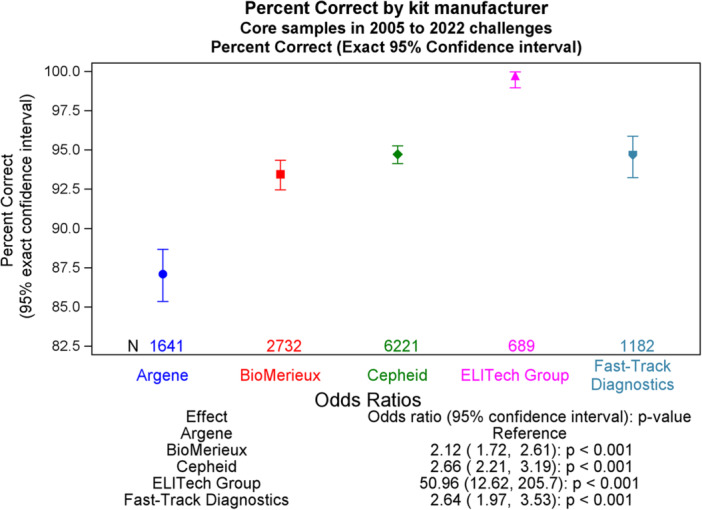
The gold standard for enterovirus (EV) detection is the polymerase chain reaction based on the detection of the 5' untranslated region of the virus. Correct detection of EV is crucial for patient and public health purposes. The performance of diagnostic and public health laboratories on molecular EV-detection was analyzed using data from the external quality assessment program distributed by Quality Control for Molecular Diagnostics (QCMD) between 2005 and 2022. Overall performance on core samples of both laboratory types has improved over the years for in-house or commercial assays (overall performance rate > 94.8%) since 2013. A similar improvement was observed for negative/specificity samples. Performance on EV-positive samples varied, with the lowest performance observed on samples containing enterovirus D68 (B3 strain) and echovirus 11. Significant differences in performance were observed between laboratory and assay types. Performance of diagnostic laboratories (91.8) was significantly higher than of public health laboratories (89.9%; p < 0.0001). Additionally, a significant higher performance of diagnostic laboratories using commercial assays was observed (92.5% vs. 91.2% for in-house assays; p < 0.0001). In contrast, the performance of public health laboratories using in-house assays (90.1%) was higher than commercial assays (89.2%; p = 0.3608). The data document the improved performance of diagnostic and public health laboratories using either commercial or in-house assays.
肠道病毒(EV)检测的金标准是基于检测病毒5'非翻译区的聚合酶链反应。准确检测EV对于患者和公共卫生目的至关重要。利用2005年至2022年期间由分子诊断质量控制(QCMD)分发的外部质量评估计划的数据,分析了诊断实验室和公共卫生实验室在分子EV检测方面的表现。自2013年以来,两种实验室类型在核心样本上的整体表现,无论是内部检测还是商业检测,多年来都有所提高(整体表现率>94.8%)。在阴性/特异性样本中也观察到了类似的改善。EV阳性样本的表现各不相同,在含有肠道病毒D68(B3株)和埃可病毒11的样本中表现最差。在实验室和检测类型之间观察到了显著的表现差异。诊断实验室的表现(91.8)显著高于公共卫生实验室(89.9%;p<0.0001)。此外,观察到使用商业检测的诊断实验室表现显著更高(商业检测为92.5%,内部检测为91.2%;p<0.0001)。相比之下,使用内部检测的公共卫生实验室的表现(90.1%)高于商业检测(89.2%;p=0.3608)。这些数据证明了使用商业或内部检测的诊断实验室和公共卫生实验室的表现有所改善。