Jarrot Pierre-André, Kim Jiyoun, Chan William, Heger Lukas, Schommer Nicolas, Cunin Pierre, Silva Camila M S, Robert Stéphane, Nigrovic Peter A, Ewenstein Bruce, Wagner Denisa D
Program in Cellular and Molecular Medicine, Boston Children's Hospital, Boston, MA, United States.
Department of Pediatrics, Harvard Medical School, Boston, MA, United States.
Front Immunol. 2024 Nov 25;15:1466234. doi: 10.3389/fimmu.2024.1466234. eCollection 2024.
Diffuse alveolar hemorrhage (DAH) is a life-threatening complication of systemic lupus erythematosus and small vessel vasculitis. We previously showed that neutrophil extracellular traps (NETs) were associated with the pathogenesis of pristane-induced DAH and demonstrated that neutrophil NOD-like receptor family pyrin domain containing 3 (NLRP3) inflammasome assembly participated in NET generation under sterile stimulation. We investigated whether NLRP3 inflammasome assembly in neutrophils may drive pulmonary NETosis in a mouse model of pristane-induced DAH.
C57BL/6J mice received a single intraperitoneal injection of 0.5mL of pristane. Neutrophil NLRP3 inflammasome assembly and NETs were characterized by immunofluorescence staining of apoptosis-associated speck-like protein a CARD (ASC), co-staining of DNA, and citrullinated histones, respectively. Clinical status of mice was assessed 11 days after pristane injection by measurement of arterial oxygen saturation and of weight loss; severity of lung injury was determined using a quantification score from hematoxylin-eosin-stained slides.
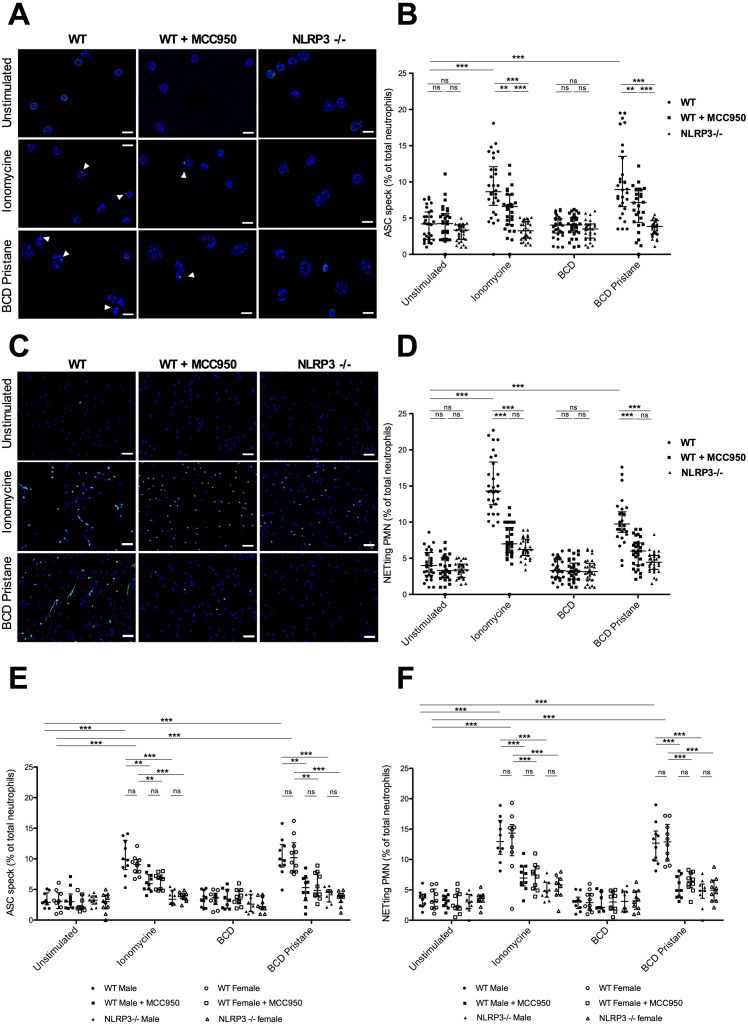
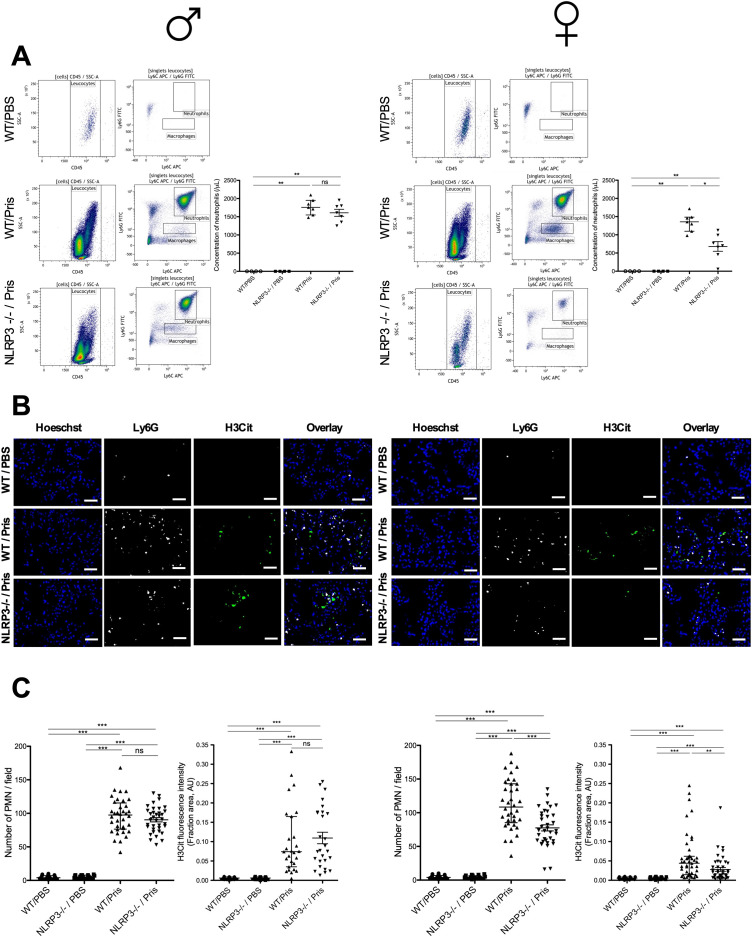
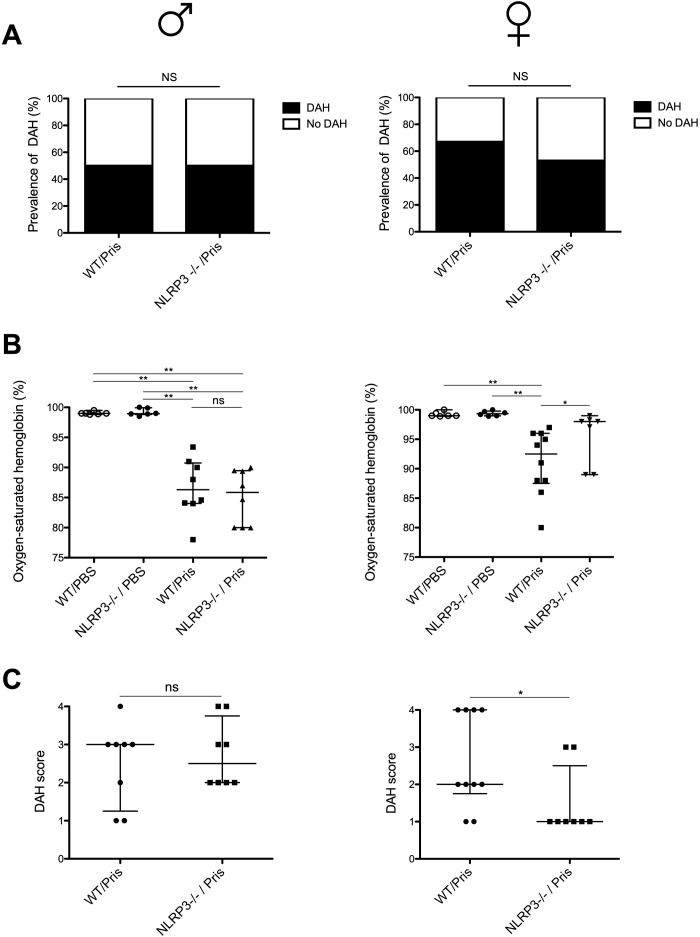
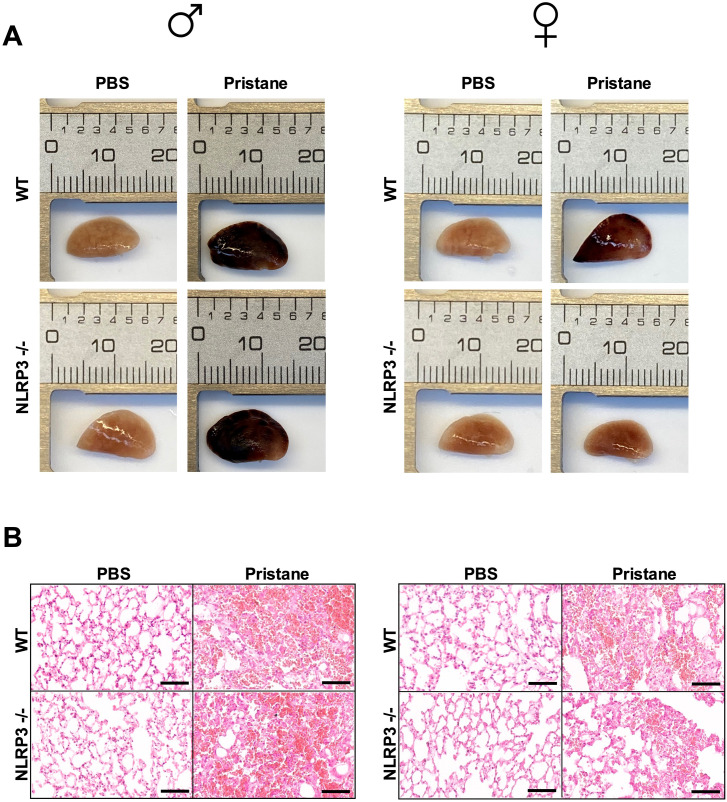
Pristane induced ASC speck formation in neutrophils and we confirmed that NLRP3 inflammasome was involved in NET generation after pristane stimulation . NLRP3 deficiency reduced the severity of pristane-induced DAH in female, but not male mice. Interestingly, NLRP3 deficiency reduced the number of neutrophils and NETs in the lungs of females compared to males.
Our results suggest a link between female sex-specific NLRP3 inflammasome activation and subsequent pulmonary NETosis in the development of pristane-induced DAH. Therefore, we identified NLRP3 inflammasome as a potential new therapeutic target in this severe complication of pro-female autoimmune disease for which specific inhibitors of NLRP3 are currently developed.
弥漫性肺泡出血(DAH)是系统性红斑狼疮和小血管血管炎的一种危及生命的并发症。我们之前表明中性粒细胞胞外陷阱(NETs)与 pristane 诱导的 DAH 的发病机制有关,并证明中性粒细胞含 NOD 样受体家族 pyrin 结构域 3(NLRP3)炎性小体组装在无菌刺激下参与 NET 的生成。我们研究了中性粒细胞中的 NLRP3 炎性小体组装是否可能在 pristane 诱导的 DAH 小鼠模型中驱动肺 NETosis。
C57BL/6J 小鼠腹腔内单次注射 0.5mL 的 pristane。中性粒细胞 NLRP3 炎性小体组装和 NETs 分别通过凋亡相关斑点样蛋白含 CARD(ASC)的免疫荧光染色、DNA 共染色和瓜氨酸化组蛋白来表征。在 pristane 注射 11 天后,通过测量动脉血氧饱和度和体重减轻来评估小鼠的临床状态;使用苏木精 - 伊红染色切片的定量评分来确定肺损伤的严重程度。
Pristane 诱导中性粒细胞中 ASC 斑点形成,并且我们证实 NLRP3 炎性小体在 pristane 刺激后参与 NET 的生成。NLRP3 缺陷降低了雌性而非雄性小鼠中 pristane 诱导的 DAH 的严重程度。有趣的是,与雄性相比,NLRP3 缺陷减少了雌性小鼠肺中的中性粒细胞和 NETs 的数量。
我们的结果表明在 pristane 诱导的 DAH 发展过程中,女性特异性 NLRP3 炎性小体激活与随后的肺 NETosis 之间存在联系。因此,我们确定 NLRP3 炎性小体是这种女性自身免疫性疾病严重并发症的潜在新治疗靶点,目前正在开发 NLRP3 的特异性抑制剂。