Division of Rheumatology, Department of Medicine, Cedars-Sinai Medical Center, Los Angeles, CA, United States.
Applied Genomics, Computation, and Translational Core, Cedars-Sinai Cancer, Cedars-Sinai Medical Center, Los Angeles, CA, United States.
Front Immunol. 2022 Feb 3;13:790043. doi: 10.3389/fimmu.2022.790043. eCollection 2022.
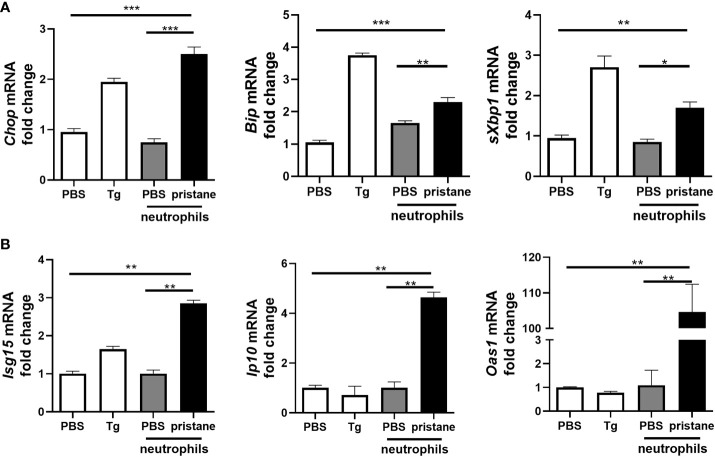
Diffuse alveolar hemorrhage (DAH), although rare, is a life-threatening complication of systemic lupus erythematosus (SLE). Little is known about the pathophysiology of DAH in humans, although increasingly neutrophils, NETosis and inflammatory monocytes have been shown to play an important role in the pristane-induced model of SLE which develops lung hemorrhage and recapitulates many of the pathologic features of human DAH. Using this experimental model, we asked whether endoplasmic reticulum (ER) stress played a role in driving the pathology of pulmonary hemorrhage and what role infiltrating neutrophils had in this process. Analysis of lung tissue from pristane-treated mice showed genes associated with ER stress and NETosis were increased in a time-dependent manner and reflected the timing of CD11bLy6G neutrophil accumulation in the lung. Using precision cut lung slices from untreated mice we observed that neutrophils isolated from the peritoneal cavity of pristane-treated mice could directly induce the expression of genes associated with ER stress, namely and . Mice which had myeloid-specific deletion of PAD4 were generated and treated with pristane to assess the involvement of PAD4 and PAD4-dependent NET formation in pristane-induced lung inflammation. Specific deletion of PAD4 in myeloid cells resulted in decreased expression of ER stress genes in the pristane model, with accompanying reduction in IFN-driven genes and pathology. Lastly, coculture experiments of human neutrophils and human lung epithelial cell line (BEAS-2b) showed neutrophils from SLE patients induced significantly more ER stress and interferon-stimulated genes in epithelial cells compared to healthy control neutrophils. These results support a pathogenic role of neutrophils and NETs in lung injury during pristane-induced DAH through the induction of ER stress response and suggest that overactivation of neutrophils in SLE and NETosis may underlie development of DAH.
弥漫性肺泡出血 (DAH) 虽然罕见,但却是系统性红斑狼疮 (SLE) 的一种危及生命的并发症。尽管人们越来越了解中性粒细胞、NETosis 和炎症性单核细胞在诱导性 SLE 模型中发挥重要作用,该模型会发展为肺出血并再现许多人类 DAH 的病理特征,但对人类 DAH 的病理生理学知之甚少。使用这种实验模型,我们询问内质网 (ER) 应激是否在驱动肺出血病理中起作用,以及浸润性中性粒细胞在这个过程中起什么作用。分析经苍术烷处理的小鼠的肺组织显示,与 ER 应激和 NETosis 相关的基因呈时间依赖性增加,反映了 CD11bLy6G 中性粒细胞在肺部积聚的时间。使用来自未处理小鼠的精密切割肺切片,我们观察到从苍术烷处理的小鼠腹腔中分离的中性粒细胞可以直接诱导与 ER 应激相关的基因的表达,即 和 。生成并经苍术烷处理具有髓样细胞特异性 PAD4 缺失的小鼠,以评估 PAD4 和 PAD4 依赖性 NET 形成在苍术烷诱导的肺炎症中的参与情况。髓样细胞中 PAD4 的特异性缺失导致苍术烷模型中 ER 应激基因的表达减少,同时伴随 IFN 驱动基因和病理学的减少。最后,人中性粒细胞和人肺上皮细胞系 (BEAS-2b) 的共培养实验表明,与健康对照中性粒细胞相比,SLE 患者的中性粒细胞在人肺上皮细胞中诱导明显更多的 ER 应激和干扰素刺激基因。这些结果支持中性粒细胞和 NET 在苍术烷诱导的 DAH 中通过诱导 ER 应激反应在肺损伤中的致病作用,并表明 SLE 中中性粒细胞的过度激活和 NETosis 可能是 DAH 发展的基础。