Mansour Abdullah M, Ismail Ezzat A, Abdalla Mohamed O, El Nashar Ahmed M, Ismail Iman Y, Abdelhalim Khaled M
Department of Urology, Faculty of Medicine, Suez Canal University, Ismailia, 41522, Egypt.
Department of Clinical Pathology, Faculty of Medicine, Suez Canal University, Ismailia, Egypt.
BMC Urol. 2024 Dec 10;24(1):265. doi: 10.1186/s12894-024-01591-9.
Healing complications are a significant concern after hypospadias repair, often attributed to deficient growth factors and reduced healing potential of hypospadiac tissue. Platelet-Rich Fibrin (PRF), a new generation of platelet concentrates rich in growth factors, has been successfully applied to provide a mechanical barrier and promote healing in different surgical fields. The objective of this study was to assess the role of a PRF membrane covering the neourethra, in addition to a Dartos flap, optimizing the outcomes of primary distal hypospadias repair.
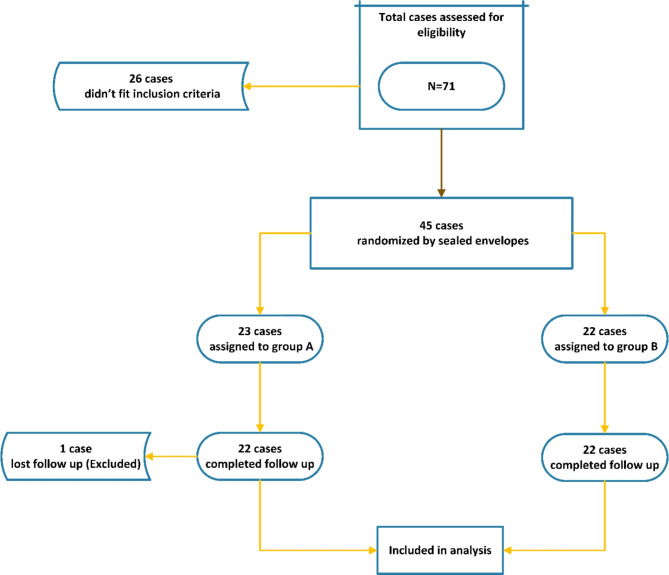
Forty-four patients undergoing primary distal hypospadias repair were randomized and then assigned to two groups according to the covering layer(s) applied over the neourethra in Tubularized Incised Plate (TIP) repair. Each group included 22 cases with an average age of 38 ± 28 months for group A and 30 ± 21 months for group B. In group A, the classical technique of a single Dartos flap was used. In group B, an autologous PRF membrane -prepared during surgery using the patient's own serum- was placed to the neourethra and subsequently covered with Dartos flap.
with a mean follow up of 17.9 ± 7.2 months (range 6-30 months), group B had the lowest rate of complicated cases (9.1% compared to 31% for group A), Nevertheless, this finding was not statistically significant. The implementation of PRF in group B scaled down the rate of urethrocutaneous fistula (UCF) formation to 4.5% compared to 18.2% in group A. Furthermore, group B had no incidence of wound infection compared to 22.7% in group A (p < 0.05).
Combined neourethral coverage with a PRF membrane and a Dartos flap leads to a trend toward a significant decrease in rate of UCF and leads to a significant reduction in wound infection after TIP repair compared to a single Dartos flap after TIP repair compared to a single Dartos flap. The technique is technically simple, inexpensive and is also not time-consuming.
尿道下裂修复术后的愈合并发症是一个重大问题,通常归因于生长因子不足和尿道下裂组织愈合潜力降低。富血小板纤维蛋白(PRF)是新一代富含生长因子的血小板浓缩物,已成功应用于在不同手术领域提供机械屏障并促进愈合。本研究的目的是评估除肉膜瓣外,PRF膜覆盖新尿道在优化原发性远端尿道下裂修复结果中的作用。
44例接受原发性远端尿道下裂修复的患者被随机分组,然后根据管状切开板(TIP)修复中应用于新尿道的覆盖层分为两组。每组包括22例,A组平均年龄为38±28个月,B组为30±21个月。A组采用经典的单肉膜瓣技术。B组在新尿道上放置术中使用患者自身血清制备的自体PRF膜,随后用肉膜瓣覆盖。
平均随访17.9±7.2个月(范围6 - 30个月),B组并发症发生率最低(9.1%,而A组为31%),然而,这一发现无统计学意义。B组PRF的应用将尿道皮肤瘘(UCF)形成率降至4.5%,而A组为18.2%。此外,B组无伤口感染发生,而A组为22.7%(p < 0.05)。
与单纯肉膜瓣相比,PRF膜与肉膜瓣联合覆盖新尿道可使TIP修复术后UCF发生率有显著降低的趋势,并使伤口感染显著减少。该技术操作简单、成本低廉且不耗时。