Al-Azzawi Huda Moutaz Asmael, Paolini Rita, Celentano Antonio
Melbourne Dental School The University of Melbourne Carlton Victoria Australia.
Health Sci Rep. 2024 Dec 9;7(12):e70249. doi: 10.1002/hsr2.70249. eCollection 2024 Dec.
An effective surgical adhesive must possess strength, biodegradability, flexibility, non-toxicity, and the ability to accommodate to tissue movement. However, existing adhesives in the market lack some of these crucial properties. Both synthetic cyanoacrylate and natural fibrin glue have been explored for sutureless oral surgery, but they come with specific limitations. This perspective review aims to explore the novel potential of hydrogels as bioadhesives for wound closure in the oral cavity.
This review thoroughly examines the properties, applications, and limitations of hydrogels as bioadhesive materials for wound closure within the human body.
We first provide a comprehensive description of materials used for sutureless oral surgery. Next, drawing on our expertise in the field of oral surgery, we propose novel potential applications for hydrogels in oral wound closure. We showed that Hydrogels represent promising bioadhesives in medical field and are undergoing continuous enhancement to expand their applications in wound closure.
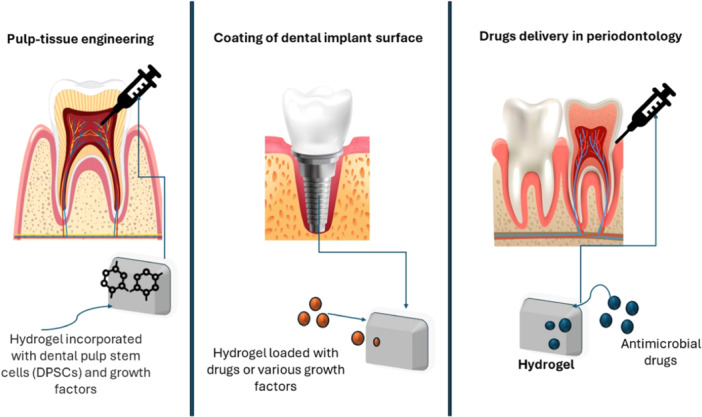
Although hydrogels have been utilized in various dental conditions, their potential for closing wounds in the oral cavity remains unexplored.
一种有效的手术粘合剂必须具备强度、生物可降解性、柔韧性、无毒性以及适应组织运动的能力。然而,市场上现有的粘合剂缺乏其中一些关键特性。合成氰基丙烯酸酯和天然纤维蛋白胶都已被用于免缝合口腔手术,但它们都有特定的局限性。这篇观点性综述旨在探讨水凝胶作为口腔伤口闭合生物粘合剂的新潜力。
本综述全面研究了水凝胶作为人体伤口闭合生物粘合材料的特性、应用和局限性。
我们首先全面描述了用于免缝合口腔手术的材料。接下来,凭借我们在口腔外科领域的专业知识,我们提出了水凝胶在口腔伤口闭合中的新潜在应用。我们表明,水凝胶是医学领域有前景的生物粘合剂,并且正在不断改进以扩大其在伤口闭合中的应用。
尽管水凝胶已被用于各种牙科病症,但它们在口腔伤口闭合方面的潜力仍未得到探索。