
影响内在能力下降的老年人自我管理能力的因素:一项横断面研究。
Factors influencing the self-management ability among older adults experiencing intrinsic capacity decline: a cross-sectional study.
作者信息
Liu Qingcai, Li Xiaoyang, Hu Mingyue, Zhao Yinan, Wu Shuang, Feng Hui
机构信息
College of Humanities and Management, Hunan University of Chinese Medicine, Changsha, Hunan, China.
Xiangya School of Nursing, Central South University, Changsha, Hunan, China.
出版信息
Front Aging Neurosci. 2024 Nov 22;16:1456167. doi: 10.3389/fnagi.2024.1456167. eCollection 2024.
AIMS
This study investigated the current status of intrinsic capacity and self-management abilities and analyzed the factors influencing the self-management abilities of older adults experiencing intrinsic capacity decline.
METHODS
We included a sample of 382 older adults, with an average age of 72.92 ± 6.81 years, exhibiting intrinsic capacity decline in 38 communities in China. Questionnaires were administered using the sociodemographic questionnaire, the intrinsic capacity questionnaire, the social support scale, the self-rated health item, the eHealth literacy scale, and the self-management ability scale. The data were analyzed using descriptive statistics, Pearson correlation coefficients, and linear regression analysis.
RESULTS
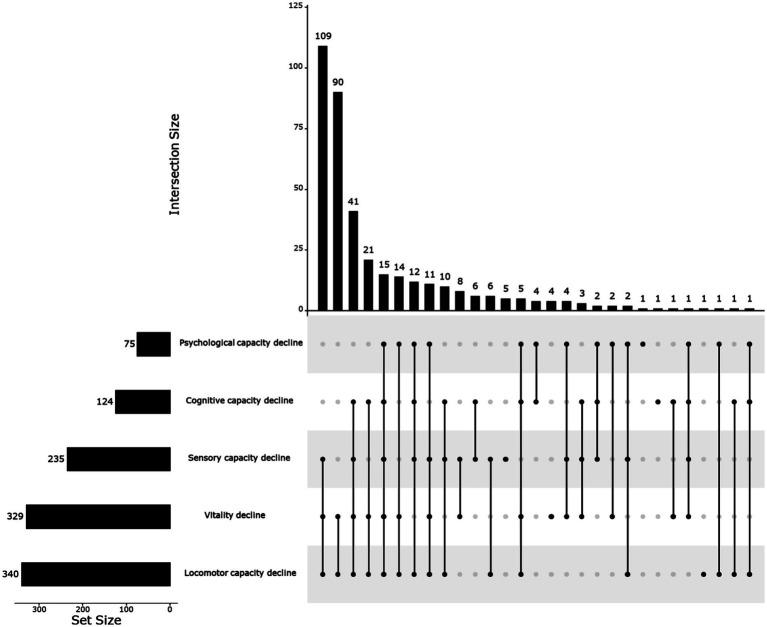
In this study, 43.5% of older people had impairments in three of the five dimensions of intrinsic capacity, the most significant proportion. The self-management ability score of older adults experiencing intrinsic capacity decline was 67.05 ± 12.53 out of 100. There were significant associations between age, perceived social support, and intrinsic ability composite score with self-management abilities (Age: = -0.263; < 0.001; social support: = 0.291; < 0.001; intrinsic capacity composite score: = 0.179; < 0.001). Higher levels of self-management ability were associated with more effective maintenance of psychological capacity, regardless of the type of older adults experiencing IC decline (all < 0.05). For example, among older adults experiencing cognitive decline, maintaining psychological function was positively associated with self-management abilities ( = 0.294; < 0.01).
CONCLUSION
The highest prevalence of concurrent impairments across three dimensions of intrinsic capacity was observed among older adults experiencing diminished intrinsic capacity. Fostering self-management abilities through social support and mental health interventions may benefit people experiencing intrinsic capacity decline.
目的
本研究调查了内在能力和自我管理能力的现状,并分析了影响内在能力下降的老年人自我管理能力的因素。
方法
我们纳入了382名平均年龄为72.92±6.81岁的老年人样本,这些老年人来自中国38个社区,均表现出内在能力下降。使用社会人口学问卷、内在能力问卷、社会支持量表、自评健康项目、电子健康素养量表和自我管理能力量表进行问卷调查。采用描述性统计、Pearson相关系数和线性回归分析对数据进行分析。
结果
在本研究中,43.5%的老年人在内在能力的五个维度中有三个维度存在损伤,这一比例最高。内在能力下降的老年人自我管理能力得分为67.05±12.53(满分100分)。年龄、感知到的社会支持和内在能力综合得分与自我管理能力之间存在显著关联(年龄:β = -0.263;P < 0.001;社会支持:β = 0.291;P < 0.001;内在能力综合得分:β = 0.179;P < 0.001)。无论内在能力下降的老年人类型如何,较高水平的自我管理能力都与更有效地维持心理能力相关(均P < 0.05)。例如,在认知能力下降的老年人中,维持心理功能与自我管理能力呈正相关(β = 0.294;P < 0.01)。
结论
在内在能力下降的老年人中,观察到内在能力三个维度同时受损的患病率最高处于最高水平。通过社会支持和心理健康干预培养自我管理能力可能会使内在能力下降的人受益。
 Zotero 插件