Cardoso Catarina Gouveia, Valente Carolina, Serino Mariana, Rodrigues Inês, Carvalho André, Coelho David Barros, Bastos Hélder Novais, Mota Patrícia Caetano, Morais António, Drummond Marta
. Departamento de Pneumologia, Unidade Local de Saúde de São João, Porto, Portugal.
. Faculdade de Medicina, Universidade do Porto, Porto, Portugal.
J Bras Pneumol. 2024 Dec 6;50(5):e20240058. doi: 10.36416/1806-3756/e20240058. eCollection 2024.
The frequency of obstructive sleep apnea (OSA) in patients with idiopathic pulmonary fibrosis (IPF) is high. The clinical course of non-IPF interstitial lung disease (ILD) can be similar to that of IPF. We sought to assess the frequency and predictors of OSA in patients with non-IPF fibrotic ILD, as well as the impact of positive airway pressure (PAP) therapy on the quality of life of such patients.
This was a prospective study in which non-IPF fibrotic ILD patients underwent a home sleep apnea test. The patients with and without OSA were compared, and a multivariate logistic regression model was used to identify independent predictors of OSA. At 3 months after initiation of PAP therapy, we evaluated the participating patients for respiratory events, nocturnal hypoxemia, and changes in quality of life.
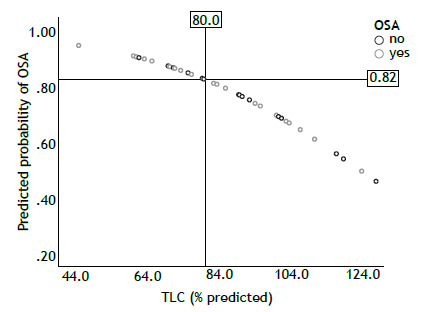
Of a total of 50 patients, 50% were male, and 76% were diagnosed with OSA. The mean age was 67.8 ± 8.3 years. The patients with OSA had significantly lower TLC (p = 0.033) and awake SpO2 (p = 0.023) than did those without OSA. In the multivariate logistic regression model, SpO2 (OR = 0.46; p = 0.016) and TLC (OR = 0.95; p = 0.026) remained significantly associated with OSA risk. A total of 12 patients received PAP therapy. At 3 months after initiation of PAP therapy, 91.7% were well controlled, Epworth Sleepiness Scale scores decreased significantly (p = 0.006), and emotional well-being tended to improve (p = 0.068). PAP therapy corrected nocturnal hypoxemia in all patients.
We found a high frequency of OSA in patients with non-IPF fibrotic ILD. A low TLC was an independent predictor of a higher risk of OSA. PAP therapy can correct nocturnal hypoxemia. There should be a low threshold for suspicion of OSA and initiation of PAP therapy in patients with non-IPF fibrotic ILD.
特发性肺纤维化(IPF)患者中阻塞性睡眠呼吸暂停(OSA)的发生率较高。非IPF间质性肺疾病(ILD)的临床病程可能与IPF相似。我们试图评估非IPF纤维化ILD患者中OSA的发生率和预测因素,以及气道正压(PAP)治疗对此类患者生活质量的影响。
这是一项前瞻性研究,非IPF纤维化ILD患者接受家庭睡眠呼吸暂停测试。对有和无OSA的患者进行比较,并使用多因素逻辑回归模型确定OSA的独立预测因素。在开始PAP治疗3个月后,我们评估参与研究的患者的呼吸事件、夜间低氧血症及生活质量变化。
总共50例患者中,50%为男性,76%被诊断为OSA。平均年龄为67.8±8.3岁。与无OSA的患者相比,OSA患者的肺总量(TLC)(p = 0.033)和清醒时血氧饱和度(SpO2)(p = 0.023)显著更低。在多因素逻辑回归模型中,SpO2(比值比[OR]=0.46;p = 0.016)和TLC(OR = 0.95;p = 0.026)仍与OSA风险显著相关。共有12例患者接受了PAP治疗。在开始PAP治疗3个月后,91.7%得到良好控制,爱泼沃斯嗜睡量表评分显著降低(p = 0.006),情绪状态有改善趋势(p = 0.068)。PAP治疗纠正了所有患者的夜间低氧血症。
我们发现非IPF纤维化ILD患者中OSA的发生率较高。低TLC是OSA风险较高的独立预测因素。PAP治疗可纠正夜间低氧血症。对于非IPF纤维化ILD患者,怀疑OSA并启动PAP治疗的阈值应较低。