Azevedo Leonardo Sotello, Banin Vanessa Burgugi, Dias Dayana Bitencourt, Mendes Marcela Lara, Alves Camila Albuquerque, Silva Maryanne Zilli Canedo, Moraes Thyago Proença de, Ponce Daniela
Internal Medicine Department, Faculdade de Medicina de Botucatu, Universidade Estadual Paulista, Botucatu, SP, Brazil.
Internal Medicine Department, Pontifícia Universidade Católica do Paraná, Curitiba, PR, Brazil.
Einstein (Sao Paulo). 2024 Dec 6;22:eAO0980. doi: 10.31744/einstein_journal/2024AO0980. eCollection 2024.
The efficacy of icodextrin versus glucose patients undergoing peritoneal dialysis remains unclear. The study was designed to compare the effects of once-daily long-dwell icodextrin versus glucose on markers of hypervolemia and survival among patients with kidney failure undergoing an unplanned initiation of automated peritoneal dialysis.
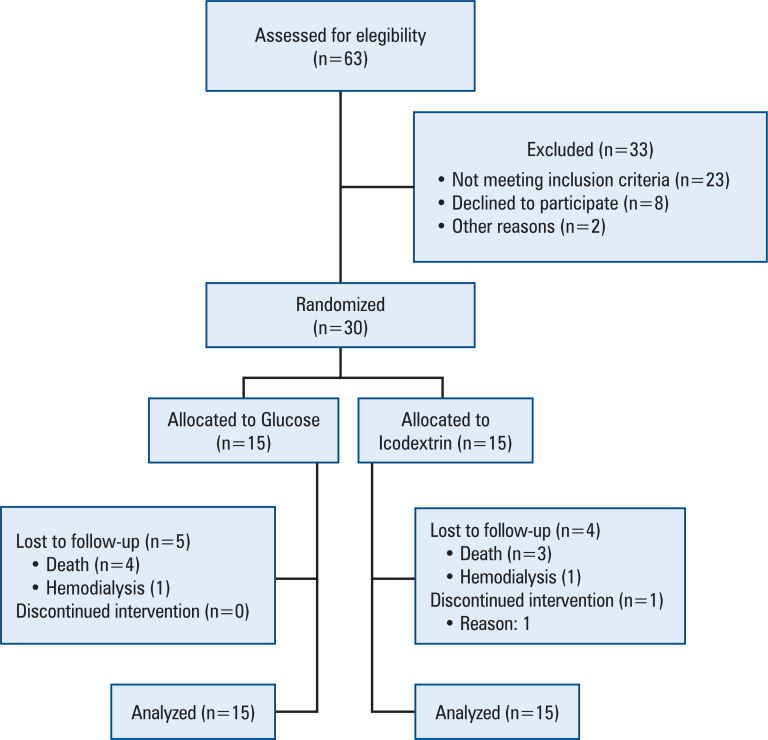
This was a randomized, non-blinded, and prospective controlled study. Prevalent and stable patients undergoing automated peritoneal dialysis with a recent peritoneal equilibration test showing a dialysate/plasma creatinine of >0.50 were randomized to receive either 7.5% icodextrin or 2.5% glucose solution. Patients were evaluated at baseline (one month after the start of peritoneal dialysis), 3 months, and 6 months after inclusion. The peritoneal dialysis solution was used for at least 3 months, with a follow-up period of 24 months.
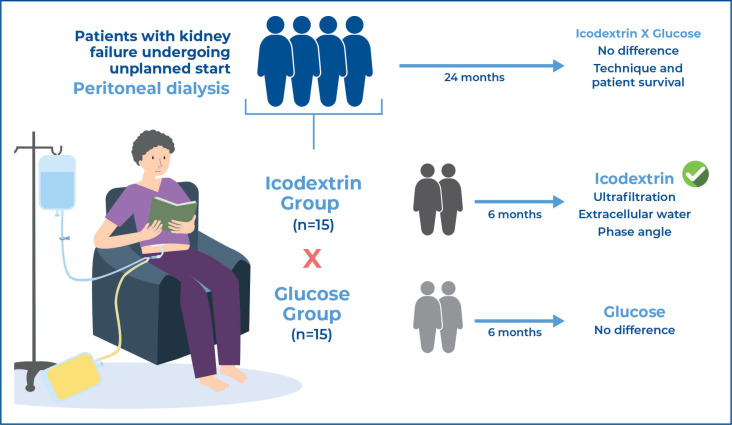
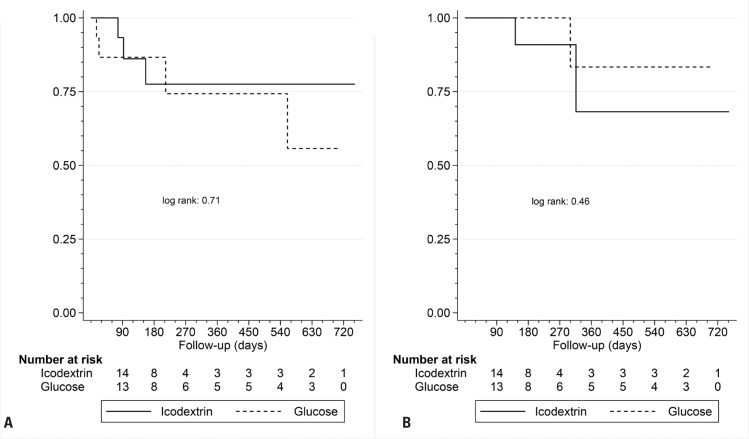
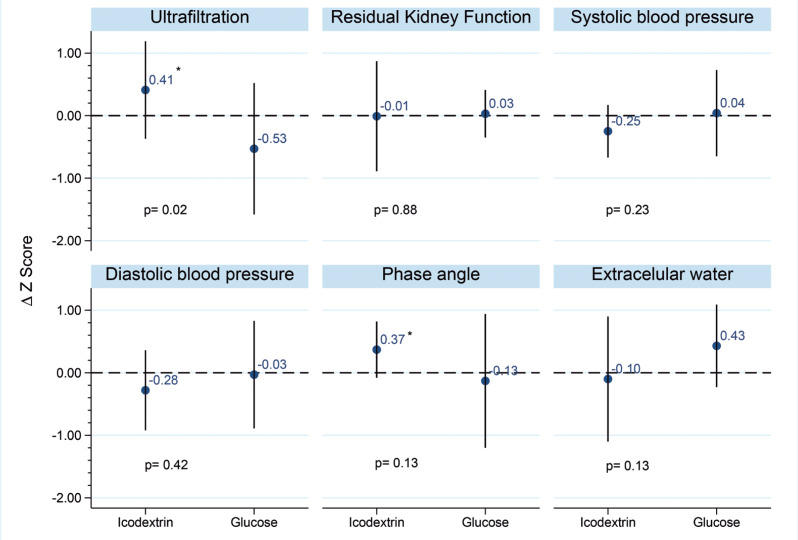
Thirty patients were enrolled. There were no baseline differences between the groups. During the study period, patients in the Icodextrin Group showed improvements in the phase angle and ultrafiltration, whereas there were no changes in the Glucose Group. Additionally, extracellular water was significantly lower in the Icodextrin Group at the end of the study than at baseline. No statistical differences between the two groups were observed in urine volume, ultrafiltration, extracellular water, phase angle, renal creatinine clearance, use of diuretics and antihypertensives, or blood pressure. During the 24-month follow-up, the number of events related to overall mortality was seven (Icodextrin Group, n=4; Glucose Group, n=3), with no difference between the groups for this outcome or technique survival.
Icodextrin significantly improved ultrafiltration, extracellular water, and phase angle at the end of the study compared to baseline in patients on the urgent start of automated peritoneal dialysis.
(www.ctri.nic.in) under the number RBR-97z4wh6.
与接受腹膜透析的葡萄糖治疗患者相比,艾考糊精的疗效尚不清楚。本研究旨在比较每日一次长时间留存的艾考糊精与葡萄糖对计划外开始自动腹膜透析的肾衰竭患者血容量过多标志物和生存率的影响。
这是一项随机、非盲法的前瞻性对照研究。近期腹膜平衡试验显示透析液/血浆肌酐>0.50的正在接受自动腹膜透析的现患且病情稳定的患者被随机分配接受7.5%艾考糊精或2.5%葡萄糖溶液。在纳入研究后的基线期(腹膜透析开始后1个月)、3个月和6个月对患者进行评估。腹膜透析液使用至少3个月,随访期为24个月。
共纳入30例患者。两组间基线无差异。在研究期间,艾考糊精组患者的相位角和超滤有所改善,而葡萄糖组则无变化。此外,研究结束时艾考糊精组的细胞外液显著低于基线水平。两组在尿量、超滤、细胞外液、相位角、肾肌酐清除率、利尿剂和抗高血压药物的使用或血压方面未观察到统计学差异。在24个月的随访期间,与总死亡率相关的事件数为7例(艾考糊精组,n = 4;葡萄糖组,n = 3),两组在该结局或技术生存率方面无差异。
与紧急开始自动腹膜透析的患者基线相比,研究结束时艾考糊精显著改善了超滤、细胞外液和相位角。
(www.ctri.nic.in),注册号为RBR - 97z4wh6。