Kim Ji-Na, Eom Ki Seong
Department of Anesthesiology and pain medicine, Seoul National University Bundang Hospital, Seongnam, Korea.
Department of Neurosurgery, Wonkwang University Hospital, Institute of Wonkwang Medical Science, Iksan, Korea.
J Korean Neurosurg Soc. 2025 Jan;68(1):25-36. doi: 10.3340/jkns.2024.0156. Epub 2024 Dec 12.
In 2006, the Korean Neurotraumatology Society (KNTS) established the 1st Korean Neurotrauma Data Bank Committee (KNTDBC) and developed the Korean Neurotrauma Data Bank System (KNTDBS). Full-scale registration of traumatic brain injury (TBI) patient data began in September 2010. Since then, KNTS has conducted two trauma-related data registration projects and is now in its 5th term of the KNTDBC. This study aimed to introduce the KNTDBS of the KNTS and report the results of the second project.
Between January 2018 and June 2021, 1109 TBI patients were registered from 18 hospitals. The inclusion criteria were 1) patients who visited the hospital with TBI, 2) patients with severe TBI with a Glasgow coma scale (GCS) score of 8 or lower, and 3) adult patients aged 19 years or older. Exclusion criteria were 1) patients under 18 years of age, 2) patients with a GCS score of 9 or higher, and 3) patients with a history of previous craniotomy or craniectomy. Data from the second project were registered into seven major categories : patient registration, neuroimaging, neuromonitoring, hypothermia, surgical treatment, medical treatment, and patient evaluation.
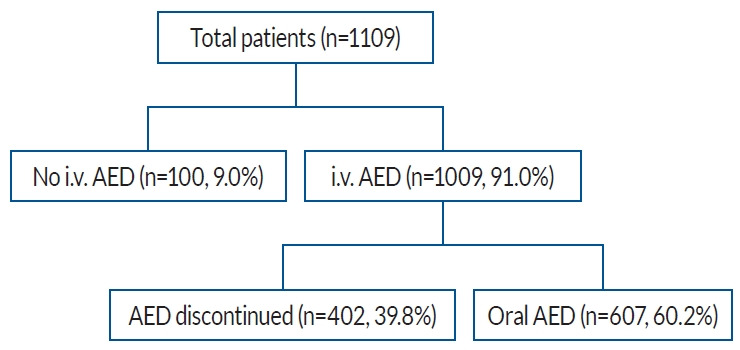
The characteristics of TBI patients in this study were not significantly different from those in previous studies, including the 1st project of KNTS. The GCS had a large number of severe patients with scores of 3 and 4, which was associated with the highest proportion of patients having bilateral pupils with unrecordable responses. Most TBI patients had severe or critical injuries (score 4 or 5) concentrated in the Abbreviated incentive scale head but had minor injuries to other regions of the body. Rotterdam computed tomography scores of 5 and 6 primarily indicated acute subdural hematomas. Surgical treatment was performed in 36.2% of all TBI cases. Most hospitals used levetiracetam and valproate as prophylactic antiepileptic drugs. Neuromonitoring, hypothermia, and coma therapy were not actively performed. The overall mortality rate was 33.3%, and among 740 survivors, 3.9% underwent shunt surgery.
The creation of a database for TBI patient data facilitated the collection of objective and valid information on trauma. Utilizing data from the KNTDBS will significantly aid in the treatment and prevention of TBI and contribute to the improvement of healthcare in the country.
2006年,韩国神经创伤学会(KNTS)成立了首届韩国神经创伤数据库委员会(KNTDBC),并开发了韩国神经创伤数据库系统(KNTDBS)。创伤性脑损伤(TBI)患者数据的全面登记于2010年9月开始。从那时起,KNTS开展了两个与创伤相关的数据登记项目,目前正处于KNTDBC的第五个任期。本研究旨在介绍KNTS的KNTDBS并报告第二个项目的结果。
2018年1月至2021年6月,18家医院登记了1109例TBI患者。纳入标准为:1)因TBI到医院就诊的患者;2)格拉斯哥昏迷量表(GCS)评分≤8分的重度TBI患者;3)年龄≥19岁的成年患者。排除标准为:1)年龄<18岁的患者;2)GCS评分≥9分的患者;3)既往有开颅手术或颅骨切除术史的患者。第二个项目的数据登记分为七个主要类别:患者登记、神经影像学、神经监测、低温治疗、手术治疗、药物治疗和患者评估。
本研究中TBI患者的特征与以往研究(包括KNTS的第一个项目)中的患者特征无显著差异。GCS评分3分和4分的重度患者数量较多,这与双侧瞳孔反应无法记录的患者比例最高相关。大多数TBI患者有严重或危急损伤(评分4或5),集中在简明损伤定级标准头部,但身体其他部位损伤较轻。鹿特丹计算机断层扫描评分5分和6分主要提示急性硬膜下血肿。36.2%的TBI病例接受了手术治疗。大多数医院使用左乙拉西坦和丙戊酸盐作为预防性抗癫痫药物。神经监测、低温治疗和昏迷治疗未积极开展。总死亡率为33.3%,在740名幸存者中,3.9%接受了分流手术。
创建TBI患者数据库有助于收集关于创伤的客观和有效信息。利用KNTDBS的数据将显著有助于TBI的治疗和预防,并有助于该国医疗保健的改善。