Kim Sun Hong, Bae Ah Young, Kim Do Hyun, Hwang Se Hwan
Department of Otolaryngology-Head and Neck Surgery, Bucheon Saint Mary's Hospital, College of Medicine, The Catholic University of Korea, Seoul, Republic of Korea.
Department of Otolaryngology-Head and Neck Surgery, Seoul Saint Mary's Hospital, College of Medicine, The Catholic University of Korea, Seoul, Republic of Korea.
J Rhinol. 2024 Mar;31(1):8-16. doi: 10.18787/jr.2024.00007. Epub 2024 Mar 31.
This study aimed to determine the efficacy of prophylactic desmopressin administered via the intranasal or intravenous route in reducing intraoperative bleeding during nasal surgery. We conducted a meta-analysis of the relevant literature to investigate the role of preoperative desmopressin in minimizing bleeding complications associated with nasal surgery.
We screened the relevant literature published before February 2023. Nine articles that compared the perioperative use of desmopressin (treatment) with a placebo or no treatment (control) were included. The analyzed outcomes were intraoperative bleeding during nasal surgery and postoperative morbidity.
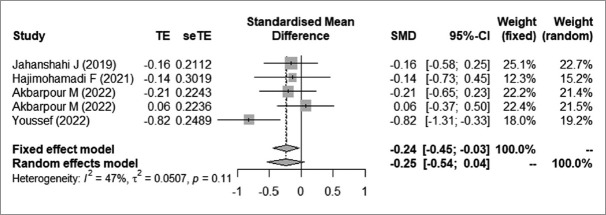
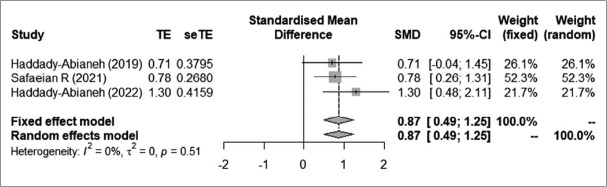
The treatment group showed significant improvements in intraoperative bleeding, the surgical field, and surgeon satisfaction compared to the control group. However, the prophylactic use of desmopressin was associated with elevated blood pressure and decreased serum sodium levels compared to the control group. Nonetheless, no significant adverse effects were reported in the included studies. Subgroup analyses comparing the route of administration (intravenous vs. intranasal) and type of surgery (rhinoplasty vs. endoscopic sinus surgery) showed that desmopressin had a beneficial effect on intraoperative bleeding and the surgical field, regardless of the route of administration or type of surgery.
The prophylactic use of desmopressin for nasal surgery effectively reduced intraoperative bleeding, improved the surgical field, and increased surgeon satisfaction, with no significant adverse effects. However, caution should be exercised when administering desmopressin as it may cause an elevation in postoperative blood pressure in patients with cardiopulmonary problems.
本研究旨在确定经鼻内或静脉途径给予预防性去氨加压素在减少鼻腔手术术中出血方面的疗效。我们对相关文献进行了荟萃分析,以探讨术前使用去氨加压素在将与鼻腔手术相关的出血并发症降至最低方面的作用。
我们筛选了2023年2月之前发表的相关文献。纳入了9篇比较去氨加压素围手术期使用(治疗组)与安慰剂或不治疗(对照组)的文章。分析的结果是鼻腔手术术中出血和术后发病率。
与对照组相比,治疗组在术中出血、手术视野和外科医生满意度方面有显著改善。然而,与对照组相比,预防性使用去氨加压素与血压升高和血清钠水平降低有关。尽管如此,纳入的研究中未报告有显著的不良反应。比较给药途径(静脉内与鼻内)和手术类型(隆鼻术与鼻内镜鼻窦手术)的亚组分析表明,无论给药途径或手术类型如何,去氨加压素对术中出血和手术视野都有有益影响。
鼻腔手术预防性使用去氨加压素可有效减少术中出血,改善手术视野,并提高外科医生满意度,且无显著不良反应。然而,使用去氨加压素时应谨慎,因为它可能会导致有心肺问题的患者术后血压升高。