Waiser Johannes, Klotsche Jens, Glander Petra, Schmidt Danilo, Naik Marcel, Liefeldt Lutz, Budde Klemens, Halbritter Jan, Halleck Fabian, Zukunft Bianca, Peters Robert, Friedersdorff Frank, Lachmann Nils, Eckardt Kai-Uwe, d'Anjou Leonie, Bachmann Friederike
Department of Nephrology and Medical Intensive Care, Charité - Universitätsmedizin Berlin, Corporate Member of Freie Universität Berlin and Humboldt-Universität zu Berlin, Berlin, Germany.
German Rheumatism Research Center Berlin - a Leibniz Institute, Berlin, Germany.
Clin Kidney J. 2024 Oct 26;17(12):sfae330. doi: 10.1093/ckj/sfae330. eCollection 2024 Dec.
Patients with autosomal dominant polycystic kidney disease (ADPKD) represent >10% of patients awaiting kidney transplantation. These patients are prone to potentially severe urinary tract (UTI) and liver cyst infections after transplantation. Whether such infections compromise outcome is unclear.
Between 2000 and 2017 we performed 193 kidney transplantations in patients with ADPKD. In 189 patients, we assessed the occurrence, frequency, and severity of infection episodes requiring inpatient treatment and their impact on graft and patient outcomes compared with 189 matched controls. Risk factors were analyzed by uni- and multivariable analyses.
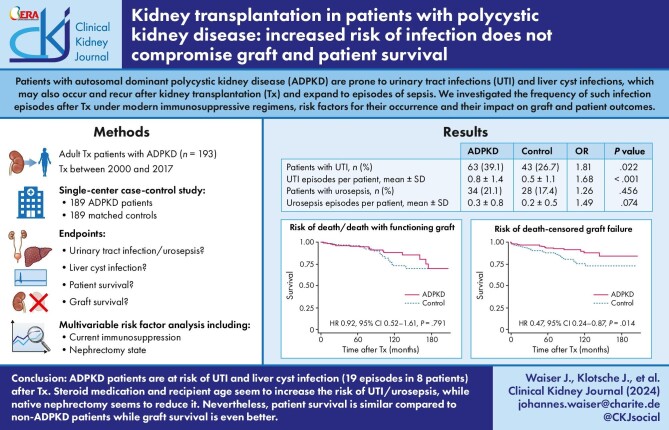
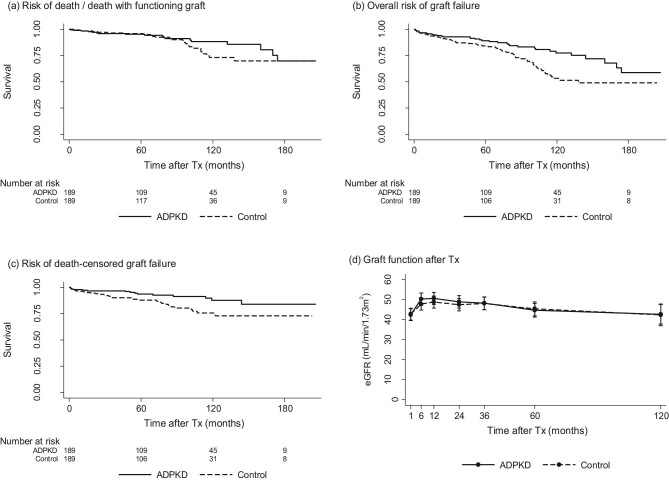
During a mean observation period of 77 months UTIs occurred more frequently in ADPKD patients (39.1% vs. 26.7%, = .022; 0.8 ± 1.4 vs. 0.5 ± 1.1 episodes, < .001). Eight ADPKD patients suffered from 19 episodes of liver cyst infection. Steroid medication (RR 3.04; < .001) and recipient age (RR 1.05; = .003) increased the risk for UTI/urosepsis, while nephrectomy reduced it (unilateral, RR 0.60; = .088; bilateral, RR 0.45; = .020). Patient survival was similar in both groups. The risk of graft failure was lower in ADPKD patients [hazard ratio (HR) 0.67; = .047] due to a lower risk of death-censored graft loss (HR 0.47; = .014). Donor age (HR 1.34; = .002) and rejection (HR 8.47; < .001) were risk factors for death-censored graft loss.
ADPKD patients are at increased risk of UTI and liver cyst infection after transplantation. Steroid medication and recipient age seem to increase the risk of UTI/urosepsis, while nephrectomy seems to reduce it. Nevertheless, patient survival was similar compared to non-ADPKD patients and death-censored graft survival even better.
常染色体显性多囊肾病(ADPKD)患者占等待肾移植患者的10%以上。这些患者移植后易发生潜在的严重尿路感染(UTI)和肝囊肿感染。此类感染是否会影响移植结果尚不清楚。
2000年至2017年间,我们对193例ADPKD患者进行了肾移植。在189例患者中,我们评估了需要住院治疗的感染发作的发生率、频率和严重程度,以及与189例匹配对照相比,它们对移植物和患者预后的影响。通过单变量和多变量分析来分析危险因素。
在平均77个月的观察期内,ADPKD患者UTI的发生率更高(39.1%对26.7%,P = 0.022;0.8±1.4次对0.5±1.1次,P < 0.001)。8例ADPKD患者发生了19次肝囊肿感染。使用类固醇药物(相对危险度3.04;P < 0.001)和受者年龄(相对危险度1.05;P = 0.003)会增加UTI/脓毒症的风险,而肾切除术则会降低这种风险(单侧,相对危险度0.60;P = 0.088;双侧,相对危险度0.45;P = 0.020)。两组患者的生存率相似。ADPKD患者移植物失败的风险较低[风险比(HR)0.67;P = 0.047],这是因为死亡审查的移植物丢失风险较低(HR 0.47;P = 0.014)。供者年龄(HR 1.34;P = 0.002)和排斥反应(HR 8.47;P < 0.001)是死亡审查的移植物丢失的危险因素。
ADPKD患者移植后发生UTI和肝囊肿感染的风险增加。类固醇药物和受者年龄似乎会增加UTI/脓毒症的风险,而肾切除术似乎会降低这种风险。然而,与非ADPKD患者相比,患者生存率相似,且死亡审查的移植物生存率甚至更高。