Zouboulis C C, Borchert J, Diesing J, Heinrich R, Galetzka W, Medelnik J-P, Altenburg A, Feldhus A, Schönfelder T
Departments of Dermatology, Venereology, Allergology and Immunology, Staedtisches Klinikum Dessau, Brandenburg Medical School Theodor Fontane and Faculty of Health Sciences Brandenburg, Dessau, Germany.
WIG2 GmbH Scientific Institute for Health Economics and Health System Research, Leipzig, Germany.
J Eur Acad Dermatol Venereol. 2025 May;39(5):1017-1027. doi: 10.1111/jdv.20489. Epub 2024 Dec 12.
Adamantiades-Behçet's disease (ABD) is a rare, chronic, relapsing, multisystem vasculitis, with a reported prevalence of 0.9 out of 100,000 population in Germany in 2012. However, more recent epidemiological data are lacking.
To estimate the prevalence and incidence of ABD in Germany and assess associated comorbidities and current treatment patterns.
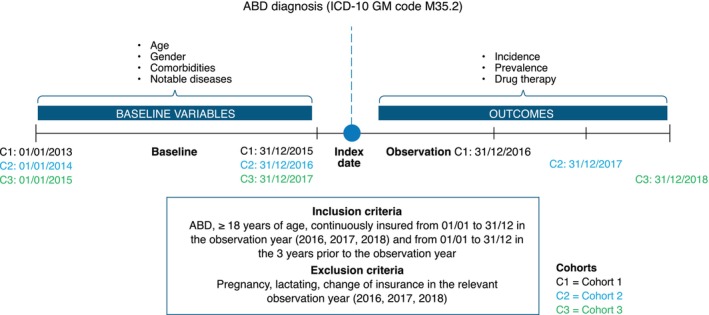
This retrospective cohort study used claims data from the anonymized Institute for Applied Health Research Berlin (InGef) research database. Cohorts were formed for the observation years 2016, 2017 and 2018, using data from 2013 to 2018 (allowing for a 3-year baseline period for incidence data). The study population included patients ≥18 years old with a diagnosis of ABD (ICD-10 diagnostic code M35.2), covered under the statutory health insurance system and in the InGef research database, with continuous insurance in the observation year and baseline period. We descriptively evaluated prevalence (≥2 outpatient ABD diagnoses in different quarters/≥1 main inpatient diagnosis in the observation year), incidence (no confirmed outpatient/inpatient diagnosis in the baseline period), comorbidities reported during the study and ABD-related medications.
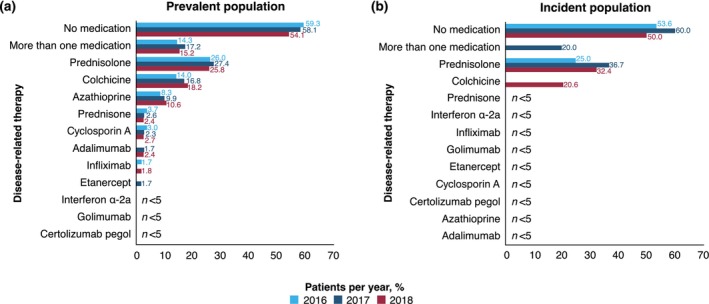
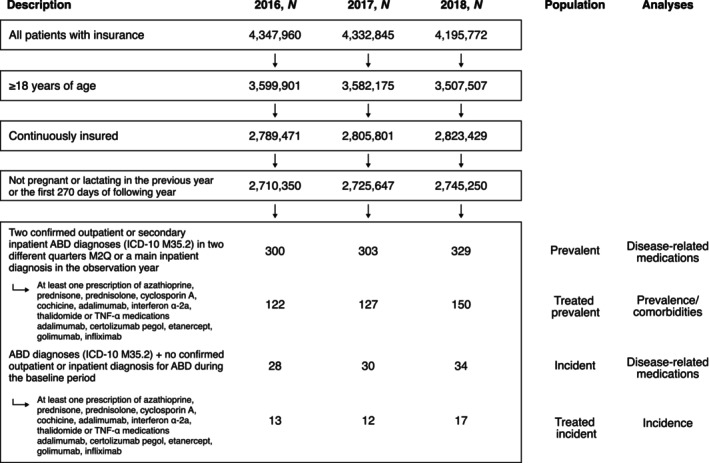
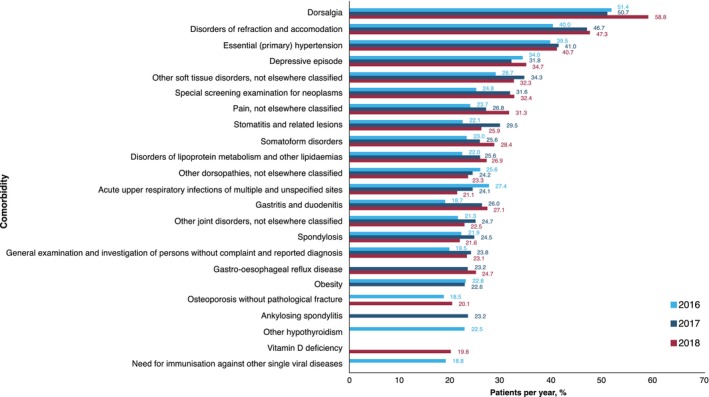
We identified 300, 303 and 329 patients diagnosed with ABD in 2016, 2017 and 2018, respectively, with fewer than half (122/300 [40.7%], 127/303 [41.9%] and 150/329 [45.6%]) prescribed ≥1 disease-related medication. In the treated population, ABD prevalence was 3.9 (2016), 4.1 (2017) and 4.7 (2018) per 100,000 population; annual ABD incidence was 0.5 per 100,000 population in 2016 and 2017 and 0.6 per 100,000 population in 2018. The most commonly reported comorbidities in patients diagnosed with ABD were dorsalgia (an indicator of possible misdiagnosis), disorders of refraction and accommodation, and essential (primary) hypertension. Prednisolone, colchicine and azathioprine were the most commonly prescribed treatments for ABD, with approximately 15% of patients taking >1 medication for ABD.
The reported data provide evidence that ABD remains a rare disease in Germany.
白塞病(ABD)是一种罕见的慢性复发性多系统血管炎,据报道,2012年德国每10万人中的患病率为0.9。然而,缺乏最新的流行病学数据。
估计德国白塞病的患病率和发病率,并评估相关合并症和当前治疗模式。
这项回顾性队列研究使用了来自柏林应用健康研究所(InGef)匿名研究数据库的理赔数据。利用2013年至2018年的数据(发病率数据允许有3年的基线期),形成了2016年、2017年和2018年的观察队列。研究人群包括年龄≥18岁、诊断为白塞病(国际疾病分类第十版诊断代码M35.2)、参加法定医疗保险系统且在InGef研究数据库中、在观察年和基线期连续参保的患者。我们对患病率(在不同季度有≥2次门诊白塞病诊断/在观察年有≥1次主要住院诊断)、发病率(在基线期无确诊的门诊/住院诊断)、研究期间报告的合并症以及与白塞病相关的药物进行了描述性评估。
我们分别在2016年、2017年和2018年确定了300例、303例和329例诊断为白塞病的患者,其中开具≥1种与疾病相关药物的患者不到一半(122/300 [40.7%]、127/303 [41.9%]和150/329 [45.6%])。在接受治疗的人群中,白塞病的患病率分别为每10万人3.9(2016年)、4.1(2017年)和4.7(2018年);2016年和2017年白塞病的年发病率为每10万人0.5,2018年为每10万人0.6。诊断为白塞病的患者中最常报告的合并症是背痛(可能误诊的一个指标)、屈光和调节障碍以及原发性高血压。泼尼松龙、秋水仙碱和硫唑嘌呤是白塞病最常用的治疗药物,约15%的患者服用>1种治疗白塞病的药物。
报告的数据提供了证据,表明白塞病在德国仍然是一种罕见疾病。