Rivera-Cardona Joel, Kakuturu Neeha, Rowland Elizabeth F, Teo Qi Wen, Thayer Elizabeth A, Tan Timothy J C, Sun Jiayi, Kieffer Collin, Wu Nicholas C, Brooke Christopher B
Department of Microbiology, University of Illinois at Urbana-Champaign, Urbana, Illinois, United States of America.
Carl R. Woese Institute for Genomic Biology, University of Illinois at Urbana-Champaign, Urbana, Illinois, United States of America.
PLoS Pathog. 2024 Dec 12;20(12):e1012727. doi: 10.1371/journal.ppat.1012727. eCollection 2024 Dec.
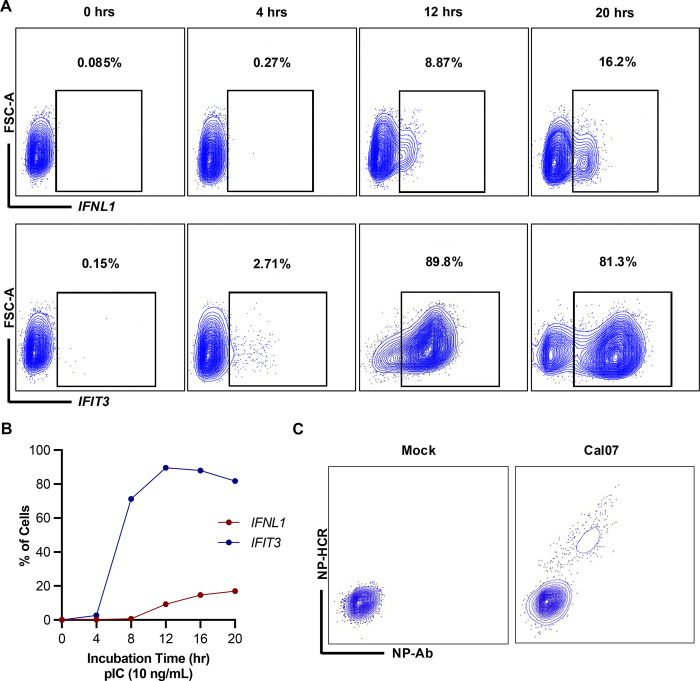
The circulation of seasonal influenza A viruses (IAVs) in humans relies on effective evasion and subversion of the host immune response. While the evolution of seasonal H1N1 and H3N2 viruses to avoid humoral immunity is well characterized, relatively little is known about the evolution of innate immune antagonism phenotypes in these viruses. Numerous studies have established that only a small subset of infected cells is responsible for initiating the type I and type III interferon (IFN) response during IAV infection, emphasizing the importance of single cell studies to accurately characterize the IFN response during infection. We developed a flow cytometry-based method to examine transcriptional changes in IFN and interferon stimulated gene (ISG) expression at the single cell level. We observed that NS segments derived from seasonal H3N2 viruses are more efficient at antagonizing IFN signaling but less effective at suppressing IFN induction, compared to the pdm2009 H1N1 lineage. We compared a collection of NS segments spanning the natural history of the current seasonal IAV lineages and demonstrate long periods of stability in IFN antagonism potential, punctuated by occasional phenotypic shifts. Altogether, our data reveal significant differences in how seasonal and pandemic H1N1 and H3N2 viruses antagonize the human IFN response at the single cell level.
甲型流感病毒(IAV)在人群中的传播依赖于对宿主免疫反应的有效逃避和颠覆。虽然季节性H1N1和H3N2病毒为逃避体液免疫而发生的进化已得到充分表征,但对于这些病毒中固有免疫拮抗表型的进化却知之甚少。大量研究表明,在IAV感染期间,只有一小部分受感染细胞负责启动I型和III型干扰素(IFN)反应,这凸显了单细胞研究对于准确表征感染期间IFN反应的重要性。我们开发了一种基于流式细胞术的方法,用于在单细胞水平检测IFN和干扰素刺激基因(ISG)表达的转录变化。我们观察到,与2009年甲型H1N1流感病毒谱系相比,源自季节性H3N2病毒的NS片段在拮抗IFN信号传导方面更有效,但在抑制IFN诱导方面效果较差。我们比较了一系列涵盖当前季节性IAV谱系自然史的NS片段,并证明IFN拮抗潜力在很长一段时间内保持稳定,偶尔会出现表型转变。总之,我们的数据揭示了季节性和大流行性H1N1和H3N2病毒在单细胞水平上拮抗人类IFN反应方式的显著差异。