Park R S, Jacobson R A, Gomez Casajus L, Nimmo F, Ermakov A I, Keane J T, McKinnon W B, Stevenson D J, Akiba R, Idini B, Buccino D R, Magnanini A, Parisi M, Tortora P, Zannoni M, Mura A, Durante D, Iess L, Connerney J E P, Levin S M, Bolton S J
Jet Propulsion Laboratory, California Institute of Technology, Pasadena, CA, USA.
Centro Interdipartimentale di Ricerca Industriale Aerospaziale, Alma Mater Studiorum - Università di Bologna, Forlì, Italy.
Nature. 2025 Feb;638(8049):69-73. doi: 10.1038/s41586-024-08442-5. Epub 2024 Dec 12.
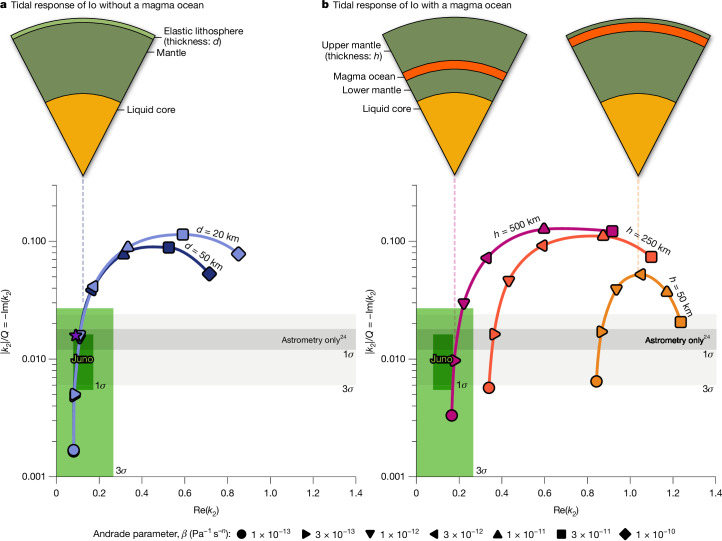
Io experiences tidal deformation as a result of its eccentric orbit around Jupiter, which provides a primary energy source for Io's continuing volcanic activity and infrared emission. The amount of tidal energy dissipated within Io is enormous and has been suggested to support the large-scale melting of its interior and the formation of a global subsurface magma ocean. If Io has a shallow global magma ocean, its tidal deformation would be much larger than in the case of a more rigid, mostly solid interior. Here we report the measurement of Io's tidal deformation, quantified by the gravitational tidal Love number k, enabled by two recent flybys of the Juno spacecraft. By combining Juno and Galileo Doppler data from the NASA Deep Space Network and astrometric observations, we recover Re(k) of 0.125 ± 0.047 (1σ) and the tidal dissipation parameter Q of 11.4 ± 3.6 (1σ). These measurements confirm that a shallow global magma ocean in Io does not exist and are consistent with Io having a mostly solid mantle. Our results indicate that tidal forces do not universally create global magma oceans, which may be prevented from forming owing to rapid melt ascent, intrusion and eruption, so even strong tidal heating-such as that expected on several known exoplanets and super-Earths-may not guarantee the formation of magma oceans on moons or planetary bodies.
木卫一由于其绕木星的偏心轨道而经历潮汐变形,这为木卫一持续的火山活动和红外辐射提供了主要能量来源。木卫一内部耗散的潮汐能量巨大,有人认为这支持了其内部的大规模熔化以及全球地下岩浆海洋的形成。如果木卫一有一个浅层的全球岩浆海洋,其潮汐变形将比内部更坚硬、大多为固体的情况大得多。在此,我们报告了对木卫一潮汐变形的测量,该变形由引力潮汐勒夫数k量化,这是由“朱诺”号航天器最近的两次飞越实现的。通过结合美国国家航空航天局深空网络的“朱诺”号和“伽利略”号多普勒数据以及天体测量观测,我们得到的有效勒夫数Re(k)为0.125±0.047(1σ),潮汐耗散参数Q为11.4±3.6(1σ)。这些测量结果证实木卫一不存在浅层的全球岩浆海洋,并且与木卫一有一个大多为固体的地幔相一致。我们的结果表明,潮汐力并非普遍会形成全球岩浆海洋,由于熔体快速上升、侵入和喷发,岩浆海洋可能无法形成,所以即使是强烈的潮汐加热——比如在一些已知系外行星和超级地球上预期的那样——也可能无法保证在卫星或行星体上形成岩浆海洋。