Yu Ben C L, Ng Jacky C K, Chio Floria H N, Mak Winnie W S
Department of Applied Social Sciences, The Hong Kong Polytechnic University, Hong Kong.
Department of Psychology, The Chinese University of Hong Kong, Hong Kong.
Appl Psychol Health Well Being. 2025 Feb;17(1):e12634. doi: 10.1111/aphw.12634.
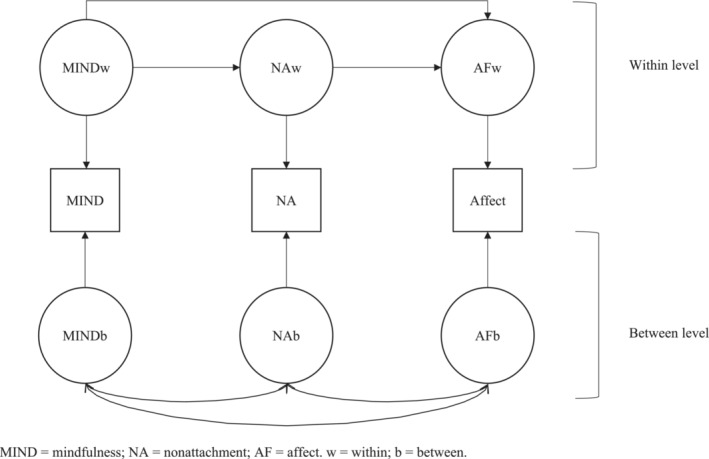
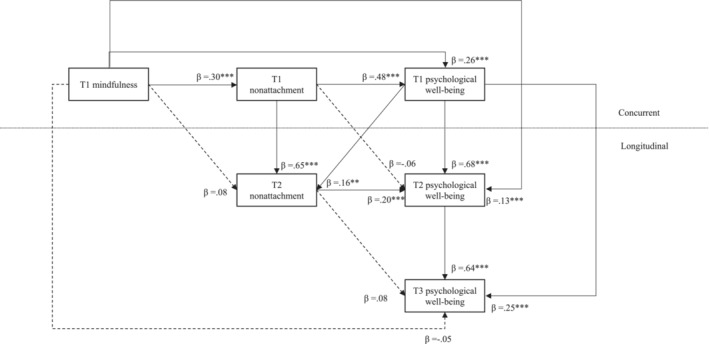
This research investigated the mediating role of nonattachment in the association between mindfulness and well-being. Study 1, a 2-week ecological momentary assessment (EMA) study with 2446 responses from 69 participants, showed that state mindfulness at time (t) - 1 was not significantly associated with nonattachment at t and (positive and negative) affect at t + 1. However, nonattachment at t significantly mediated the association between state mindfulness at t and (positive and negative) affect at t. Study 2, a 2-month study with three waves of measurement (n = 224), showed that trait mindfulness at baseline could not predict psychological well-being at 2-month follow-up through nonattachment at 1-month follow-up. However, this mediating relationship was significant when all these variables were measured at baseline. People who are mindful at one moment may experience higher nonattachment and better well-being at the same moment; the beneficial effect could not be sustained over time among people who are largely non-meditators.
本研究调查了无执着在正念与幸福感之间的关联中所起的中介作用。研究1是一项为期两周的生态瞬时评估(EMA)研究,69名参与者提供了2446份回复,结果显示,前一时间点(t)-1的状态正念与时间点t的无执着以及时间点t+1的(积极和消极)情绪没有显著关联。然而,时间点t的无执着显著中介了时间点t的状态正念与时间点t的(积极和消极)情绪之间的关联。研究2是一项为期两个月的研究,进行了三轮测量(n = 224),结果显示,基线时的特质正念无法通过1个月随访时的无执着来预测2个月随访时的心理健康。然而,当所有这些变量在基线时进行测量时,这种中介关系是显著的。当下正念的人可能在同一时刻体验到更高的无执着和更好的幸福感;对于大部分非冥想者来说,这种有益效果无法随着时间持续。