Lu Rongrong, Wu Changcai
Department of Neurosurgery, The Second Affiliated Hospital and Yuying Children's Hospital of Wenzhou Medical University, Wenzhou, Zhejiang, China.
Department of Ultrasound, The First Affiliated Hospital of Wenzhou Medical University, Wenzhou, Zhejiang, China.
Front Neurol. 2024 Nov 28;15:1456884. doi: 10.3389/fneur.2024.1456884. eCollection 2024.
The purpose of this study was to investigate the relationship between platelet-to-red cell distribution width ratio (PRR) and all-cause mortality in critically ill patients with non-traumatic cerebral hemorrhage (NCH).
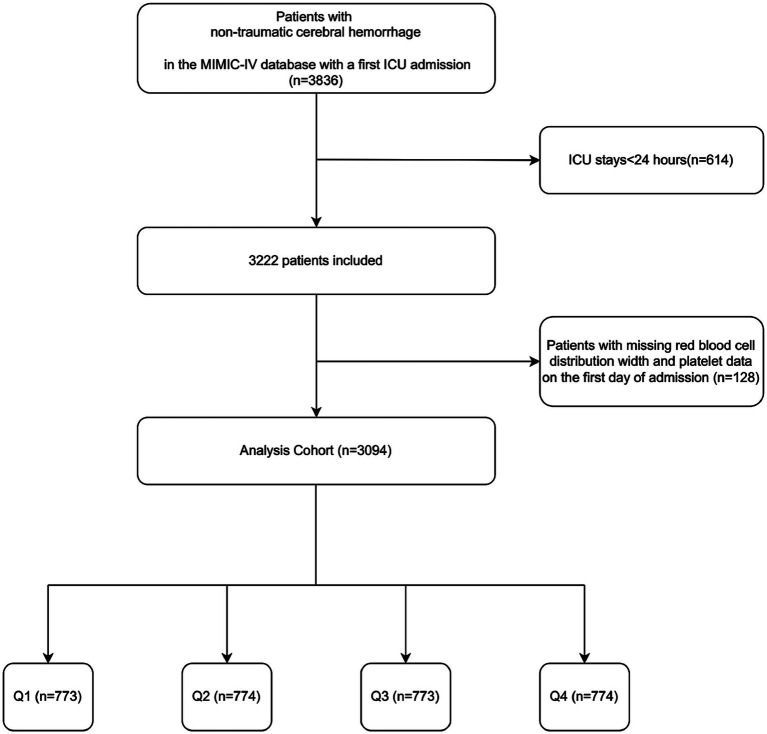
The Medical Information Mart for Intensive Care (MIMIC-IV) database was used to identify patients with NCH who needed to be admitted to intensive care unit (ICU). The outcomes of the study included both ICU and in-hospital mortality. Restricted cubic splines and Cox proportional hazards regression analysis were used to clarify the relationship between PRR and clinical outcomes in critically ill patients with NCH.
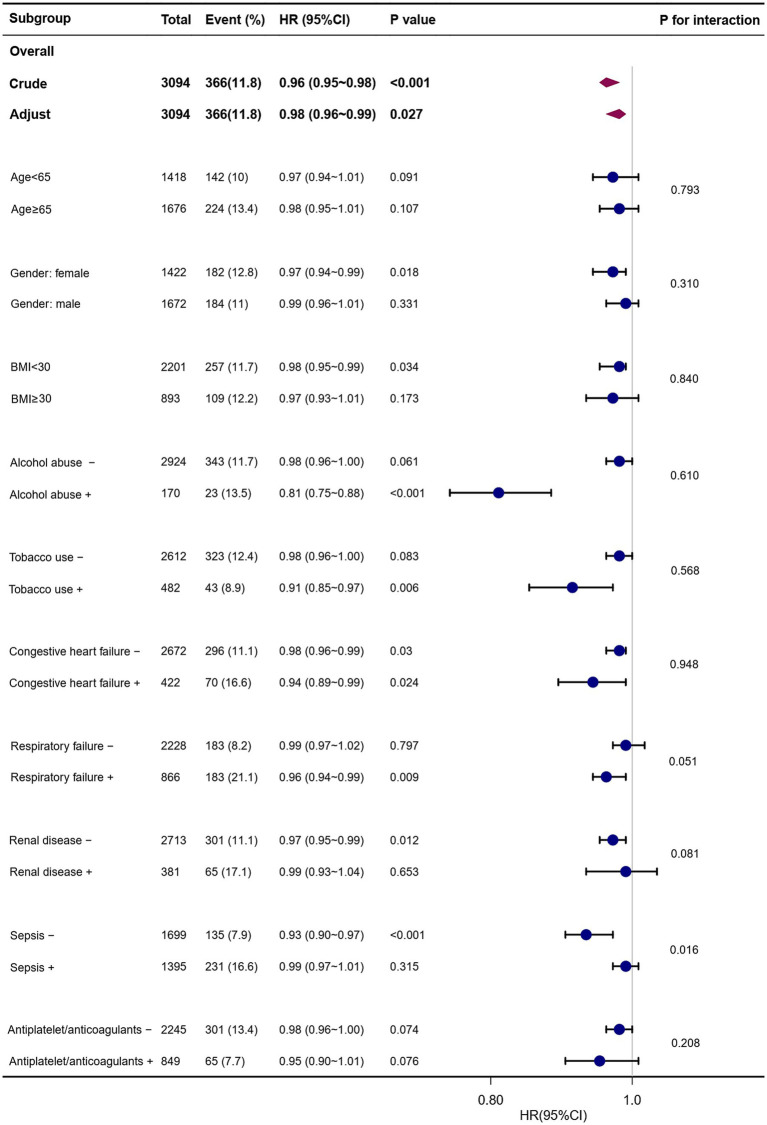
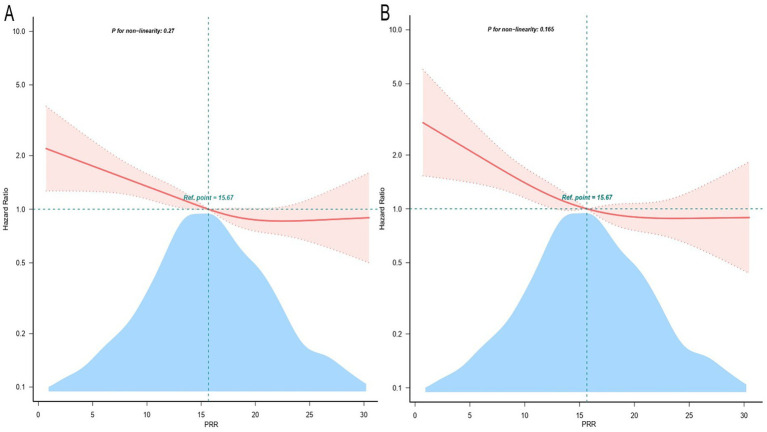
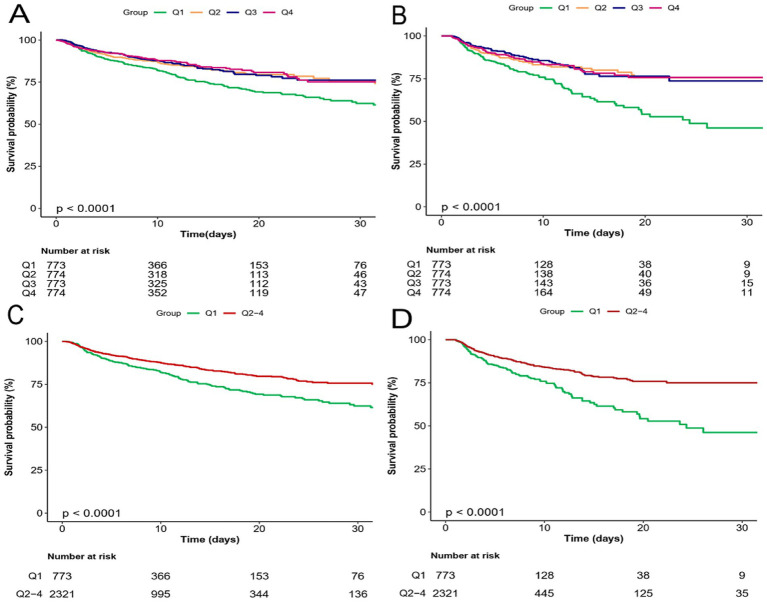
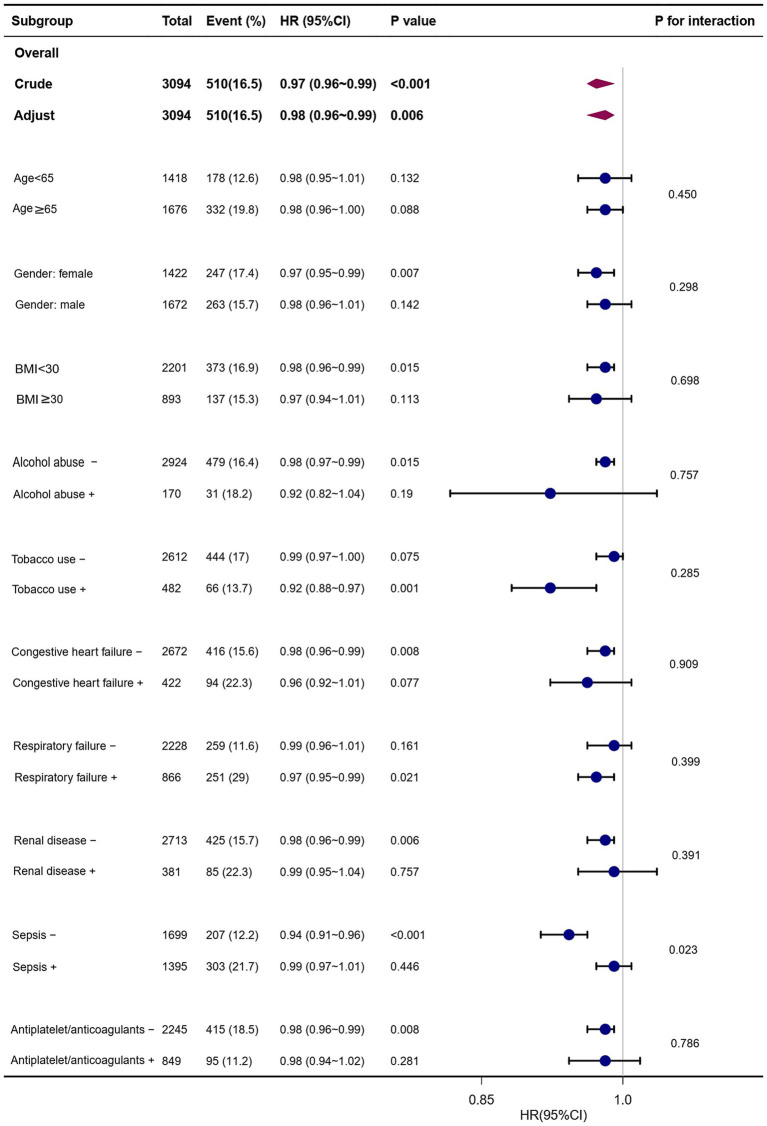
A total of 3,094 patients (54.0% male) were included in the study, with in-hospital mortality and ICU mortality rates of 16.5 and 11.8%, respectively. A substantial correlation was found by multivariate Cox proportional hazards analysis between increased PRR and a lower risk of in-hospital and ICU mortality. Following adjustment for confounding factors, patients with elevated PRR exhibited a significantly decreased risk of in-hospital death (HR, 0.98; 95% CI, 0.96-0.99; = 0.006) and ICU death (HR, 0.98; 95% CI, 0.96-0.99; = 0.027). As PRR increased, restrictive cubic splines showed a progressive decrease in the probability of all-cause mortality. Stratified analyses indicated a consistent association between PRR and both in-hospital and ICU mortality.
Among critically ill patients with NCH, lower PRR was substantially correlated with the increased probability of all-cause mortality in both the ICU and hospital. According to this research, PRR might be a valuable indicator for identifying NCH patients at risk of all-cause mortality.
本研究旨在探讨血小板与红细胞分布宽度比值(PRR)与非创伤性脑出血(NCH)重症患者全因死亡率之间的关系。
使用重症监护医学信息数据库(MIMIC-IV)来识别需要入住重症监护病房(ICU)的NCH患者。研究结果包括ICU死亡率和院内死亡率。采用受限立方样条和Cox比例风险回归分析来阐明PRR与NCH重症患者临床结局之间的关系。
本研究共纳入3094例患者(男性占54.0%),院内死亡率和ICU死亡率分别为16.5%和11.8%。多变量Cox比例风险分析发现,PRR升高与较低的院内和ICU死亡风险之间存在显著相关性。在调整混杂因素后,PRR升高的患者院内死亡风险显著降低(HR,0.98;95%CI,0.96-0.99;P=0.006),ICU死亡风险也显著降低(HR,0.98;95%CI,0.96-0.99;P=0.027)。随着PRR升高,受限立方样条显示全因死亡率概率逐渐降低。分层分析表明PRR与院内和ICU死亡率之间存在一致的关联。
在NCH重症患者中,较低的PRR与ICU和医院内全因死亡率增加的可能性显著相关。根据本研究,PRR可能是识别有全因死亡风险的NCH患者的一个有价值指标。