Cabello Ana Elisa Ribeiro da Silva, Cabello César, Ramalho Susana Oliveira Botelho, Coelho Otávio Rizzi, Coelho-Filho Otávio Rizzi, Machado Helymar da Costa, Conde Délio Marques, Zeferino Luiz Carlos
Universidade Estadual de Campinas School of Medical Sciences Department of Obstetrics and Gynecology CampinasSP Brazil Department of Obstetrics and Gynecology, School of Medical Sciences, Universidade Estadual de Campinas, Campinas, SP, Brazil.
Universidade Estadual de Campinas School of Medical Sciences Department of Internal Medicine CampinasSP Brazil Department of Internal Medicine, School of Medical Sciences, Universidade Estadual de Campinas, Campinas, SP, Brazil.
Rev Bras Ginecol Obstet. 2024 Dec 4;46. doi: 10.61622/rbgo/2024rbgo93. eCollection 2024.
To analyze the prognosis of patients with breast cancer who developed trastuzumab-induced cardiotoxicity and to analyze factors associated with and resulting from cardiotoxicity.
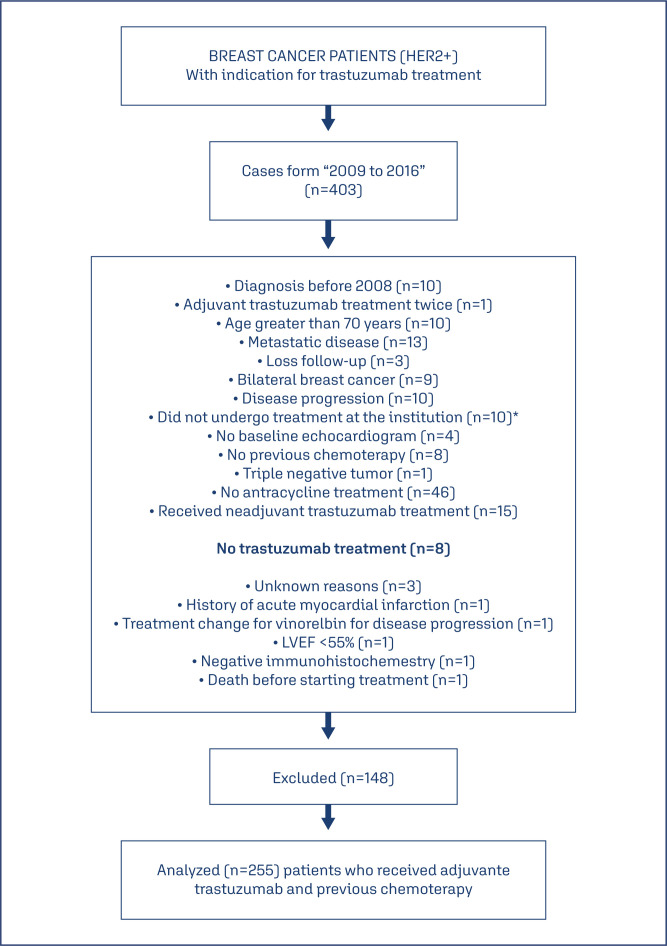
This was a retrospective cohort study that included 255 HER2-positive breast cancer patients who received adjuvant trastuzumab therapy. The inclusion criteria were a diagnosis of HER2-positive breast cancer and adjuvant trastuzumab therapy; disease stage I-III; <70 years; and a baseline echocardiogram showing a left ventricular ejection fraction (LVEF) ≥ 55%. The Kaplan-Meier method, the log-rank test, and the Cox proportional hazards model were used.
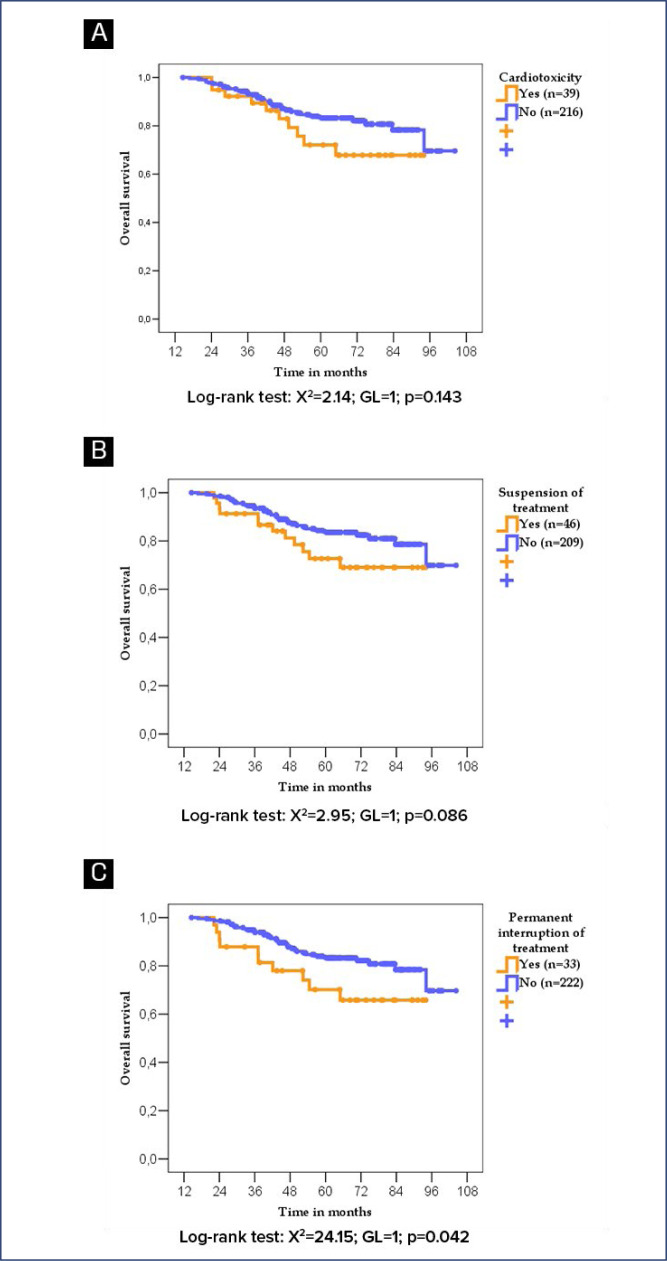
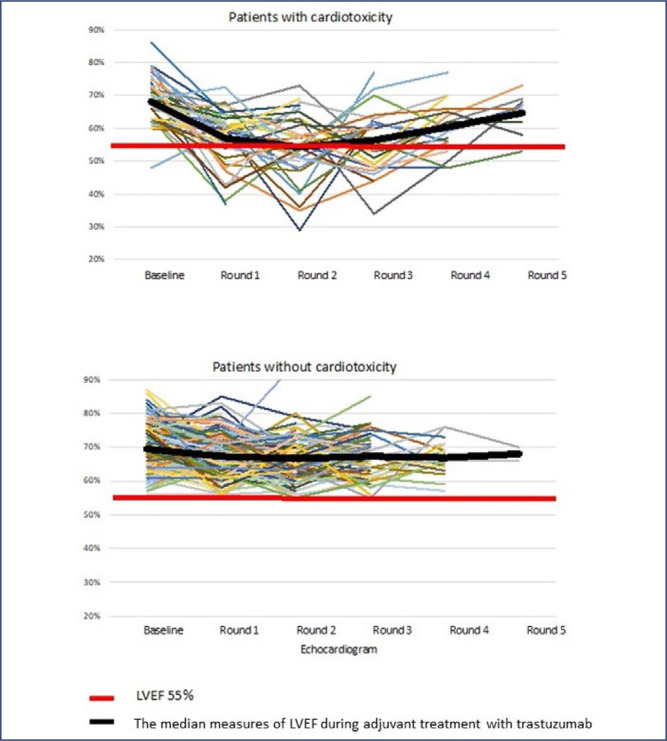
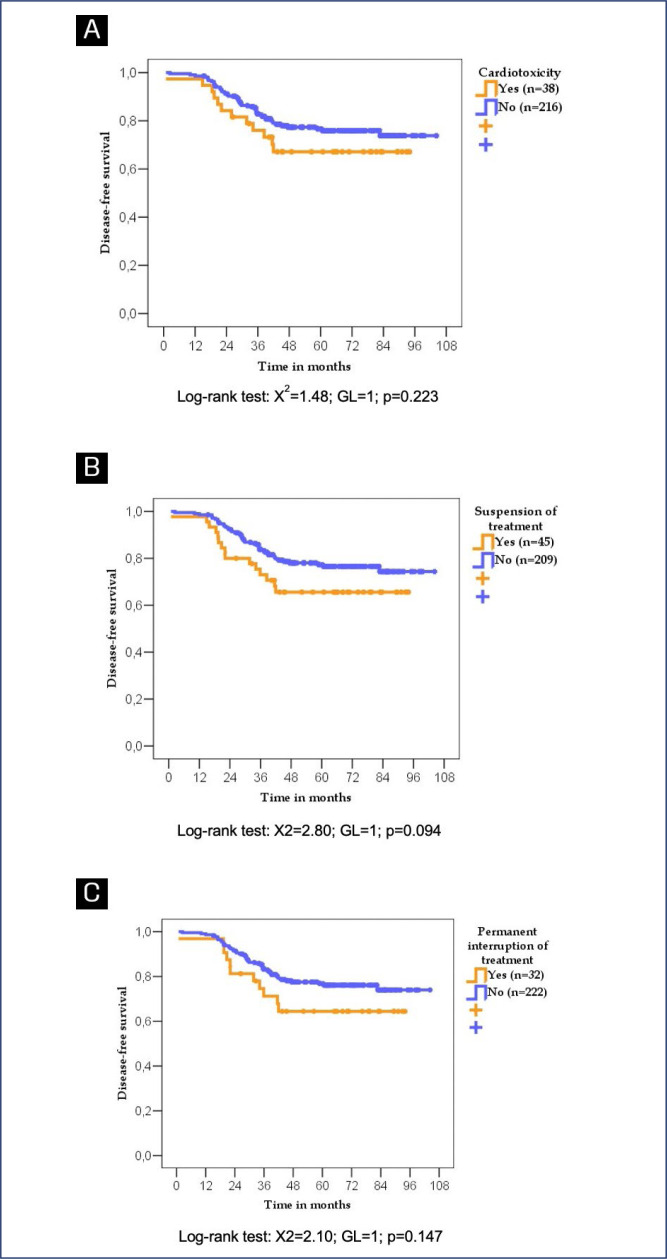
In all, 15.3% (39/255) of patients presented with cardiotoxicity. Treatment was suspended in 92.3% (36/39) of patients who presented with cardiotoxicity during trastuzumab treatment. The treatment was suspended in 46 of 255 patients and it was permanently interrupted in 84.8% (33/46) of these patients, with 84.8% (28/33) due to cardiotoxicity. Cardiotoxicity was not associated with disease-free survival (DFS) (hazard ratio (HR) = 1.48; 95% confidence interval (CI = 0.79-2.78) or overall survival (OS) (HR = 1.68; 95%CI= 0.83-3.41). Patients with clinical stage III and whom trastuzumab therapy was suspended (all causes) had worse DFS; (HR = 3.19; 95% CI=1.77-5.74) and (HR = 1.83; 95% CI=1.01-3.32) respectively. Those with clinical stage III and whom trastuzumab therapy was permanently interrupted had worse OS; (HR = 3.80; 95% CI =1.82-7.94), and (HR = 2,26; 95% CI =1.09-4.68 respectively.
Cardiotoxicity was not associated with DFS or OS. Clinical stage III, Suspension and permanent interruption of treatment regardless of the cause were associated with worse DFS and OS in breast cancer patients.
分析发生曲妥珠单抗所致心脏毒性的乳腺癌患者的预后,并分析与心脏毒性相关及由心脏毒性导致的因素。
这是一项回顾性队列研究,纳入了255例接受辅助曲妥珠单抗治疗的HER2阳性乳腺癌患者。纳入标准为HER2阳性乳腺癌诊断及辅助曲妥珠单抗治疗;疾病分期为I - III期;年龄<70岁;基线超声心动图显示左心室射血分数(LVEF)≥55%。采用Kaplan - Meier法、对数秩检验和Cox比例风险模型。
总共15.3%(39/255)的患者出现心脏毒性。在曲妥珠单抗治疗期间出现心脏毒性的患者中,92.3%(36/39)的患者治疗被暂停。255例患者中有46例治疗被暂停,其中84.8%(33/46)的患者治疗被永久中断,其中84.8%(28/33)是由于心脏毒性。心脏毒性与无病生存期(DFS)(风险比(HR)=1.48;95%置信区间(CI)=0.79 - 2.78)或总生存期(OS)(HR = 1.68;95%CI = 0.83 - 3.41)无关。临床分期为III期且曲妥珠单抗治疗被暂停(所有原因)的患者DFS较差;(HR = 3.19;95%CI = 1.77 - 5.74)和(HR = 1.83;95%CI = 1.01 - 3.32)。临床分期为III期且曲妥珠单抗治疗被永久中断的患者OS较差;(HR = 3.80;95%CI = 1.82 - 7.94),以及(HR = 2.26;95%CI = 1.09 - 4.68)。
心脏毒性与DFS或OS无关。临床分期为III期、无论何种原因导致的治疗暂停和永久中断与乳腺癌患者较差的DFS和OS相关。