Polazzo Francesco, Hermann Markus, Crettaz-Minaglia Melina, Rico Andreu
Department of Evolutionary Biology and Environmental Studies University of Zurich Zurich Switzerland.
Department of Aquatic Ecology Eawag, Swiss Federal Institute of Aquatic Science and Technology Dübendorf Switzerland.
Ecol Evol. 2024 Dec 11;14(12):e70539. doi: 10.1002/ece3.70539. eCollection 2024 Dec.
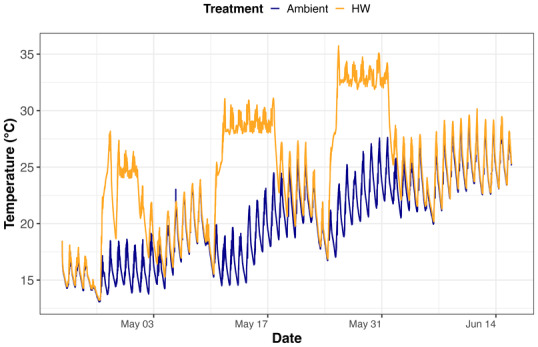
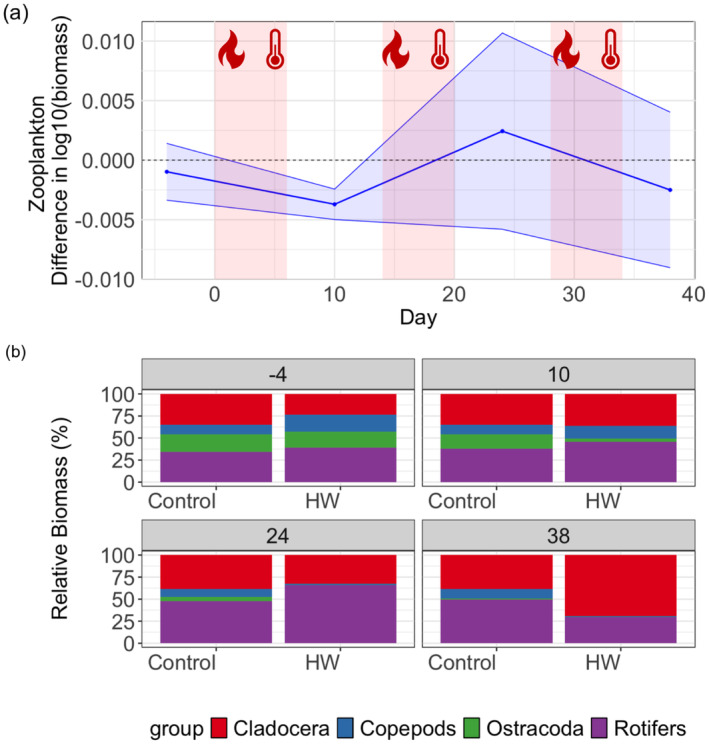
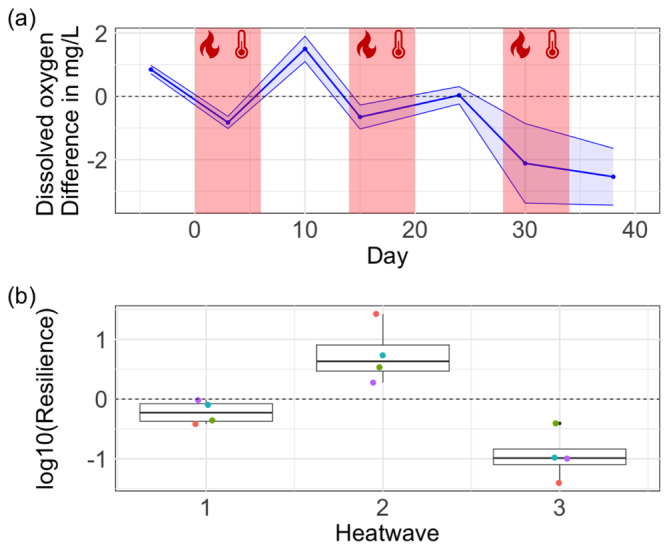
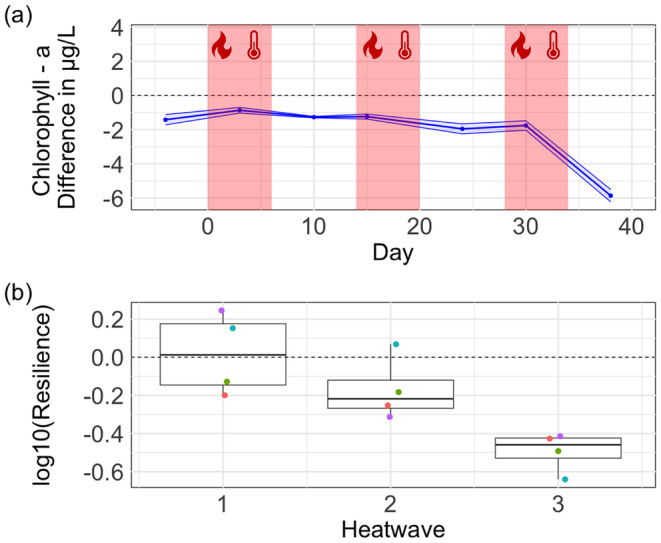
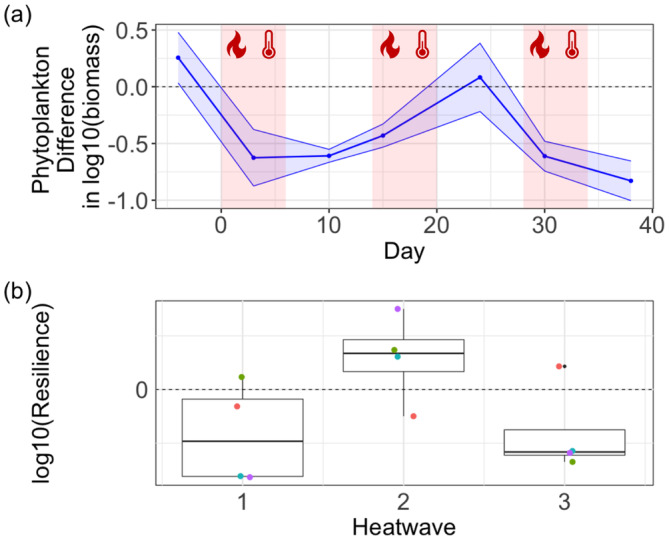
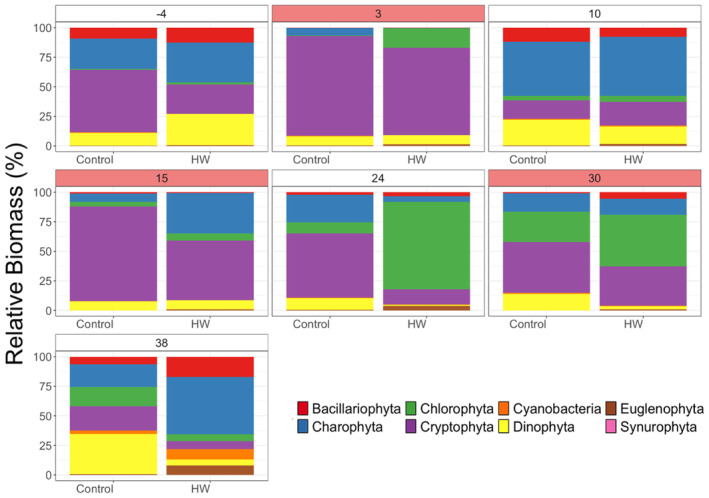
Heatwaves (HWs) are predicted to increase in frequency and severity due to climate change. Yet, there is limited information about how ecological resilience of aquatic communities is going to be impacted by recurrent HWs. Here, we used data from an outdoor freshwater mesocosm experiment where a semi-natural phytoplankton community was exposed to three subsequent HWs. The data were used to test two different hypotheses regarding community and ecosystem responses to recurrent perturbations: critical slowing down and rescue. Slowing down would determine a reduction in resilience and eventually a community or ecosystem collapse, whereas rescue would increase community or ecosystem resilience and maintain stable community and ecosystem properties. The results of our experiment showed evidence for critical slowing down, but not for community or ecosystem rescue. The recovery capacity of phytoplankton biomass and dissolved oxygen gradually decreased after the first two HWs and sharply declined after the third one. The decline in these community and ecosystem properties were linked to a significant compositional turnover in the phytoplankton community. Although we did not find evidence for a transition into an alternative stable state, our results provide insights into how the overall resilience of a phytoplankton community may decline in the presence of recurrent heatwaves. Thus, we highlight the importance of monitoring the slowing down of recovery of aquatic communities experiencing repeated exposure to severe perturbations.
由于气候变化,预计热浪(HWs)的频率和强度将会增加。然而,关于反复出现的热浪将如何影响水生群落的生态恢复力,相关信息有限。在此,我们使用了一项室外淡水中型生态系统实验的数据,在该实验中,一个半自然的浮游植物群落经历了三次连续的热浪。这些数据用于检验关于群落和生态系统对反复扰动的反应的两种不同假设:临界减速和救援。减速将导致恢复力下降,并最终导致群落或生态系统崩溃,而救援则会增加群落或生态系统的恢复力,并维持群落和生态系统属性的稳定。我们的实验结果显示了临界减速的证据,但没有显示群落或生态系统救援的证据。在前两次热浪之后,浮游植物生物量和溶解氧的恢复能力逐渐下降,在第三次热浪之后急剧下降。这些群落和生态系统属性的下降与浮游植物群落显著的组成转变有关。虽然我们没有找到向另一种稳定状态转变的证据,但我们的结果提供了关于在反复出现热浪的情况下浮游植物群落的整体恢复力可能如何下降的见解。因此,我们强调了监测反复遭受严重扰动的水生群落恢复放缓情况的重要性。