Malpartida-Carrillo Violeta, Tinedo-López Pedro Luis, Salas-Quispe Julio Enrique, Fry-Oropeza María Angélica, Amaya-Pajares Silvia, Özcan Mutlu
DDS, MSc. Professor, School of Stomatology, Universidad Privada San Juan Bautista, Lima, Perú.
DDS, MSc. Associate Professor of the Division of Oral Implantology, Department of Postgraduate in Stomatology, Universidad Científica del Sur, Lima, Perú.
J Clin Exp Dent. 2024 Nov 1;16(11):e1422-e1428. doi: 10.4317/jced.62119. eCollection 2024 Nov.
Ultraviolet C (UVC) light is a physical method proposed for disinfecting dental impression materials and preventing cross-infections in clinical practice. The investigations have focused on the UVC disinfection potential, but little is known about the consequences on dental materials' properties. This scoping review's objective is to evaluate information about the effect of UVC light on the dimensional stability of dental impression materials.
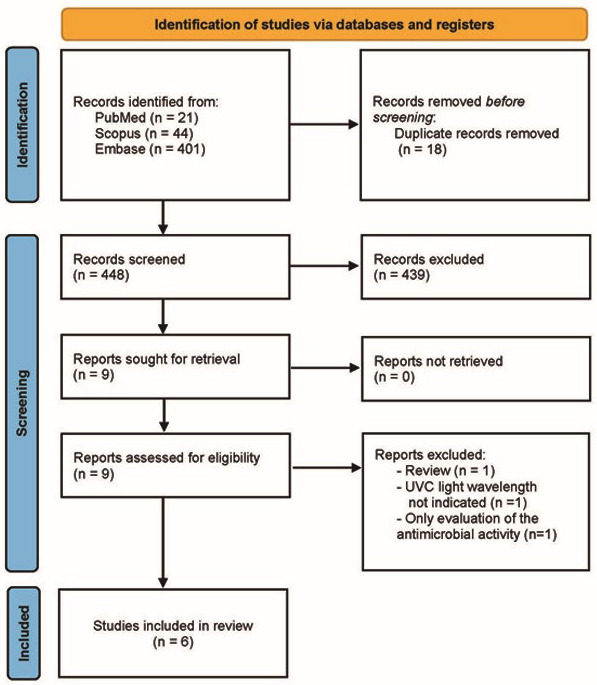
An electronic search of dental literature in the Medline (via PubMed), Scopus, and Embase databases were systematically searched until July 31 of 2024 following the PRISMA-ScR guidelines. The search strategy was carried out considering three groups of words with indexing terms and Boolean operators. Two reviewers selected the titles and analyzed the abstracts according to the inclusion and exclusion criteria.
A total of six articles were included through electronic database searches. Four studies evaluated the dimensional stability by measuring dental casts made from an impression and two studies measured distances on discs made from stainless steel dies. The studies reported the use of polyether, addition and condensation silicones, alginate, and zinc oxide eugenol in the protocols followed. Three of the six included studies compared the effect of UVC light against glutaraldehyde 2% and sodium hypochlorite (1% or 5.25%), one study compared the UVC light against quaternary ammonium salts, phenoxyethanol, alcohol, and ozone, meanwhile another study compared the effect of UVC light against peracetic acid 0.2%, natural polymer of glucosamine and ozonated water. Regarding measuring devices, only one study reported the use of a measuring software, the majority used traveling microscope.
Based on the findings, UVC light showed no significant dimensional changes in polyether, addition, and condensation silicones. Disinfection, dental impression materials, ultraviolet light.
紫外线C(UVC)光作为一种物理方法,被提议用于临床实践中对牙科印模材料进行消毒并预防交叉感染。以往研究主要聚焦于UVC的消毒潜力,但对于其对牙科材料性能的影响却知之甚少。本综述的目的是评估有关UVC光对牙科印模材料尺寸稳定性影响的信息。
按照PRISMA-ScR指南,对Medline(通过PubMed)、Scopus和Embase数据库中的牙科文献进行电子检索,检索截至2024年7月31日。搜索策略是通过索引词和布尔运算符考虑三组词汇来进行的。两名评审员根据纳入和排除标准筛选标题并分析摘要。
通过电子数据库搜索共纳入6篇文章。4项研究通过测量由印模制成的牙模来评估尺寸稳定性,2项研究测量了由不锈钢模具制成的圆盘上的距离。这些研究报告了在后续方案中使用聚醚、加成型和缩合型硅橡胶、藻酸盐和氧化锌丁香酚。6项纳入研究中有3项比较了UVC光与2%戊二醛和次氯酸钠(1%或5.25%)的效果,1项研究比较了UVC光与季铵盐、苯氧乙醇、酒精和臭氧的效果,同时另一项研究比较了UVC光与0.2%过氧乙酸、氨基葡萄糖天然聚合物和臭氧水的效果。关于测量设备,只有1项研究报告使用了测量软件,大多数研究使用了移动显微镜。
基于这些发现,UVC光在聚醚、加成型和缩合型硅橡胶中未显示出显著的尺寸变化。消毒、牙科印模材料、紫外线。