Zeng Yi, Huang Yu, Tan Qiaoyun, Peng Ling, Wang Jian, Tong Fan, Dong Xiaorong
Cancer Center, Union Hospital, Tongji Medical College, Huazhong University of Science and Technology, Wuhan, Hubei 430022, P.R. China.
Mol Med Rep. 2025 Feb;31(2). doi: 10.3892/mmr.2024.13413. Epub 2024 Dec 13.
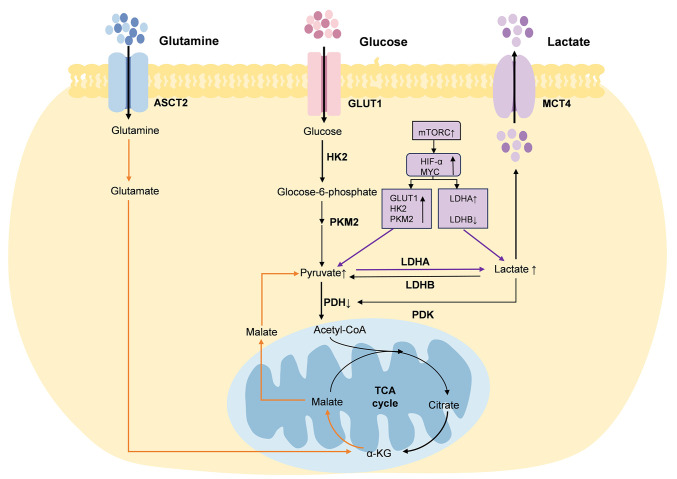
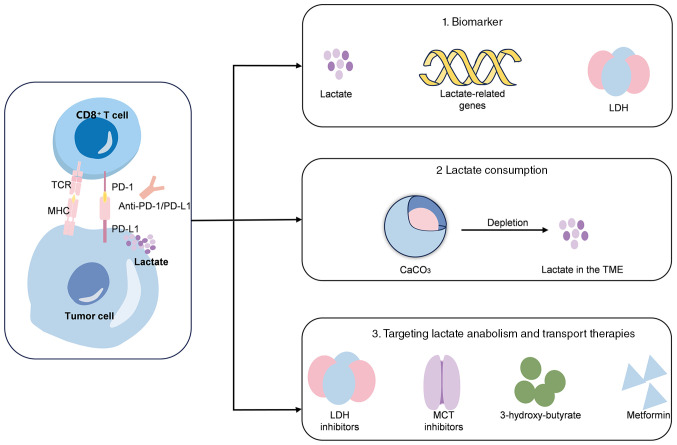
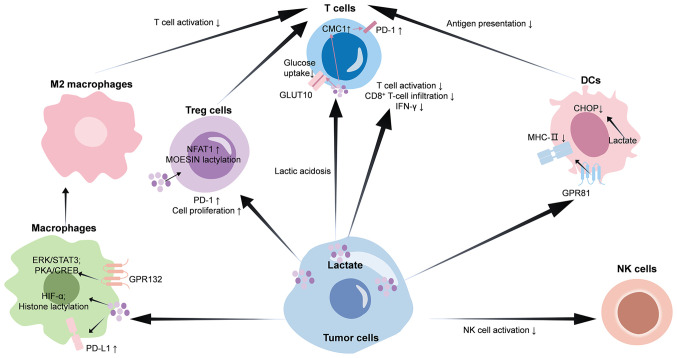
Metabolic reprogramming is a prominent characteristic of tumor cells, evidenced by heightened secretion of lactate, which is linked to tumor progression. Furthermore, the accumulation of lactate in the tumor microenvironment (TME) influences immune cell activity, including the activity of macrophages, dendritic cells and T cells, fostering an immunosuppressive milieu. Anti‑programmed cell death protein 1 (PD‑1)/programmed death‑ligand 1 (PD‑L1) therapy is associated with a prolonged survival time of patients with non‑small cell lung cancer. However, some patients still develop resistance to anti‑PD‑1/PD‑L1 therapy. Lactate is associated with resistance to anti‑PD‑1/PD‑L1 therapy. The present review summarizes what is known about lactate metabolism in tumor cells and how it affects immune cell function. In addition, the present review emphasizes the relationship between lactate secretion and immunotherapy resistance. The present review also explores the potential for targeting lactate within the TME to enhance the efficacy of immunotherapy.
代谢重编程是肿瘤细胞的一个显著特征,表现为乳酸分泌增加,这与肿瘤进展有关。此外,乳酸在肿瘤微环境(TME)中的积累会影响免疫细胞活性,包括巨噬细胞、树突状细胞和T细胞的活性,从而营造一个免疫抑制环境。抗程序性细胞死亡蛋白1(PD-1)/程序性死亡配体1(PD-L1)疗法可延长非小细胞肺癌患者的生存时间。然而,一些患者仍会对抗PD-1/PD-L1疗法产生耐药性。乳酸与抗PD-1/PD-L1疗法的耐药性有关。本综述总结了关于肿瘤细胞中乳酸代谢及其如何影响免疫细胞功能的已知信息。此外,本综述强调了乳酸分泌与免疫治疗耐药性之间的关系。本综述还探讨了靶向TME内乳酸以提高免疫治疗疗效的潜力。