Wili Patrik, Rauber Cedric, Saade Amal, Bliggenstorfer Salomé, Ramirez-Garmendia Valentina, Schweizer Ramon, Irastorza-Landa Ainara, Chappuis Vivianne, Zysset Philippe
ARTORG Centre for Biomedical Engineering Research, University of Bern, Bern, Switzerland.
Nobel Biocare Services AG, Kloten, Switzerland.
Clin Oral Implants Res. 2025 Mar;36(3):339-352. doi: 10.1111/clr.14386. Epub 2024 Dec 13.
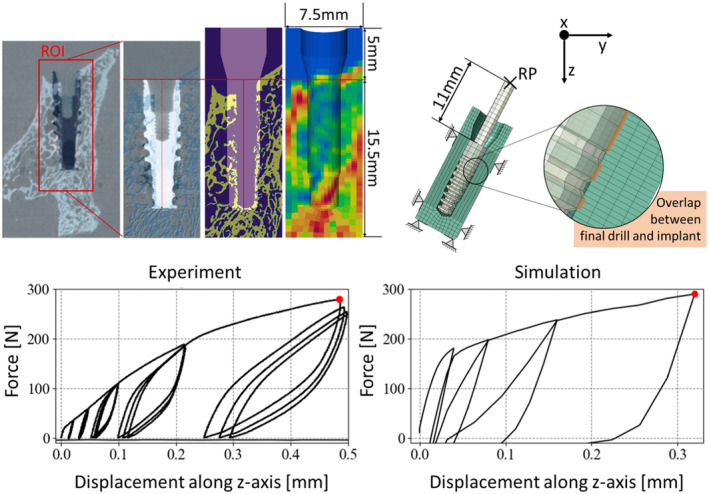
Primary stability (PS) is a key factor for promoting osseointegration and long-term success of dental implants particularly for immediate loading protocols. Beyond the current assessments of PS, an accurate pre-operative evaluation of PS would contribute to the improvement of surgical planning and treatment outcome. This study used biomechanical testing and homogenized finite element (hFE) analysis to objectively measure PS in the laboratory, and digitally estimate PS from prior μCT reconstructions.
Thirty-five bone samples extracted from the jaws of two donors were examined. Twenty-two were finally evaluated for PS. After scanning of the samples with μCT, implants were inserted by two experienced surgeons, and various metrics such as μCT-based bone volume fraction (BV/TV), insertion torque (IT), and resonance frequency analysis (RFA) were assessed to determine PS. Mechanical tests were conducted to measure ultimate force (UFexp) as an objective indicator of PS while the hFE simulations were performed to estimate this same ultimate force (UFsim).
Higher correlation was found between UFsim and UFexp (R = 0.85) than between BV/TV and UFexp (R = 0.61), IT and UFexp (R = 0.50), and RFA and UFexp (R = 0.38). All variables demonstrated a statistically significant linear correlation with UFexp (p < 0.01).
UFsim turns out to be a more reliable and objective indicator of PS than IT and RFA. The hFE analysis requires prior μCT reconstructions and is currently limited by numerical convergence problems. Despite these limitations, pre-operative hFE analysis emerges as a promising tool with a higher accuracy for estimation of PS than state of care techniques.
初期稳定性(PS)是促进牙种植体骨结合及长期成功的关键因素,对于即刻加载方案尤为重要。除了目前对PS的评估外,准确的术前PS评估将有助于改善手术规划和治疗效果。本研究采用生物力学测试和均质有限元(hFE)分析在实验室客观测量PS,并从先前的μCT重建数据中数字估计PS。
检查了从两名捐赠者颌骨中提取的35个骨样本。最终对22个样本进行了PS评估。在用μCT扫描样本后,由两名经验丰富的外科医生植入种植体,并评估各种指标,如基于μCT的骨体积分数(BV/TV)、植入扭矩(IT)和共振频率分析(RFA),以确定PS。进行力学测试以测量极限力(UFexp)作为PS的客观指标,同时进行hFE模拟以估计相同的极限力(UFsim)。
发现UFsim与UFexp之间的相关性(R = 0.85)高于BV/TV与UFexp之间的相关性(R = 0.61)、IT与UFexp之间的相关性(R = 0.50)以及RFA与UFexp之间的相关性(R = 0.38)。所有变量与UFexp均呈现出具有统计学意义的线性相关性(p < 0.01)。
事实证明,与IT和RFA相比,UFsim是PS更可靠、更客观的指标。hFE分析需要先前的μCT重建数据,目前受数值收敛问题限制。尽管存在这些局限性,但术前hFE分析仍是一种有前景的工具,在估计PS方面比现有技术具有更高的准确性。