Grohmann Teresa, Vivekanantham Arani, Coates Laura C, Pennington Stephen, FitzGerald Oliver
School of Medicine, Conway Institute, University College Dublin, Dublin, Ireland.
Nuffield Department of Orthopaedics, Rheumatology and Musculoskeletal Sciences, University of Oxford, Oxford, UK.
RMD Open. 2024 Dec 12;10(4):e004176. doi: 10.1136/rmdopen-2024-004176.
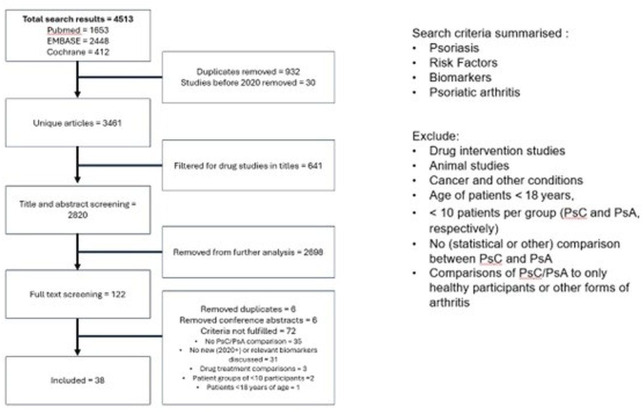
It is known that 25%-30% of individuals with cutaneous psoriasis (PsC) will develop psoriatic arthritis (PsA). To date, the reasons for the development of PsA in individuals with PsC have not been identified. Furthermore, there are considerable delays in the diagnosis and treatment of PsA, which lead to joint and bone deformation and chronic pain. It is therefore important to develop more precise diagnostic and screening tools. In this narrative review of the literature, clinical risk factors and novel molecular biomarkers (genetic markers, blood and inflammatory markers, lipid, metabolite and protein biomarkers) have been evaluated. The review included 38 publications that were reported between May 2020 and May 2024. Similar to previous reviews, nail involvement was one of the strongest clinical risk factors for the development of PsA, while molecular biomarkers did not provide a clear and robust differentiation between PsC and PsA groups. The seemingly poor performance of molecular markers may be largely attributed to small study populations and heterogeneity in study designs. Data and sample sharing in large consortia such as HIPPOCRATES (Health initiatives in Psoriasis and PsOriatic arthritis ConsoRTium European States) could help to overcome the limitations of small studies and enable the development of more robust diagnostic and screening tools for PsA.
已知25%-30%的皮肤型银屑病(PsC)患者会发展为银屑病关节炎(PsA)。迄今为止,PsC患者发生PsA的原因尚未明确。此外,PsA的诊断和治疗存在相当大的延迟,这会导致关节和骨骼变形以及慢性疼痛。因此,开发更精确的诊断和筛查工具很重要。在这篇文献综述中,对临床风险因素和新型分子生物标志物(基因标志物、血液和炎症标志物、脂质、代谢物和蛋白质生物标志物)进行了评估。该综述纳入了2020年5月至2024年5月期间报道的38篇出版物。与之前的综述相似,指甲受累是发生PsA最强的临床风险因素之一,而分子生物标志物并未在PsC组和PsA组之间提供清晰且有力的区分。分子标志物表现不佳似乎很大程度上归因于研究人群规模小以及研究设计的异质性。像希波克拉底(银屑病和银屑病关节炎欧洲国家联合研究健康倡议)这样的大型联盟中的数据和样本共享,可能有助于克服小型研究的局限性,并推动开发更强大的PsA诊断和筛查工具。