Claus Maren, Freitag Merle, Ewald Meike, Rodon Lea, Deicher Franca, Watzl Carsten, Kolb Philipp, Lorenz Hanns-Martin, Schmitt Michael, Merkt Wolfgang
Leibniz Research Center for Working Environment and Human Factors at TU Dortmund (IfADo), Ardeystrasse 67, 44139, Dortmund, Germany.
Department of Hematology, Oncology and Rheumatology, Internal Medicine V, University Hospital Heidelberg, Im Neuenheimer Feld 410, 69120, Heidelberg, Germany.
Arthritis Res Ther. 2024 Dec 13;26(1):211. doi: 10.1186/s13075-024-03451-1.
The high potential of CD19.CAR-T cells to treat autoimmune diseases such as Systemic Sclerosis (SSc) supposedly relies on the disappearance of autoantibodies. Here we investigated effects of CAR-T cells on the innate immune system which is an important contributor to pathology in SSc.
Longitudinal analysis of peripheral blood mononuclear cells from an Scl70 + SSc patient treated with CAR-T cells sampled over 18 months by 29-color spectral flow cytometry, in vitro experiments using sera from patient cohorts.
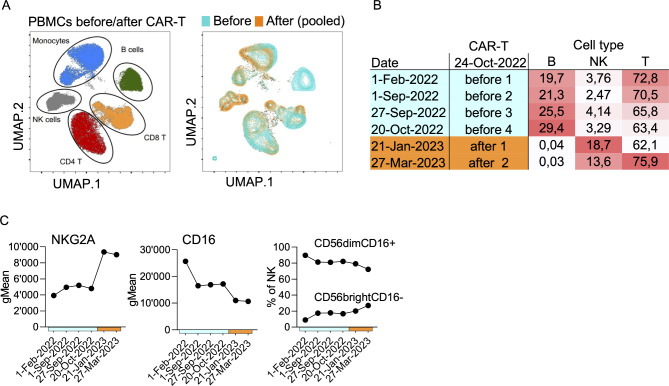
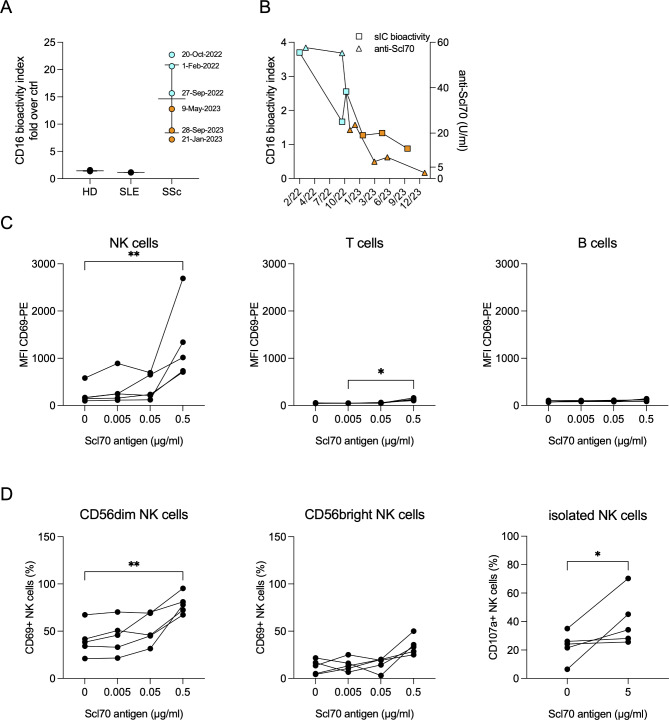
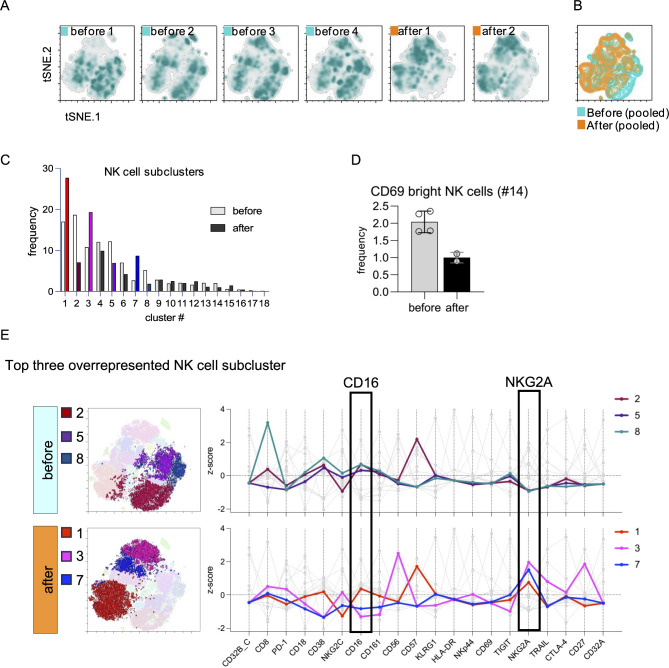
In the patient treated with CAR-T cells, the substantial clinical improvement was paralleled by dynamic changes in innate lymphoid cells, namely Fcγ-receptor IIIA-expressing natural killer (NK) cells. NK cells adopted a more juvenile, less activated, and less differentiated phenotype. In parallel, the potency of serum to form Scl70-containing immune complexes that activate Fcγ-receptor IIIA decreased over time. These observations suggested a mechanistic link between reversal of adaptive autoimmunity and recovering Fcγ-receptor IIIA-expressing innate immune cells after CAR-T cell therapy via regressing immune complex activity. Experiments with sera from the non-CAR-T-treated SSc cohort confirmed that Scl70-containing immune complexes activate Fcγ-receptor IIIA-expressing NK cells in a dose-dependent manner, substantiating the relevance of this link between adaptive and innate immunity in SSc.
This report describes for the first time the phenotypic recovery of innate Fcγ-receptor-expressing cells in an SSc patient treated with CAR-T cells. Decreasing autoantibody levels associated with a reduced ability to form functional immune complexes, the latter appearing to contribute to pathology in SSc via activation of Fcγ receptor IIIA + cells such as NK cells.
CD19嵌合抗原受体T细胞(CAR-T细胞)治疗系统性硬化症(SSc)等自身免疫性疾病的巨大潜力据推测依赖于自身抗体的消失。在此,我们研究了CAR-T细胞对先天性免疫系统的影响,而先天性免疫系统是SSc病理过程的一个重要促成因素。
通过29色光谱流式细胞术对一名接受CAR-T细胞治疗的Scl70+SSc患者在18个月内采集的外周血单个核细胞进行纵向分析,并使用患者队列的血清进行体外实验。
在接受CAR-T细胞治疗的患者中,显著的临床改善与先天性淋巴细胞的动态变化同时出现,即表达Fcγ受体IIIA的自然杀伤(NK)细胞。NK细胞呈现出更幼稚、活化程度更低和分化程度更低的表型。同时,血清形成激活Fcγ受体IIIA的含Scl70免疫复合物的能力随时间下降。这些观察结果表明,通过降低免疫复合物活性,CAR-T细胞治疗后适应性自身免疫的逆转与表达Fcγ受体IIIA的先天性免疫细胞的恢复之间存在机制联系。来自未接受CAR-T治疗的SSc队列患者血清的实验证实,含Scl70免疫复合物以剂量依赖方式激活表达Fcγ受体IIIA的NK细胞,证实了SSc中适应性免疫与先天性免疫之间这种联系的相关性。
本报告首次描述了一名接受CAR-T细胞治疗的SSc患者中表达先天性Fcγ受体细胞的表型恢复情况。自身抗体水平降低与形成功能性免疫复合物的能力降低相关,后者似乎通过激活Fcγ受体IIIA+细胞(如NK细胞)而导致SSc的病理改变。