Ke Jin, Yan Yuehua
Department of Dermatology, Shanghai Pudong Hospital, Fudan University Pudong Medical Center, No. 2800 Gongwei Road, Pudong New District, Shanghai, 201399, People's Republic of China.
Arch Dermatol Res. 2024 Dec 14;317(1):124. doi: 10.1007/s00403-024-03599-5.
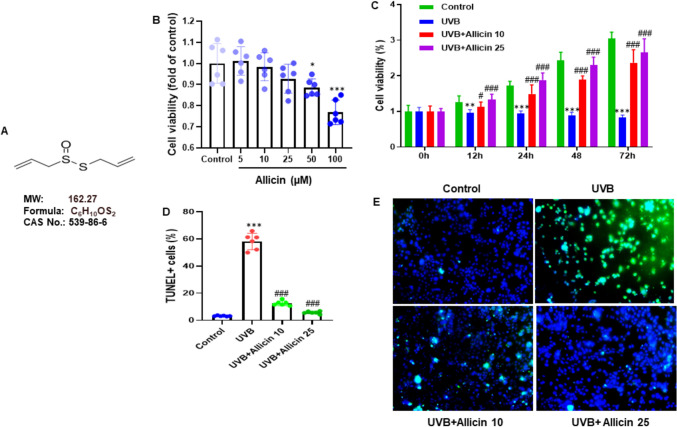
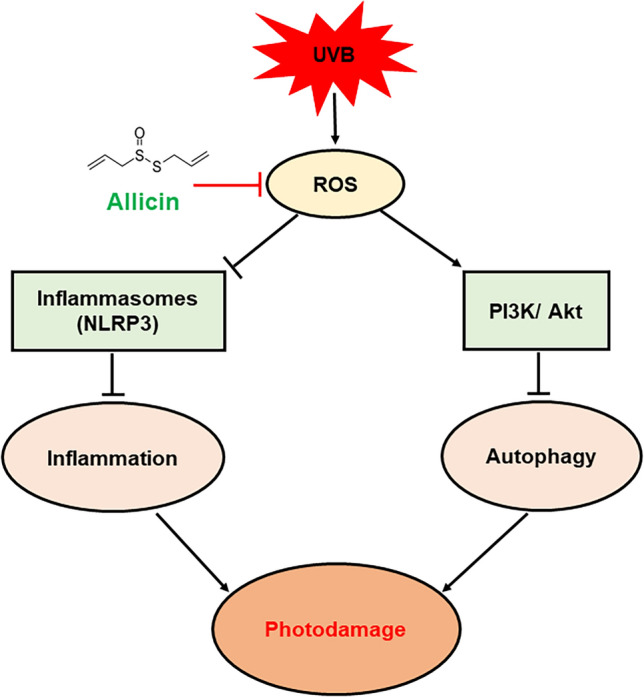
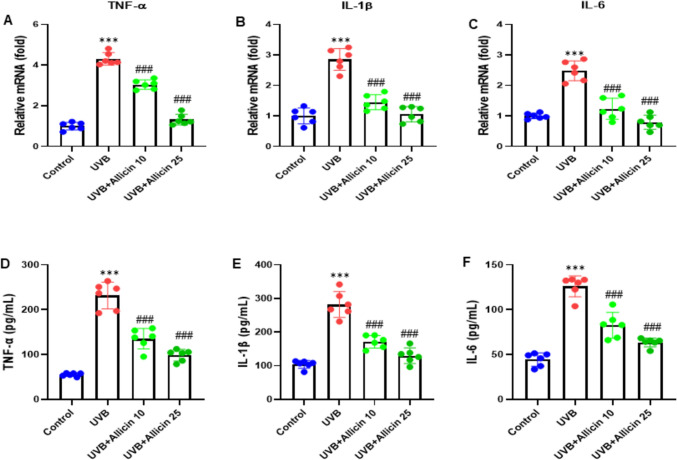
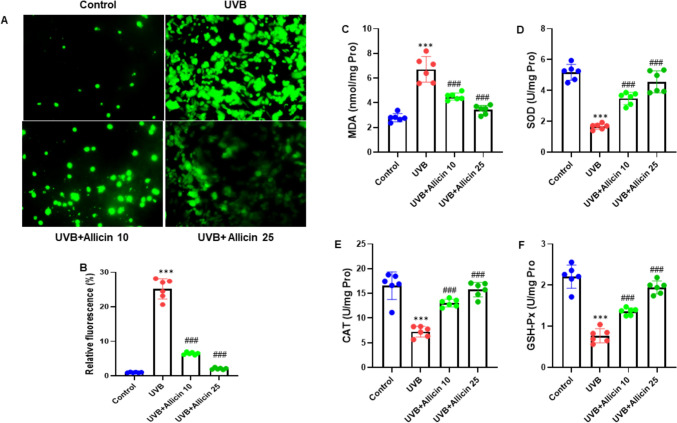
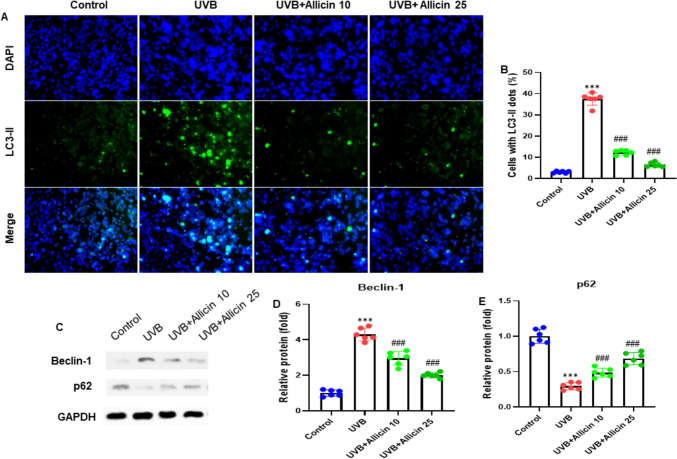
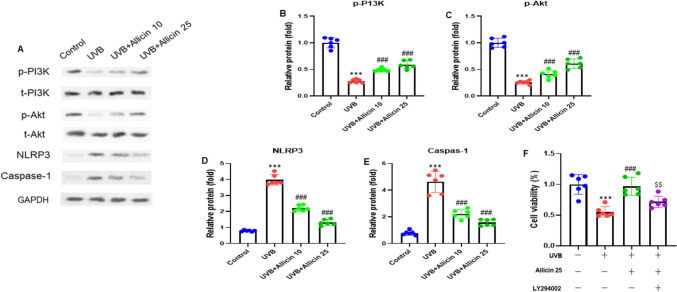
Allicin is a sulfide extracted from garlic bulbs responsible for various physiological and pathophysiological effects, including antioxidant, antibacterial, and anti-parasite activities. However, its efficacy and mechanism of protecting UVB-induced photodamage have not been studied. The research explores Allicin's protective roles and underlying mechanisms in UVB-induced photodamage of keratinocytes. UVB was employed to generate photodamage in the HaCaT cell line. DCFH-DA fluorescent and Biochemical analyses were carried out to evaluate reactive oxygen species (ROS) and oxidative stress on UVB-induced photodamage to HaCaT cells. RT-qPCR and western blot were performed to measure mRNA and protein expression. Allicin pretreatment (10 and 25 µM) improved cell proliferation and reduced apoptotic rates in UVB-induced HaCaT cells. Allicin (10 and 25 µM) inhibited tumor necrosis factor-alpha (TNF-α), interleukin-6 (IL-6), and interleukin-1 beta (IL-1β) expressions (all, P < 0.001). Allicin reduced the intracellular ROS level and attenuated oxidative stress, with reduced malondialdehyde (MDA) level while increasing the levels of superoxide dismutase (SOD), catalase (CAT), and glutathione peroxidase (GSh-Px) (all, P < 0.001) in UVB-induced HaCaT cells. Allicin pretreatment inhibited autophagy and reduced the protein expression of Beclin-1 while increasing the p62 protein expression (all, P < 0.001). We also observed that Allicin pretreatment reduced the NLRP3-related protein, such as Caspase-1 (P < 0.001) and increased the protein expressions of the PI3K/Akt pathway molecules, such as PI3K and Akt (all, P < 0.001). Our research data demonstrated that Allicin might inhibit UVB-induced photodamage of keratinocytes via inhibiting NLRP3 inflammasomes and activating the PI3K/Akt pathway.
大蒜素是一种从大蒜鳞茎中提取的硫化物,具有多种生理和病理生理作用,包括抗氧化、抗菌和抗寄生虫活性。然而,其对紫外线B(UVB)诱导的光损伤的保护作用及其机制尚未得到研究。本研究探讨大蒜素在UVB诱导的角质形成细胞光损伤中的保护作用及其潜在机制。采用UVB对HaCaT细胞系造成光损伤。进行2',7'-二氯二氢荧光素二乙酸酯(DCFH-DA)荧光分析和生化分析,以评估活性氧(ROS)和氧化应激对UVB诱导的HaCaT细胞光损伤的影响。采用逆转录定量聚合酶链反应(RT-qPCR)和蛋白质免疫印迹法检测mRNA和蛋白质表达。大蒜素预处理(10和25μM)可改善UVB诱导的HaCaT细胞的增殖并降低凋亡率。大蒜素(10和25μM)抑制肿瘤坏死因子-α(TNF-α)、白细胞介素-6(IL-6)和白细胞介素-1β(IL-1β)的表达(均为P<0.001)。大蒜素降低了细胞内ROS水平,减轻了氧化应激,在UVB诱导的HaCaT细胞中,丙二醛(MDA)水平降低,而超氧化物歧化酶(SOD)、过氧化氢酶(CAT)和谷胱甘肽过氧化物酶(GSh-Px)水平升高(均为P<0.001)。大蒜素预处理抑制自噬,降低Beclin-1蛋白表达,同时增加p62蛋白表达(均为P<0.001)。我们还观察到,大蒜素预处理降低了NLRP3相关蛋白,如半胱天冬酶-1(Caspase-1)(P<0.001),并增加了PI3K/Akt通路分子,如PI3K和Akt的蛋白表达(均为P<0.001)。我们的研究数据表明,大蒜素可能通过抑制NLRP3炎性小体和激活PI3K/Akt通路来抑制UVB诱导的角质形成细胞光损伤。