Tarnutzer Alexander A, Garces Pilar, Antoniades Chrystalina A
Cantonal Hospital of Baden, Baden, Switzerland.
Faculty of Medicine, University of Zurich, Zurich, Switzerland.
Cerebellum. 2024 Dec 15;24(1):12. doi: 10.1007/s12311-024-01774-y.
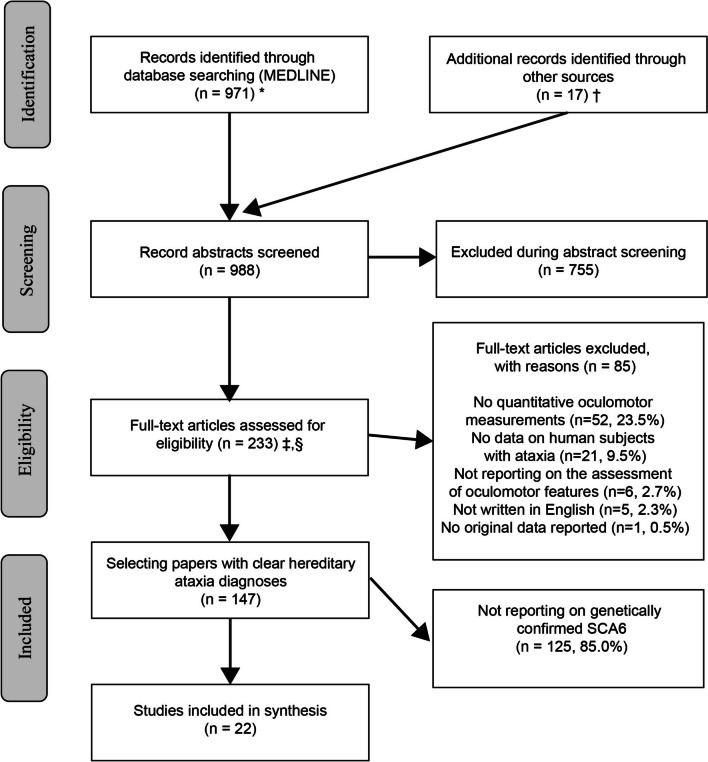
Whereas several studies have reported on quantitative oculomotor and vestibular measurements in spinocerebellar ataxia type 6 (SCA6), selecting the most suitable paradigms remains challenging. We aimed to address this knowledge gap through a systematic literature review and providing disease-specific recommendations for a tailored set of eye-movement recordings in SCA6. A literature search (MEDLINE, Embase) was performed focusing on studies reporting on quantitative oculomotor and/or vestibular measurements in SCA6-patients. Oculomotor and vestibular parameters were extracted and correlations with various epidemiologic and clinical parameters were sought. Twenty-two studies were included reporting on 154 patients. Abnormalities observed included reduced pursuit gain (58/69), frequent square-wave jerks (23/40), spontaneous downbeat nystagmus (DBN, 34/55) and triggered nystagmus including positional nystagmus (25/34) and vertical ("perverted") head-shaking nystagmus (21/34), gaze-evoked nystagmus (48/70) and angular vestibulo-ocular reflex (aVOR)-suppression (21/25), and high-frequency aVOR-deficits (26/33). For horizontal visually-guided saccades (VGS), changes in metrics (36/66) were frequently observed, whereas saccade velocity was usually preserved (39/44) and saccade latency within normal limits. Reduced high-frequency aVOR gains, VGS-latency and metrics correlated with disease severity. Longitudinal data indicated deterioration of individual video-head-impulse testing gains over time. A broad range of oculomotor and vestibular domains are affected in SCA6. Impairments in pursuit, saccade metrics, gaze-holding (gaze-evoked nystagmus, DBN) and high-frequency aVOR were most frequently identified and as such, should be prioritized as disease markers. Quantitative oculomotor testing in SCA6 may facilitate an early diagnosis and prove valuable in monitoring disease progression.
尽管已有多项研究报道了6型脊髓小脑共济失调(SCA6)患者的定量眼动和前庭测量结果,但选择最合适的检测范式仍然具有挑战性。我们旨在通过系统的文献综述来填补这一知识空白,并为SCA6患者量身定制一套眼动记录提供针对该疾病的建议。我们进行了文献检索(MEDLINE、Embase),重点关注报告SCA6患者定量眼动和/或前庭测量结果的研究。提取了眼动和前庭参数,并寻找其与各种流行病学和临床参数的相关性。纳入了22项研究,共涉及154例患者。观察到的异常包括追踪增益降低(58/69)、频繁的方波急跳(23/40)、自发性下跳性眼震(DBN,34/55)以及诱发性眼震,包括位置性眼震(25/34)和垂直(“异常”)摇头性眼震(21/34)、凝视性眼震(48/70)和角前庭眼反射(aVOR)抑制(21/25),以及高频aVOR缺陷(26/33)。对于水平视觉引导性扫视(VGS),经常观察到指标变化(36/66),而扫视速度通常得以保留(39/44)且扫视潜伏期在正常范围内。高频aVOR增益降低、VGS潜伏期和指标与疾病严重程度相关。纵向数据表明,随着时间推移,个体视频头脉冲测试增益会恶化。SCA6患者的广泛眼动和前庭领域均受到影响。追踪、扫视指标、凝视维持(凝视性眼震、DBN)和高频aVOR方面的损害最为常见,因此应优先将其作为疾病标志物。SCA6患者的定量眼动测试可能有助于早期诊断,并在监测疾病进展方面具有重要价值。