Department of Neurology, University Hospital Heidelberg, Heidelberg, Germany.
German Center for Neurodegenerative Diseases (DZNE), Bonn, Germany.
Ann Clin Transl Neurol. 2023 Oct;10(10):1833-1843. doi: 10.1002/acn3.51875. Epub 2023 Aug 17.
Our aim was to study the evolution of ataxia and neurological symptoms before and after ataxia onset in the most common spinocerebellar ataxias (SCAs), SCA1, SCA2, SCA3 and SCA6. We therefore jointly analysed the data of the EUROSCA and RISCA studies, which recruited ataxic and non-ataxic mutation carriers.
We used mixed effect models to analyse the evolution of Scale for the Rating and Assessment of Ataxia (SARA) scores, SCA Functional Index (SCAFI) and Inventory of Non-Ataxia Signs (INAS) counts. We applied multivariable modelling to identify factors associated with SARA progression. In the time interval 5 years prior to and after ataxia onset, we calculated sensitivity to change ratios (SCS) of SARA, SCAFI and INAS.
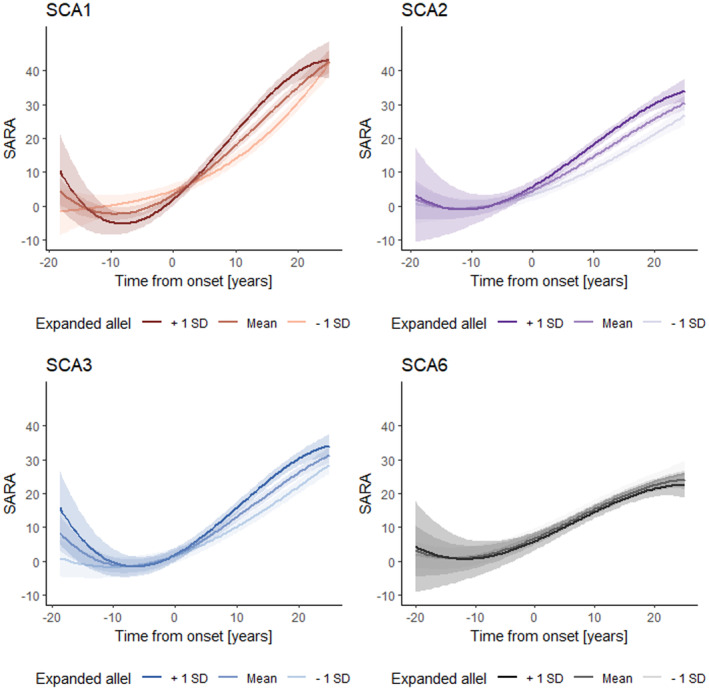
2740 visits of 677 participants were analysed. All measures showed non-linear progression that was best fitted by linear mixed models with linear, quadratic and cubic time effects. R values indicating quality of the fit ranged from 0.70 to 0.97. CAG repeat was associated with faster progression in SCA1, SCA2 and SCA3, but not SCA6. 5 years prior to and after ataxia onset, SARA had the highest SCS of all measures with a mean of 1.21 (95% CI: 1.20, 1.21) in SCA1, 0.94 (0.93, 0.94) in SCA2 and 1.23 (1.22, 1.23) in SCA3.
Our data have important implications for the understanding of disease progression in SCA1, SCA2, SCA3 and SCA6 across the lifespan. Furthermore, our study provides information for the design of interventional trials, especially in pre-ataxic mutation carriers close to ataxia onset and patients in early disease stages.
我们旨在研究最常见的脊髓小脑共济失调(SCA),即 SCA1、SCA2、SCA3 和 SCA6 中,共济失调发病前后的共济失调和神经症状演变。因此,我们联合分析了 EUROSCA 和 RISCA 研究的数据,该研究招募了共济失调和非共济失调突变携带者。
我们使用混合效应模型分析了共济失调评定量表(SARA)评分、SCA 功能指数(SCAFI)和非共济失调体征量表(INAS)计数的演变。我们应用多变量模型来确定与 SARA 进展相关的因素。在共济失调发病前 5 年和发病后 5 年内,我们计算了 SARA、SCAFI 和 INAS 的变化敏感比(SCS)。
共分析了 677 名参与者的 2740 次就诊。所有指标均显示出非线性进展,线性、二次和三次时间效应的线性混合模型拟合效果最佳。R 值表示拟合质量,范围从 0.70 到 0.97。CAG 重复与 SCA1、SCA2 和 SCA3 的进展速度更快相关,但与 SCA6 无关。在共济失调发病前 5 年和发病后 5 年内,SARA 的所有指标的 SCS 最高,SCA1 为 1.21(95%CI:1.20,1.21),SCA2 为 0.94(0.93,0.94),SCA3 为 1.23(1.22,1.23)。
我们的数据对于理解 SCA1、SCA2、SCA3 和 SCA6 在整个生命周期中的疾病进展具有重要意义。此外,我们的研究为干预试验的设计提供了信息,特别是在接近共济失调发病的前共济失调突变携带者和早期疾病阶段的患者中。