Miura Hikari, Yamamoto Hayato, Okuyama Yoshiharu, Ishi Noritaka, Tanaka Ryuma, Oishi Takuya, Yoneyama Fumiya, Hamaya Tomoko, Togashi Kyo, Fujita Naoki, Okamoto Teppei, Ohyama Chikara, Hatakeyama Shingo
Department of Urology, Hirosaki University School of Medicine, Hirosaki, Japan.
Department of Advanced Transplant and Regenerative Medicine, Hirosaki University School of Medicine, Hirosaki, Japan.
Cancer Med. 2024 Dec;13(24):e70226. doi: 10.1002/cam4.70226.
We aimed to examine trends in novel antiandrogen receptor signal inhibitor (ARSI) usage and medical costs by collecting real-world big data included in The National Database of Health Insurance Claims and Specific Health Checkups of Japan (NDB) Open Data, covering most of the clinical practices throughout Japan.
Usage data for outpatient prescriptions from 2016 to 2021 were extracted from the NDB Open Data. Among the 459,610 million tablets/capsules prescribed, prostate cancer-specific agents (bicalutamide, estramustine phosphate, flutamide, abiraterone, enzalutamide, apalutamide, and darolutamide) were selected to investigate the trends of usage and medical costs.
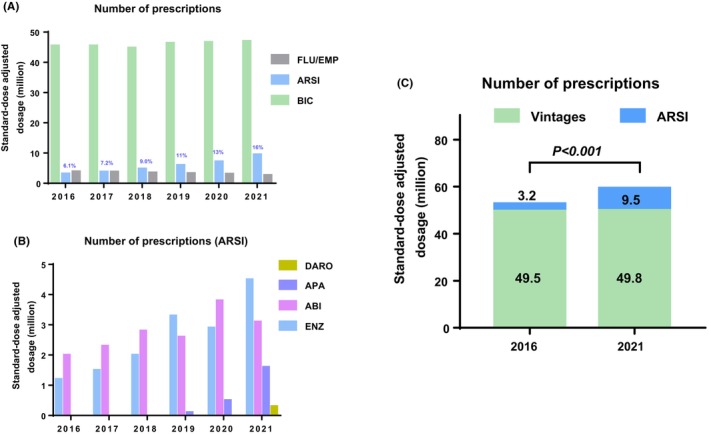
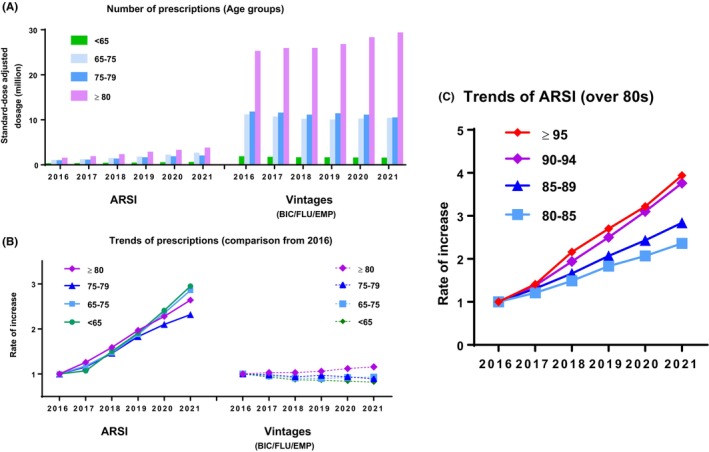
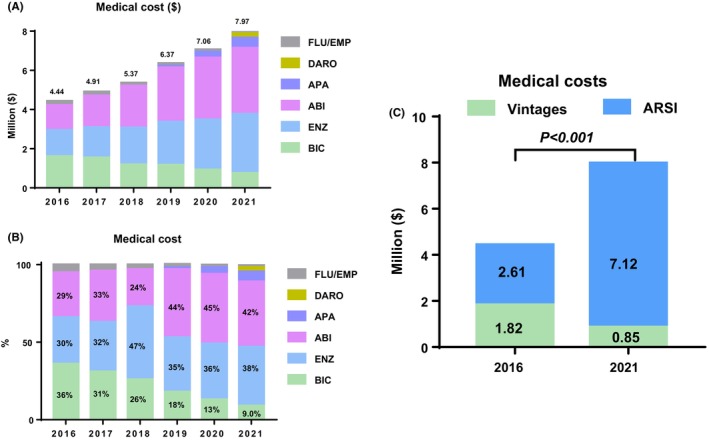
In total, 764.8 billion medications were recorded. Among these, standard dose-adjusted prescriptions for bicalutamide, abiraterone, enzalutamide, apalutamide, darolutamide, and other vintages (estramustine phosphate, flutamide) was 276, 14.2, 18.1, 2.19, 0.34, and 20.3 million, respectively. The usage of ARSI increased significantly from 6.1% in 2016 to 16% in 2021. The medical costs for prostate cancer-specific agents increased significantly (1.8-fold) from 2016 to 2021. Despite the limited usage of ARSIs, a majority of the medical costs had been spent on ARSIs. Medical costs associated with ARSIs increased significantly from 59% to 89% (p < 0.001).
ARSI usage and medical costs associated with prostate cancer increased significantly from 2016 to 2021. Despite the limited use of ARSIs, a considerable proportion of the medical costs for prostate cancer-specific agents had been spent on ARSIs.
我们旨在通过收集日本全国健康保险理赔和特定健康检查数据库(NDB)开放数据中的真实世界大数据,来研究新型抗雄激素受体信号抑制剂(ARSI)的使用趋势和医疗费用,该数据涵盖了日本大部分临床实践。
从NDB开放数据中提取2016年至2021年门诊处方的使用数据。在开出的45.961亿片/粒药物中,选择前列腺癌特异性药物(比卡鲁胺、磷酸雌莫司汀、氟他胺、阿比特龙、恩杂鲁胺、阿帕他胺和达罗他胺)来研究使用趋势和医疗费用。
总共记录了7648亿剂药物。其中,比卡鲁胺、阿比特龙、恩杂鲁胺、阿帕他胺、达罗他胺以及其他年份药物(磷酸雌莫司汀、氟他胺)的标准剂量调整处方分别为2.76亿、1420万、1810万、219万、34万和2030万。ARSI的使用从2016年的6.1%显著增加到2021年的16%。前列腺癌特异性药物的医疗费用从2016年到2021年显著增加(1.8倍)。尽管ARSI的使用有限,但大部分医疗费用都花在了ARSI上。与ARSI相关的医疗费用从59%显著增加到89%(p<0.001)。
2016年至2021年,ARSI的使用和与前列腺癌相关的医疗费用显著增加。尽管ARSI的使用有限,但前列腺癌特异性药物的相当一部分医疗费用都花在了ARSI上。