Division of Medical Oncology, Department of Internal Medicine, University of Kentucky, Lexington.
Markey Cancer Center, University of Kentucky, Lexington.
JAMA Netw Open. 2020 Nov 2;3(11):e2025826. doi: 10.1001/jamanetworkopen.2020.25826.
A high incidence of fall and fracture in a subset of patients treated with androgen receptor inhibitors (ARIs) has been reported, although the relative risk (RR) of fall and fracture for patients who receive ARI treatment is unknown.
To evaluate whether treatment with ARIs is associated with an elevated relative risk for fall and fracture in patients with prostate cancer.
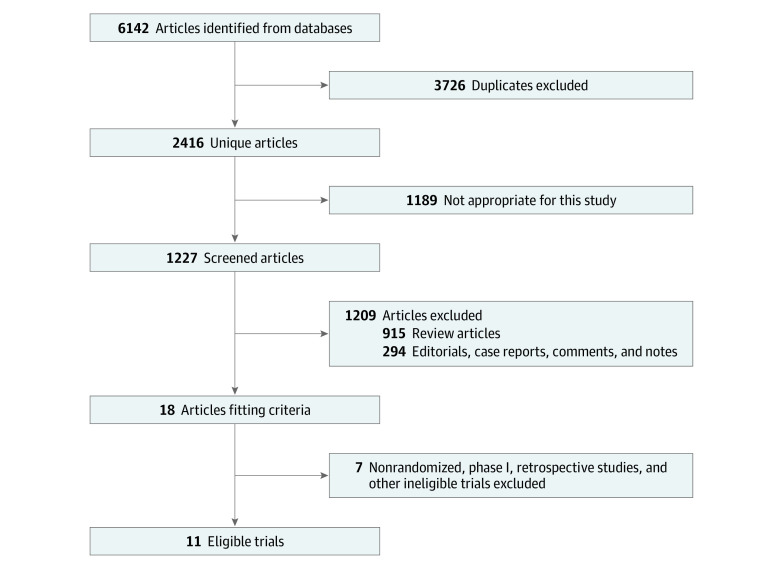
Cochrane, Scopus, and MedlinePlus databases were searched from inception through August 2019.
Randomized clinical trials comparing patients with prostate cancer treated with any ARI or placebo were included.
Two independent reviewers used a standardized data extraction and quality assessment form. A mixed effects model was used to estimate the effects of ARI on relative risk, with included studies treated as random effects and study groups treated as fixed effects in the pooled analysis. Sample size for each study was used to weight the mixed model. Statistical analysis was performed from August to October 2019.
The primary outcome was RR of fall and fractures for patients receiving ARI treatment.
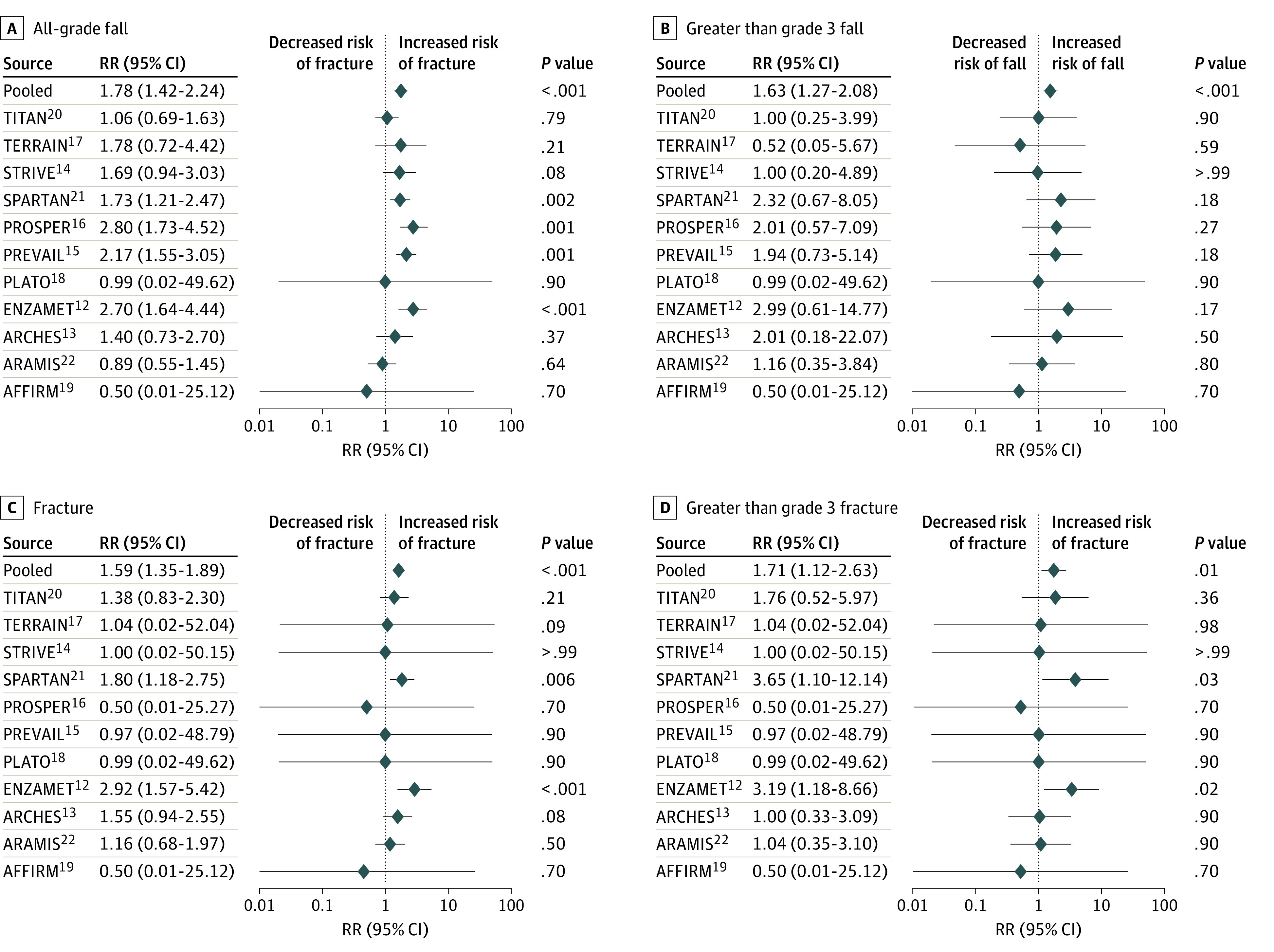
Eleven studies met this study's inclusion criteria. The total population was 11 382 men (median [range] age: 72 [43-97] years), with 6536 in the ARI group and 4846 in the control group. Participants in the ARI group could have received enzalutamide, apalutamide, or darolutamide in combination with androgen deprivation therapy or other enzalutamide combinations; patients in the control group could have received placebo, bicalutamide, or abiraterone. The reported incidence of fall was 525 falls (8%) in the ARI group and 221 falls (5%) in the control group. The incidence of fracture was 242 fractures (4%) in the ARI group and 107 fractures (2%) in the control group. Use of an ARI was associated with an increased risk of falls and fractures: all-grade falls (RR, 1.8; 95% CI, 1.42-2.24; P < .001); grade 3 or greater fall (RR, 1.6; 95% CI, 1.27-2.08; P < .001); all-grade fracture (RR, 1.59; 95% CI, 1.35-1.89; P < .001), and likely grade 3 or greater fracture (RR, 1.71; 95% CI, 1.12-2.63; P = .01).
Use of ARI was associated with an increase in falls and fractures in patients with prostate cancer as assessed by a retrospective systematic review and meta-analysis. Further studies are warranted to identify and understand potential mechanisms and develop strategies to decrease falls and fractures associated with ARI use.
已有报道称,在接受雄激素受体抑制剂(ARIs)治疗的患者亚组中,跌倒和骨折的发生率较高,尽管接受 ARI 治疗的患者跌倒和骨折的相对风险(RR)尚不清楚。
评估雄激素受体抑制剂(ARIs)治疗是否与前列腺癌患者跌倒和骨折的相对风险增加有关。
从创建到 2019 年 8 月,对 Cochrane、Scopus 和 MedlinePlus 数据库进行了检索。
纳入了比较接受任何 ARI 或安慰剂治疗的前列腺癌患者的随机临床试验。
两名独立审查员使用标准化的数据提取和质量评估表。使用混合效应模型来估计 ARI 对相对风险的影响,将纳入的研究视为随机效应,并在汇总分析中将研究组视为固定效应。对每项研究的样本量进行加权,以调整混合模型。统计分析于 2019 年 8 月至 10 月进行。
主要结局是接受 ARI 治疗的患者跌倒和骨折的 RR。
11 项研究符合本研究的纳入标准。总人群为 11382 名男性(中位数[范围]年龄:72[43-97]岁),ARI 组 6536 人,对照组 4846 人。ARI 组的参与者可能接受了恩扎鲁胺、阿帕鲁胺或达罗鲁胺联合雄激素剥夺治疗或其他恩扎鲁胺联合治疗;对照组的参与者可能接受了安慰剂、比卡鲁胺或阿比特龙。ARI 组报告的跌倒发生率为 525 例(8%),对照组为 221 例(5%)。ARI 组骨折发生率为 242 例(4%),对照组为 107 例(2%)。使用 ARI 与跌倒和骨折风险增加相关:所有级别跌倒(RR,1.8;95%CI,1.42-2.24;P<0.001);3 级或更高级别的跌倒(RR,1.6;95%CI,1.27-2.08;P<0.001);所有级别骨折(RR,1.59;95%CI,1.35-1.89;P<0.001),以及可能 3 级或更高级别的骨折(RR,1.71;95%CI,1.12-2.63;P=0.01)。
回顾性系统评价和荟萃分析评估显示,使用 ARI 与前列腺癌患者跌倒和骨折的增加有关。需要进一步的研究来确定和了解潜在的机制,并制定降低与 ARI 使用相关的跌倒和骨折的策略。