Poursalehian Mohammad, Pakbaz Yeganeh, Mortazavi Seyed Mohammad Javad
Joint Reconstruction Research Center Tehran University of Medical Sciences Tehran Iran.
J Exp Orthop. 2024 Dec 15;11(4):e70110. doi: 10.1002/jeo2.70110. eCollection 2024 Oct.
Mobile-bearing total knee arthroplasty (MB-TKA) and fixed-bearing (FB) TKA are both widely used, with MB-TKA theoretically offering better functional outcomes due to its natural kinematics. This systematic review and meta-analysis aimed to compare joint awareness between MB-TKA and FB-TKA, as measured by Forgotten Joint Score-12 (FJS-12), to provide insights into patient-perceived outcomes.
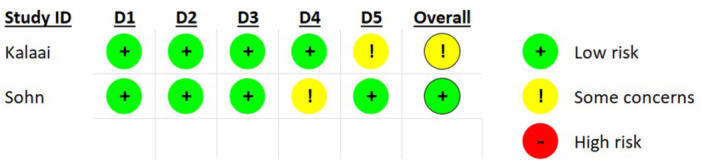
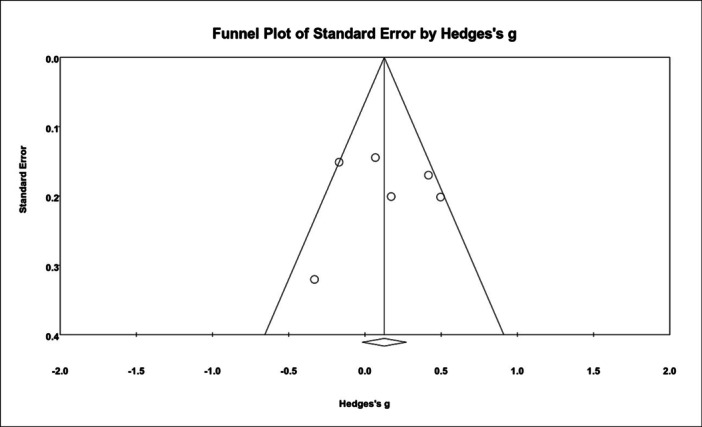
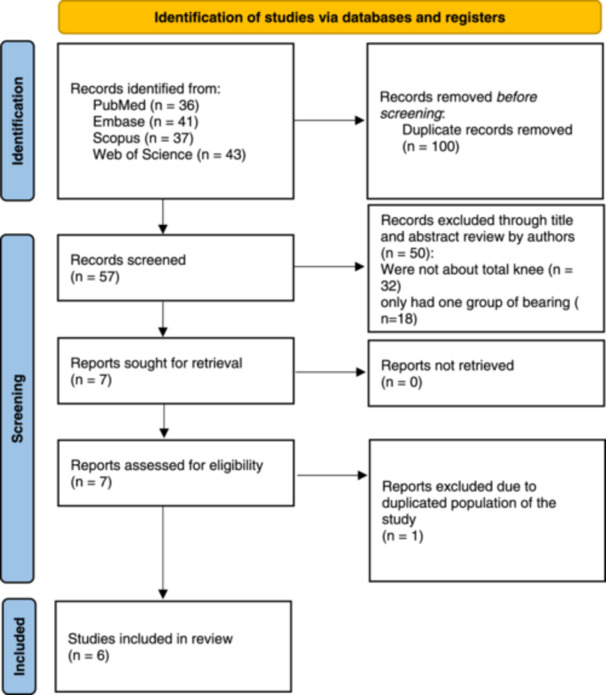
A comprehensive literature search was conducted across major databases following PRISMA guidelines, without date or language restrictions. Studies focusing on TKA with MB or FB as the intervention and control groups, respectively, and reporting on FJS-12 were included. The selection process involved two independent reviewers. Data extraction was carried out using a structured checklist and assessed for quality using the Newcastle-Ottawa Scale (NOS). The meta-analysis employed Hedge's method to compare FJS-12 and assessed publication bias using Egger's test and funnel plot analyses.
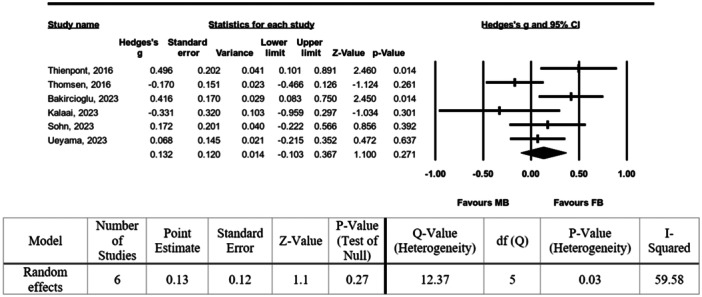
Six studies, including two randomized clinical trials and four cohort studies with 731 participants and mean follow-up of 5.4 years, met the inclusion criteria. The meta-analysis revealed no significant difference in FJS-12 between MB and FB TKA (pooled difference = 0.132, 95% confidence interval: -0.103 to 0.367, = 0.271), with moderate heterogeneity observed ( = 53.5%). Publication bias assessment indicated no significant bias. Meta-regression did not identify factors contributing to heterogeneity.
MB-TKA does not provide superior patient-perceived outcomes in terms of joint awareness compared to FB-TKA. This suggests that the clinical advantage of MB-TKA in terms of joint awareness is likely negligible. Therefore, the choice between MB and FB TKA should be based on other considerations, such as surgeon preference, implant cost and individual patient needs.
Level III.
活动平台全膝关节置换术(MB-TKA)和固定平台(FB)全膝关节置换术均被广泛应用,理论上MB-TKA因其自然的运动学特性可提供更好的功能结果。本系统评价和荟萃分析旨在比较MB-TKA和FB-TKA之间的关节感知,采用遗忘关节评分-12(FJS-12)进行测量,以深入了解患者的主观感受结果。
按照PRISMA指南在各大数据库进行全面的文献检索,无日期或语言限制。纳入分别以MB或FB作为干预组和对照组的全膝关节置换术研究,并报告FJS-12。选择过程由两名独立评审员进行。使用结构化清单进行数据提取,并使用纽卡斯尔-渥太华量表(NOS)评估质量。荟萃分析采用Hedge's方法比较FJS-12,并使用Egger检验和漏斗图分析评估发表偏倚。
六项研究符合纳入标准,包括两项随机临床试验和四项队列研究,共731名参与者,平均随访5.4年。荟萃分析显示,MB-TKA和FB-TKA在FJS-12方面无显著差异(合并差异=0.132,95%置信区间:-0.103至0.367,P=0.271),观察到中度异质性(I²=53.5%)。发表偏倚评估表明无显著偏倚。荟萃回归未发现导致异质性的因素。
与FB-TKA相比,MB-TKA在关节感知方面并未提供更好的患者主观感受结果。这表明MB-TKA在关节感知方面的临床优势可能微不足道。因此,MB-TKA和FB-TKA之间的选择应基于其他考虑因素,如外科医生的偏好、植入物成本和个体患者需求。
三级。