Tsuda Ayano, Manalo Emmanuel, Miyai Ichiro, Noda Tomoyuki
Department of Brain Robot Interface, ATR Computational Neuroscience Laboratories, Kyoto, Japan.
Graduate School of Education, Kyoto University, Kyoto, Japan.
Front Rehabil Sci. 2024 Nov 29;5:1450157. doi: 10.3389/fresc.2024.1450157. eCollection 2024.
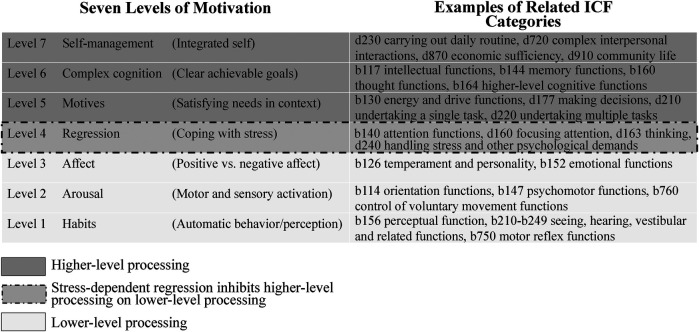
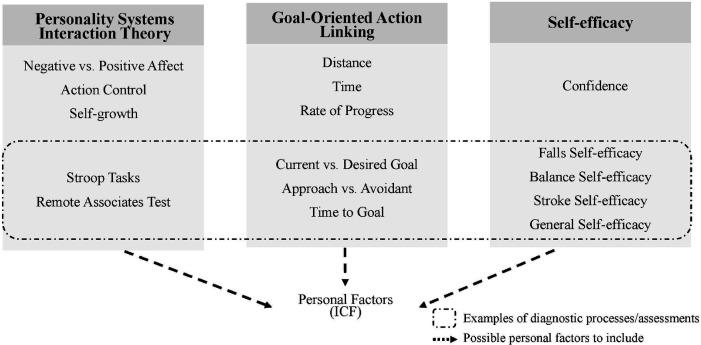
The International Classification of Functioning, Disability, and Health (ICF) is a widely used framework in rehabilitation that provides standardized measures to describe health and health-related states of people. The strength of the ICF lies in its provision of a common language for describing rehabilitation progress. However, personal factors are not classified within the ICF due to their significant variability across cultures, which may render it not adequately capturing the subjective and social dimensions of disability. Our objective in this research was to propose theoretical frameworks that could help identify relevant personal factors for inclusion in the ICF. We discuss the Personality Systems Interaction (PSI) Theory to identify personal variability in goal pursuit, highlighting the importance of emotions like negative and positive affect in handling adverse situations and managing habitual behaviors. Additionally, the theory helps to determine personality factors relevant to patients, facilitating the resolution of potential issues that may emerge during the goal achievement process. We also emphasize the role of goal setting in rehabilitation and suggest the Goal-Oriented Action Linking (GOAL) model as a useful tool for understanding how motivational values change over time, distance, and progress. Following from this, we discuss the importance of self-efficacy and its relationship to effort and goal achievement, while noting potential issues in its assessment. Finally, we propose viable assessment methods for measuring the potential components to be incorporated as personal factors.
《国际功能、残疾和健康分类》(ICF)是康复领域广泛使用的一个框架,它提供标准化的衡量标准来描述人们的健康及与健康相关的状态。ICF的优势在于它为描述康复进展提供了一种通用语言。然而,由于个人因素在不同文化间存在显著差异,因此未在ICF中进行分类,这可能导致ICF无法充分涵盖残疾的主观和社会层面。我们这项研究的目的是提出一些理论框架,以帮助确定可纳入ICF的相关个人因素。我们讨论了人格系统交互(PSI)理论,以识别目标追求中的个人差异,强调诸如消极和积极情感等情绪在应对不利情况和管理习惯行为方面的重要性。此外,该理论有助于确定与患者相关的人格因素,促进解决目标实现过程中可能出现的潜在问题。我们还强调了目标设定在康复中的作用,并建议将目标导向行动链接(GOAL)模型作为一种有用工具,以理解动机价值观如何随时间、距离和进展而变化。在此基础上,我们讨论了自我效能的重要性及其与努力和目标实现的关系,同时指出其评估中存在的潜在问题。最后,我们提出了可行的评估方法,以衡量可作为个人因素纳入的潜在组成部分。