Martinez-Cano Juan Pablo, Iversen Maura D, Gallego Alejandro, Alfonso Gallon Luis, Askenberger Marie, von Heideken Johan
Departamento de Ortopedia, Fundación Valle del Lili, Cali, Colombia.
Universidad Icesi, Cali, Colombia.
Orthop J Sports Med. 2024 Dec 13;12(12):23259671241298306. doi: 10.1177/23259671241298306. eCollection 2024 Dec.
The Banff Patellofemoral Instability Instrument (BPII) 2.0 is a patient-reported outcome measure (PROM) tailored specifically for patellofemoral instability. The BPII 2.0 was developed in English and has been validated for adolescents and translated into several languages, but not into Spanish.
PURPOSE/HYPOTHESIS: This investigation involved translating the BPII 2.0 into Spanish and evaluating and validating its psychometric properties. It was hypothesized that there would be a moderate correlation between the Spanish BPII 2.0 and the Spanish version of the Kujala score.
Cohort study (diagnosis); Level of evidence, 3.
The BPII 2.0 underwent forward and backward translations into Colombian Spanish according to the Consensus-Based Standards for the Selection of Health Measurement Instrument guidelines. Colombian patients aged 9 to 18 years who experienced knee symptoms after a primary or recurrent patellar dislocation were recruited from a hospital-based orthopaedic clinic. Participants completed the Spanish BPII 2.0 and the Kujala score during their initial visit (t) and the Spanish BPII 2.0 again 1 week later (t). Internal consistency and test-retest reliability were assessed using the intraclass correlation coefficient (ICC). Concurrent validity of the Spanish BPII 2.0 with the Kujala score was explored through Pearson correlation analysis.
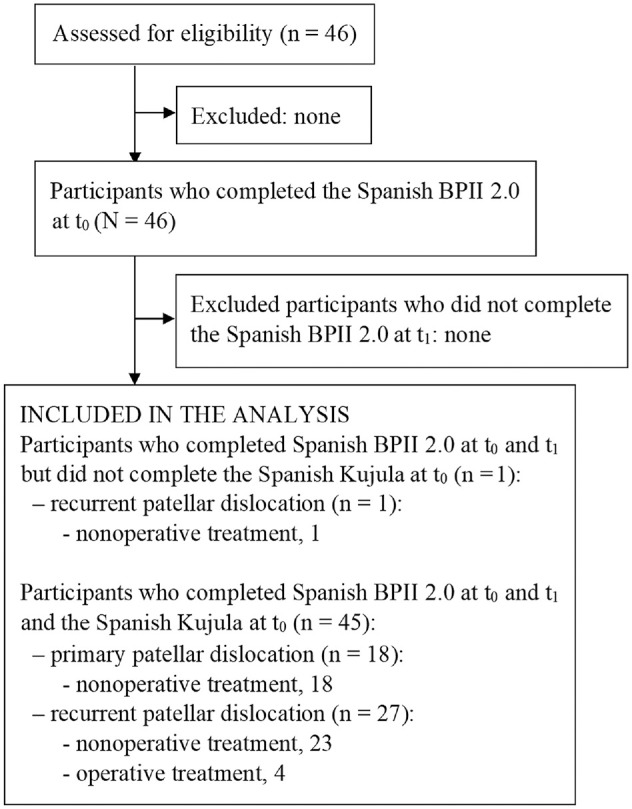
A total of 46 participants (31 [67%] female; mean age, 15.1 ± 2.0 years) were included. The mean time since first patellofemoral dislocation was 22 ± 28 months. Of the 4 participants who received operative treatment for patellar instability, the mean time since surgery was 12 months (range, 7-18 months). All patients completed the BPII 2.0 at t and at t, a mean of 7 days later (range, 6-7 days), and 45 (98%) participants completed the Kujala score at t. Five Spanish BPII 2.0 items exhibited floor or ceiling effects, however no subscales demonstrated these effects. Th Spanish BPII 2.0 demonstrated excellent internal consistency at both t (ICC, 0.94; 95% CI, 0.92-0.96) and t (ICC, 0.96; 95% CI, 0.93-0.97), along with excellent test-retest reliability (ICC, 0.98; 95% CI, 0.97-0.99). Concurrent validity of the Spanish BPII 2.0 with the Spanish Kujala score was good to strong ( = 0.74; 95% CI, 0.57-0.85).
The Spanish BPII 2.0 had excellent internal consistency and test-retest reliability, suggesting this PROM is a reliable and valid questionnaire.
班夫髌股关节不稳量表(BPII)2.0是一种专门针对髌股关节不稳的患者报告结局量表(PROM)。BPII 2.0最初以英文开发,已在青少年中得到验证,并被翻译成多种语言,但未翻译成西班牙语。
目的/假设:本研究旨在将BPII 2.0翻译成西班牙语,并评估和验证其心理测量学特性。研究假设西班牙版BPII 2.0与西班牙版库贾拉评分之间存在中度相关性。
队列研究(诊断);证据等级为3级。
根据健康测量工具选择的基于共识的标准指南,将BPII 2.0进行正向和反向翻译为哥伦比亚西班牙语。从一家医院的骨科诊所招募9至18岁的哥伦比亚患者,这些患者在初次或复发性髌骨脱位后出现膝关节症状。参与者在初次就诊时(t)完成西班牙版BPII 2.0和库贾拉评分,并在1周后再次完成西班牙版BPII 2.0(t)。使用组内相关系数(ICC)评估内部一致性和重测信度。通过Pearson相关分析探讨西班牙版BPII 2.0与库贾拉评分的同时效度。
共纳入46名参与者(31名[67%]女性;平均年龄15.1±2.0岁)。首次髌股关节脱位后的平均时间为22±28个月。在4名接受髌骨不稳手术治疗的参与者中,术后平均时间为12个月(范围7 - 18个月)。所有患者在t和t时均完成了BPII 2.0,平均间隔7天(范围6 - 7天),45名(98%)参与者在t时完成了库贾拉评分。西班牙版BPII 2.0的5个项目表现出地板效应或天花板效应,然而没有子量表表现出这些效应。西班牙版BPII 2.0在t时(ICC,0.94;95%CI,0.92 - 0.96)和t时(ICC,0.96;95%CI,0.93 - 0.97)均表现出出色的内部一致性,以及出色的重测信度(ICC,0.98;95%CI,0.97 - 0.99)。西班牙版BPII 2.0与西班牙版库贾拉评分的同时效度良好至较强(= 0.74;95%CI,0.57 - 0.85)。
西班牙版BPII 2.0具有出色的内部一致性和重测信度,表明该患者报告结局量表是一份可靠且有效的问卷。