
美国与中风和心房颤动相关的死亡率的时间趋势:对疾病控制与预防中心(CDC)-WONDER数据库的21年回顾性分析
Temporal Trends in Mortality Related to Stroke and Atrial Fibrillation in the United States: A 21-Year Retrospective Analysis of CDC-WONDER Database.
作者信息
Ahmad Owais, Farooqi Hanzala Ahmed, Ahmed Isra, Jamil Adeena, Nabi Rayyan, Ullah Irfan, Khan Abdul Wali, Ahmed Raheel, Alam Mahboob, Cortese Bernardo, Mamas Mamas A
机构信息
Islamic International Medical College, Riphah International University, Islamabad, Pakistan.
Aga Khan University, Karachi, Pakistan.
出版信息
Clin Cardiol. 2024 Dec;47(12):e70058. doi: 10.1002/clc.70058.
AIMS
Atrial Fibrillation (AF) is one of the most strongly associated risk factors for stroke. Our study aims to analyze changes in mortality from 1999 to 2020 in patients with AF and stroke.
METHODS
Using the Centre for Disease Control and Prevention Wide-Ranging Online Data for Epidemiologic Research (CDC-WONDER), we retrospectively analyzed annual age-adjusted mortality rates (AAMR) per million from 1999 to 2020 in stroke patients with AF. Temporal trends were analyzed, and Annual Percentage Change (APC) was calculated using the JoinPoint regression model across variations in demographics (sex, race) and regional subgroups.
RESULTS
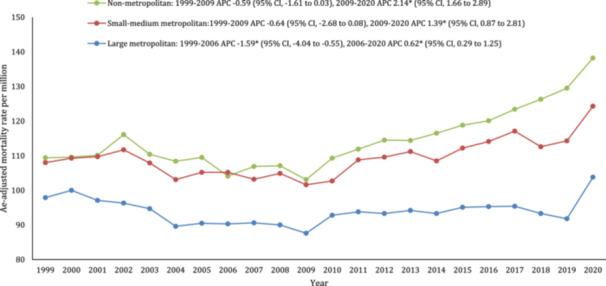
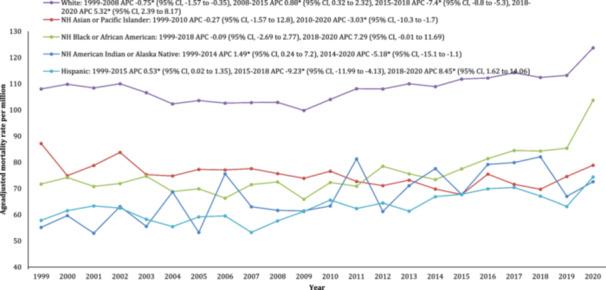
Around 490 000 deaths were reported between 1999 and 2020 from stroke and AF across the 25-85+ age group. AAMR initially decreased until 2008 (APC = -0.9), followed by an increase till 2020 (APC = 1.1). Women had a higher AAMR than men throughout the years. Non-Hispanic white patients had a marginally higher AAMR than all other races and ethnicities. The highest AAMR was observed in the western region. States like Vermont, Oregon, Washington, Alaska, Minnesota, and West Virginia were in the top 90th percentile, while Nevada, Louisiana, Florida, New York, New Mexico, and Arizona were in the bottom 10th percentile. Nonmetropolitan areas had consistently higher AAMRs throughout the 2 decades.
CONCLUSION
An overall rise in mortality has been observed in stroke and AF patients, with a greater surge in 2019. The need for healthcare policy changes, especially in areas with high mortality and awareness of healthier lifestyle factors, can be an essential preventative measure to help mitigate growing mortality rates.
目的
心房颤动(AF)是与中风关联最为紧密的危险因素之一。我们的研究旨在分析1999年至2020年期间房颤合并中风患者的死亡率变化。
方法
利用疾病控制与预防中心的广泛在线流行病学研究数据(CDC-WONDER),我们回顾性分析了1999年至2020年期间每百万例房颤合并中风患者的年龄调整死亡率(AAMR)。分析了时间趋势,并使用JoinPoint回归模型计算了不同人口统计学特征(性别、种族)和地区亚组的年度百分比变化(APC)。
结果
在1999年至2020年期间,25至85岁以上年龄组中,约有49万人死于中风和房颤。AAMR最初在2008年之前下降(APC = -0.9),随后在2020年之前上升(APC = 1.1)。多年来,女性的AAMR高于男性。非西班牙裔白人患者的AAMR略高于所有其他种族和族裔。西部地区的AAMR最高。佛蒙特州、俄勒冈州、华盛顿州、阿拉斯加州、明尼苏达州和西弗吉尼亚州等州处于第90百分位以上,而内华达州、路易斯安那州、佛罗里达州、纽约州、新墨西哥州和亚利桑那州处于第10百分位以下。在这20年中,非都市地区的AAMR一直较高。
结论
已观察到中风和房颤患者的死亡率总体上升,2019年上升幅度更大。医疗保健政策的改变,尤其是在死亡率高的地区以及对更健康生活方式因素的认知,可能是帮助降低不断上升的死亡率的一项重要预防措施。


 Zotero 插件