Zafar Mohammad, Subramaniyan Vasudevan, Ansari Kamal Uddin, Yakir Hadar, Danovich David, Tulchinsky Yuri
Institute of Chemistry, Hebrew University of Jerusalem, Jerusalem 9190401, Israel.
Inorg Chem. 2024 Dec 30;63(52):24466-24481. doi: 10.1021/acs.inorgchem.4c03819. Epub 2024 Dec 16.
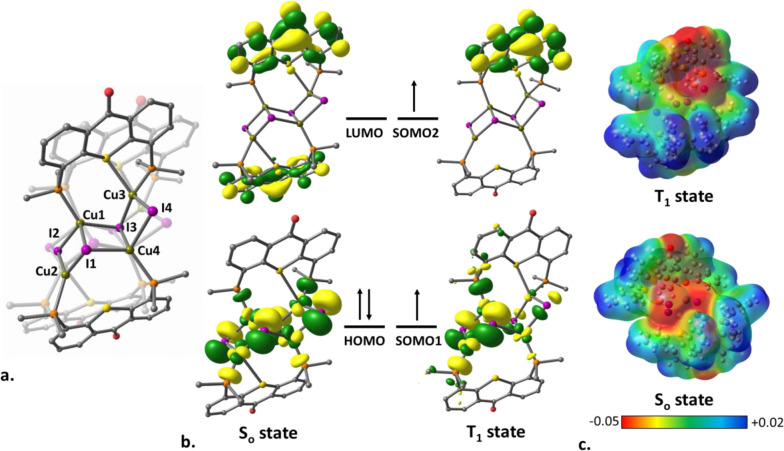
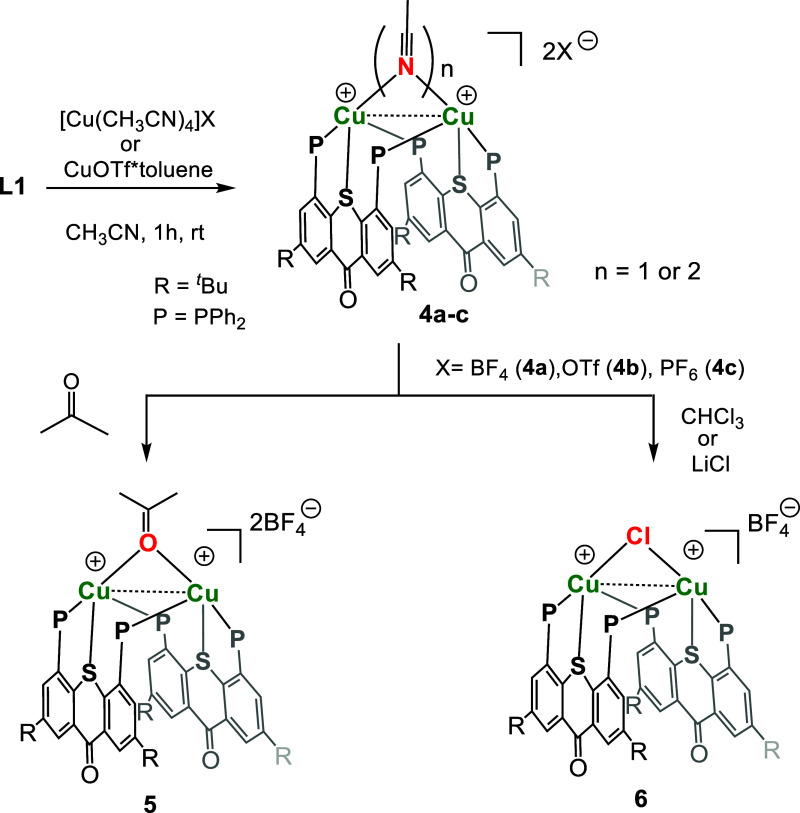
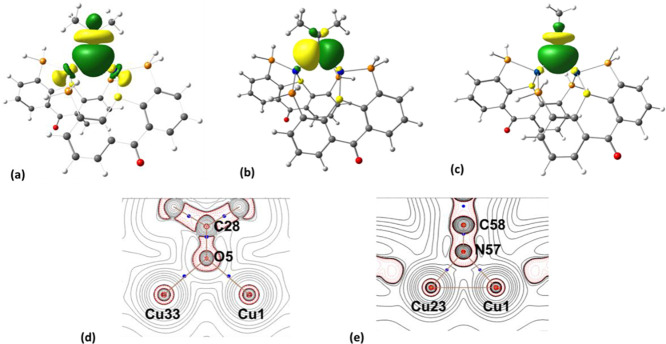
Thioxanthone (TX) molecules and their derivatives are well-known photoactive compounds. Yet, there exist only a handful of luminescent systems combining TX with transition metals. Recently, we reported a TX-based PSP pincer ligand () that appears as a promising platform for filling this niche. Herein, we demonstrate that with Cu(I) this ligand exclusively assembles into dimeric structures with either di- or polynuclear Cu(I) cores. With cationic Cu(I) precursors, complexes featuring solvent-bridged bis-cationic cores were obtained. These coordinatively unsaturated bimetallic systems showed surprisingly facile activation of the chloroform C-Cl bonds, suggesting a possible metal-metal cooperation. The reaction of with binary Cu(I) halides afforded dimeric complexes with polynuclear [CuX] ( = 3 or 4) cores. With X = Br or I, emissive complexes containing stairstep [CuX] clusters were obtained. Emission lifetimes in the microsecond range measured for these complexes were indicative of a triplet emission (phosphorescence), which according to our time-dependent density functional theory study originates from a halide-metal-to-ligand charge transfer between the [CuX] cluster and the TX backbone of . Finally, the distinctive polynucleating behavior of toward Cu(I) was also showcased by a comparison to another PSP ligand with a diaryl thioether backbone (), which formed only mononuclear pincer-type complexes, lacking any unusual reactivity or photoluminescence.
噻吨酮(TX)分子及其衍生物是众所周知的光活性化合物。然而,将TX与过渡金属结合的发光体系却寥寥无几。最近,我们报道了一种基于TX的PSP钳形配体(),它似乎是填补这一空白的一个有前途的平台。在此,我们证明,该配体与Cu(I)仅组装成具有双核或多核Cu(I)核的二聚体结构。使用阳离子Cu(I)前体,获得了具有溶剂桥连双阳离子核的配合物。这些配位不饱和双金属体系显示出令人惊讶的氯仿C-Cl键的易活化,表明可能存在金属-金属协同作用。与二元Cu(I)卤化物反应得到具有多核[CuX](=3或4)核的二聚体配合物。当X = Br或I时,得到含有阶梯状[CuX]簇的发光配合物。对这些配合物测得的微秒级发射寿命表明是三重态发射(磷光),根据我们的含时密度泛函理论研究,这源于[CuX]簇与的TX主链之间的卤化物-金属-配体电荷转移。最后,通过与另一种具有二芳基硫醚主链的PSP配体()比较,也展示了对Cu(I)独特的多核化行为,后者仅形成单核钳形配合物,没有任何异常反应性或光致发光。