Calderon-Williams Debora R, de Souza Rimenez Rodrigues, Tseng Ching T, Abdi Hervé, Sandoval-Flores Alfredo, Ploski Jonathan E, Thorn Catherine A, McIntyre Christa K
Department of Neuroscience, University of Texas at Dallas, Richardson, Texas 75080, USA.
Texas Biomedical Device Center, Richardson, Texas 75080, USA.
Learn Mem. 2024 Dec 16;31(12). doi: 10.1101/lm.053958.124. Print 2024 Dec.
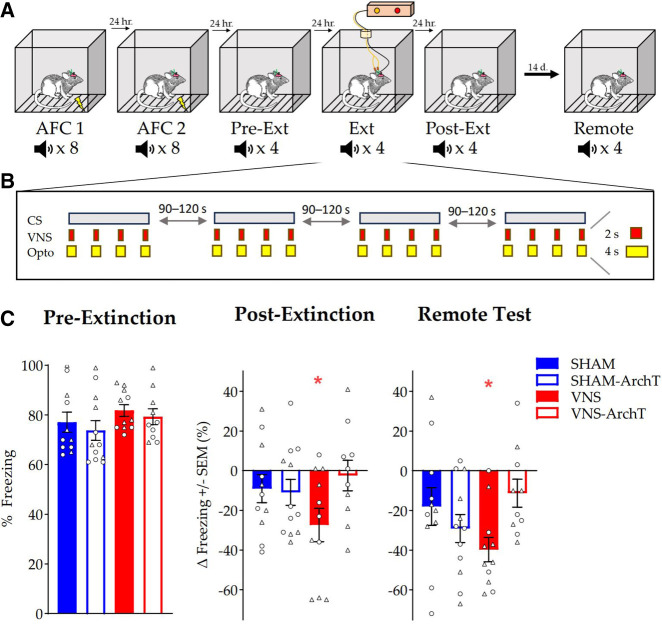
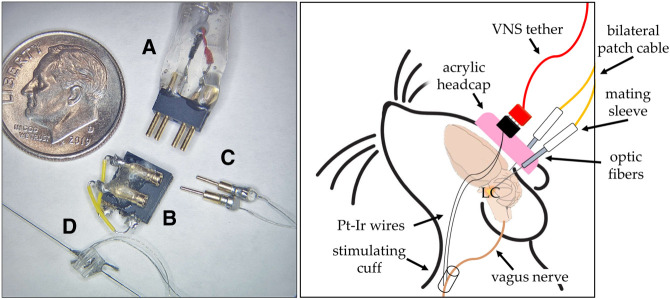
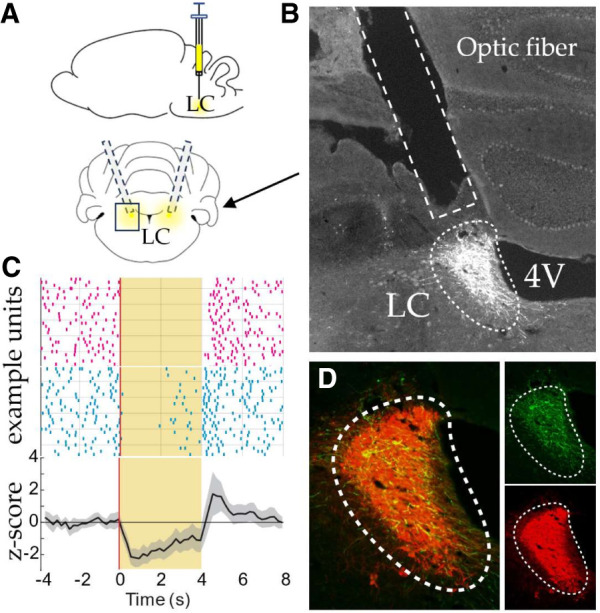
Vagus nerve stimulation (VNS) is a therapeutic intervention previously shown to enhance fear extinction in rats. VNS is approved for use in humans for the treatment of epilepsy, depression, and stroke, and it is currently under investigation as an adjuvant to exposure therapy in the treatment of PTSD. However, the mechanisms by which VNS enhances extinction of conditioned fear remain unresolved. VNS increases norepinephrine levels in extinction-related pathways, but recent studies indicate that norepinephrine release from the locus coeruleus interferes with extinction learning. The purpose of this study is to elucidate the role of the locus coeruleus (LC) in VNS-enhanced fear extinction. Adult male and female tyrosine hydroxylase (Th)-Cre rats were implanted with a stimulating cuff electrode around the left cervical vagus nerve, and a Cre-dependent viral vector expressing the inhibitory opsin ArchT3.0 was infused bilaterally into the LC. Rats then underwent auditory fear conditioning followed by extinction training. During extinction training, rats were divided into four treatment groups: Sham stimulation, Sham with LC inhibition, VNS, and VNS with LC inhibition. Consistent with previous findings, VNS treatment during extinction training significantly reduced freezing 24 h and 2 weeks later. This effect was blocked by optogenetic LC inhibition, suggesting that VNS enhances extinction by engaging the LC.
迷走神经刺激(VNS)是一种治疗干预措施,先前已证明其可增强大鼠的恐惧消退。VNS已被批准用于人类治疗癫痫、抑郁症和中风,目前正在研究其作为创伤后应激障碍(PTSD)暴露疗法辅助手段的效果。然而,VNS增强条件性恐惧消退的机制仍未明确。VNS会增加与消退相关通路中的去甲肾上腺素水平,但最近的研究表明,蓝斑核释放的去甲肾上腺素会干扰消退学习。本研究的目的是阐明蓝斑核(LC)在VNS增强恐惧消退中的作用。成年雄性和雌性酪氨酸羟化酶(Th)-Cre大鼠在左颈迷走神经周围植入刺激袖带电极,并将表达抑制性视蛋白ArchT3.0的Cre依赖性病毒载体双侧注入蓝斑核。然后对大鼠进行听觉恐惧条件反射,随后进行消退训练。在消退训练期间,大鼠被分为四个治疗组:假刺激、蓝斑核抑制的假刺激、VNS以及蓝斑核抑制的VNS。与先前的研究结果一致,在消退训练期间进行VNS治疗可在24小时和2周后显著降低僵住行为。这种效应被光遗传学蓝斑核抑制所阻断,表明VNS通过激活蓝斑核来增强消退。