Weisert Nadine, Majewski Verena, Hartleb Laura, Luko Katarina, Lototska Liudmyla, Krapoth Nils Christian, Ulrich Helle D, Janzen Christian J, Butter Falk
Department of Cell and Developmental Biology, Biocenter, University of Würzburg, 97074, Würzburg, Germany.
Quantitative Proteomics, Institute of Molecular Biology (IMB), 55128, Mainz, Germany.
Sci Rep. 2024 Dec 16;14(1):30493. doi: 10.1038/s41598-024-81972-0.
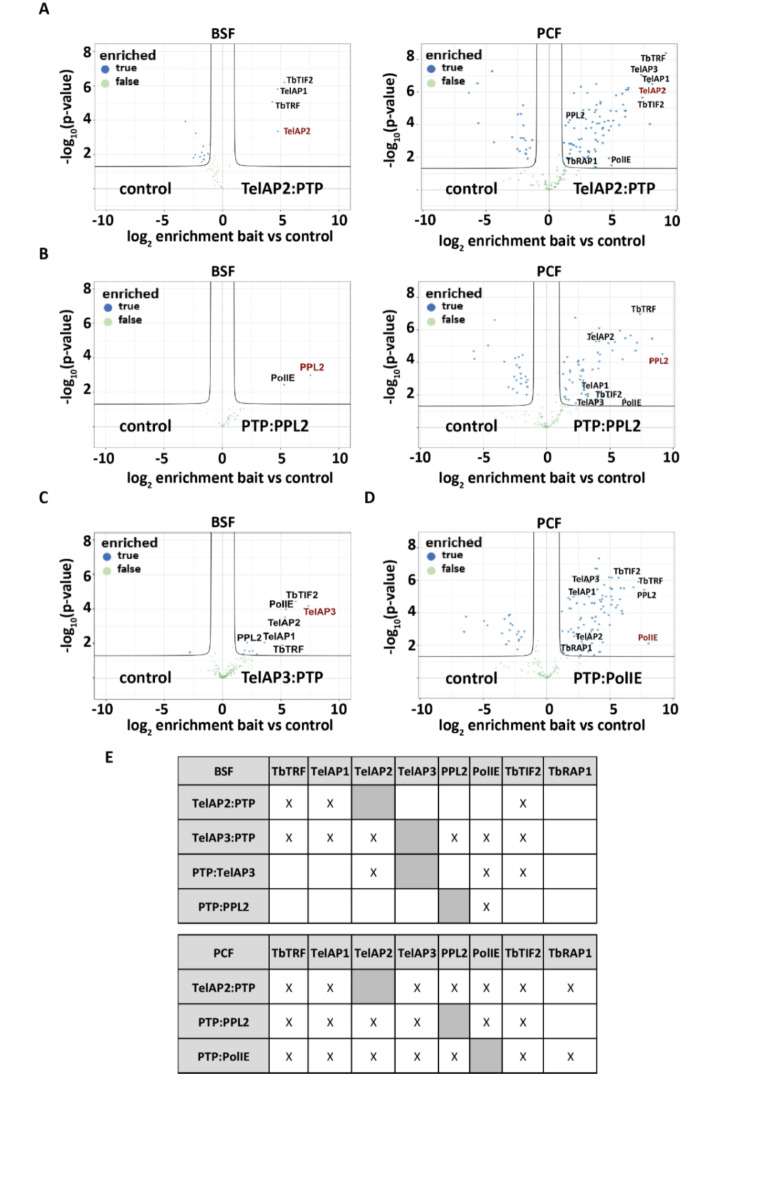
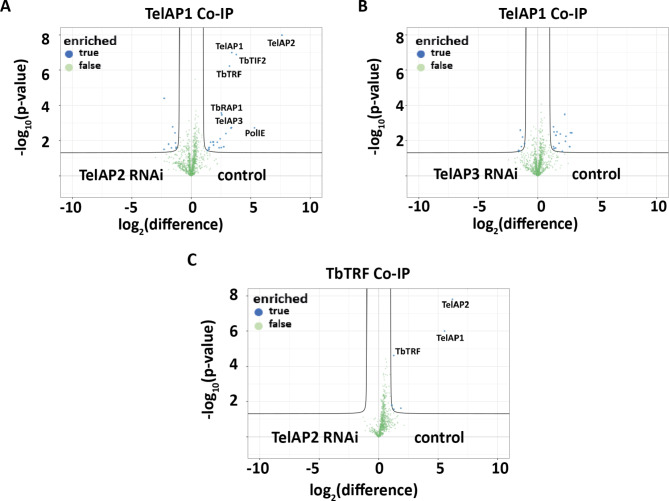
The extracellular parasite Trypanosoma brucei evades the immune system of the mammalian host by periodically exchanging its variant surface glycoprotein (VSG) coat. Hereby, only one VSG gene is transcribed from one of 15 subtelomeric so-called bloodstream form expression sites (BES) at any given timepoint, while all other BESs are silenced. VSG gene expression is altered by homologous recombination using a large VSG gene repertoire or by a so-called in situ switch, which activates a previously silent BES. Transcriptional activation, VSG switching and VSG silencing during developmental differentiation from the bloodstream form to the procyclic form present in the tsetse fly vector are tightly regulated. Due to their subtelomeric position, telomere-associated proteins are involved in the regulation of VSG expression. Three functional homologs of mammalian telomere complex proteins have been characterized thus far, and novel telomere-interacting proteins, such as telomere-associated protein 1 (TelAP1), have recently been identified. Here, we used mass spectrometry-based proteomics and interactomics approaches, telomere pull-down assays with recombinant material and immunofluorescence analysis to elucidate the interactions of 21 other putative TelAPs. We investigated the influence on VSG expression and showed that depletion of TelAPs does not ultimately lead to changes in VSG expression. Additionally, we examined the interaction patterns of four TelAPs with the TbTRF/TbTIF2/TbRAP1 telomere complex by reciprocal affinity purification. We further propose that TelAP1 interacts with Tb927.6.4330, now called TelAP2, and that TelAP1 depends on this interaction to form a complex with the telomeric proteins TbTRF, TbTIF2 and TbRAP1.
细胞外寄生虫布氏锥虫通过周期性更换其可变表面糖蛋白(VSG)外衣来逃避哺乳动物宿主的免疫系统。在此过程中,在任何给定时间点,15个亚端粒所谓的血流形式表达位点(BES)中只有一个VSG基因被转录,而所有其他BES均处于沉默状态。VSG基因表达可通过使用大量VSG基因库的同源重组或通过所谓的原位转换来改变,原位转换可激活先前沉默的BES。从血流形式向采采蝇载体中存在的前循环形式发育分化过程中的转录激活、VSG转换和VSG沉默受到严格调控。由于它们的亚端粒位置,端粒相关蛋白参与了VSG表达的调控。迄今为止,已鉴定出三种哺乳动物端粒复合体蛋白的功能同源物,最近还发现了新型端粒相互作用蛋白,如端粒相关蛋白1(TelAP1)。在此,我们使用基于质谱的蛋白质组学和相互作用组学方法、重组材料的端粒下拉实验以及免疫荧光分析来阐明其他21种假定的TelAP的相互作用。我们研究了对VSG表达的影响,结果表明TelAP的缺失最终不会导致VSG表达的变化。此外,我们通过相互亲和纯化研究了四种TelAP与TbTRF/TbTIF2/TbRAP1端粒复合体的相互作用模式。我们进一步提出,TelAP1与Tb927.6.4330(现称为TelAP2)相互作用,并且TelAP1依赖于这种相互作用与端粒蛋白TbTRF、TbTIF2和TbRAP1形成复合体。