Konrad Carolin, Neuhoff Lina, Adolph Dirk, Goerigk Stephan, Herbert Jane S, Jagusch-Poirier Julie, Weigelt Sarah, Seehagen Sabine, Schneider Silvia
Clinical Child and Adolescent Psychology, Mental Health Research and Treatment Center, Faculty of Psychology, Ruhr University Bochum, Bochum, Germany.
German Center for Mental Health (DZPG), Partner Site Bochum/Marburg, Marburg, Germany.
Commun Psychol. 2024 Dec 16;2(1):118. doi: 10.1038/s44271-024-00176-4.
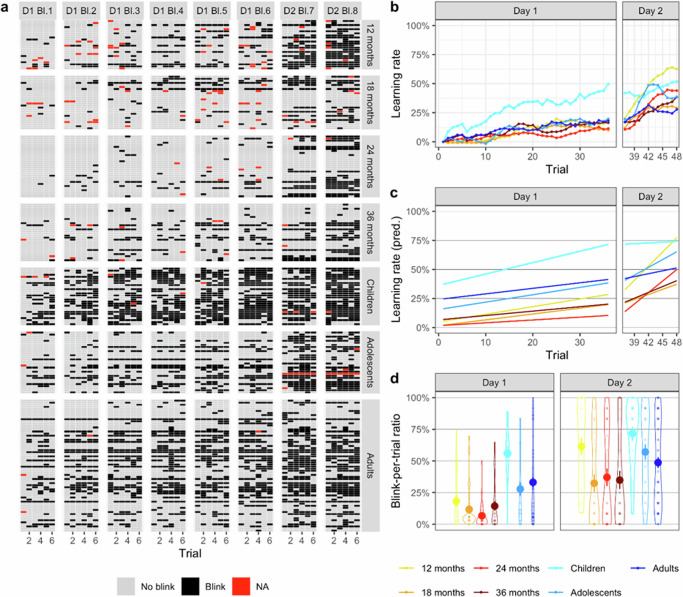
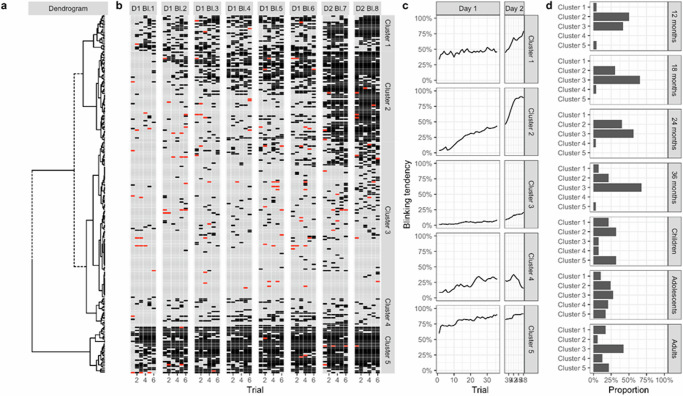
Associative learning is a key feature of adaptive behaviour and mental health, enabling individuals to adjust their actions in anticipation of future events. Comprehensive documentation of this essential component of human cognitive development throughout different developmental periods is needed. Here, we investigated age-related changes in associative learning in key developmental stages, including infancy, childhood, adolescence, and adulthood. We employed a classical delay eyeblink conditioning paradigm that consisted of two sessions with a total of 48 paired trials. Our initial hypothesis was that performance in associative learning would increase linearly with age. However, our findings suggest that performance peaks during the primary school years: Children in this age-group exhibited superior performance compared to all other age-groups and displayed the most consistent and least variable learning. Adults and adolescents exhibited faster association learning than infants. An additional learning session supported learning in infants and adolescents indicating that during these developmental stages, consolidation processes are vital for learning. A comprehensive account of the development of associative learning may inform theories on aetiology and treatment options in clinical psychology and neurosciences.
联想学习是适应性行为和心理健康的一个关键特征,使个体能够在预期未来事件时调整自己的行为。需要全面记录人类认知发展这一重要组成部分在不同发育阶段的情况。在此,我们研究了关键发育阶段(包括婴儿期、儿童期、青少年期和成年期)联想学习中与年龄相关的变化。我们采用了经典的延迟眨眼条件反射范式,该范式包括两个阶段,共有48次配对试验。我们最初的假设是联想学习的表现会随着年龄的增长而线性增加。然而,我们的研究结果表明,表现高峰出现在小学阶段:与所有其他年龄组相比,这个年龄组的儿童表现更优,学习最为一致且变化最小。成年人和青少年的联想学习比婴儿更快。额外的一次学习阶段对婴儿和青少年的学习有促进作用,这表明在这些发育阶段,巩固过程对学习至关重要。对联想学习发展的全面描述可能为临床心理学和神经科学中的病因学理论及治疗选择提供参考。