Huang Ping-Hsiu, Lin Yung-Chi, Lin Yu-Wen, Zhang You-Wei, Huang Da-Wei
School of Food, Jiangsu Food and Pharmaceutical Science College, No.4, Meicheng Rd., Higher Education Park, Huai'an 223003, China.
Department of Biotechnology and Food Technology, Southern Taiwan University of Science and Technology, No.1, Nantai St., Yungkang Dist., Tainan 710301, Taiwan.
Foods. 2024 Nov 26;13(23):3794. doi: 10.3390/foods13233794.
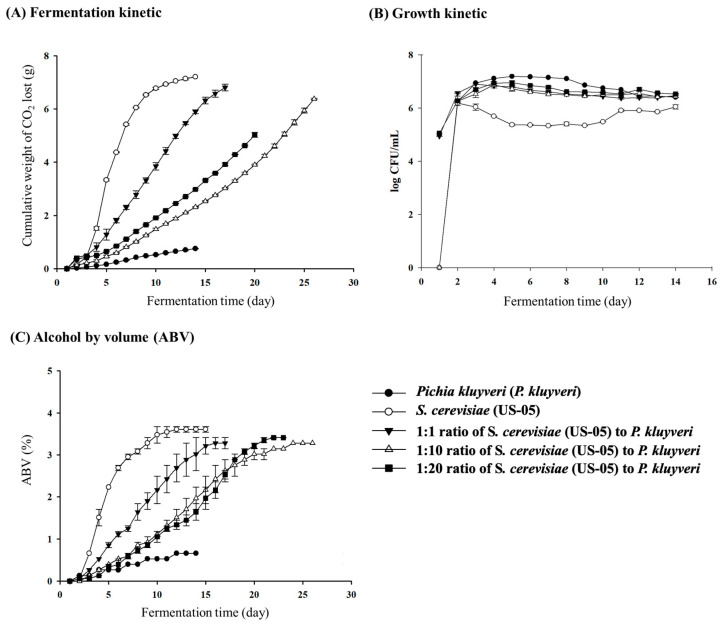
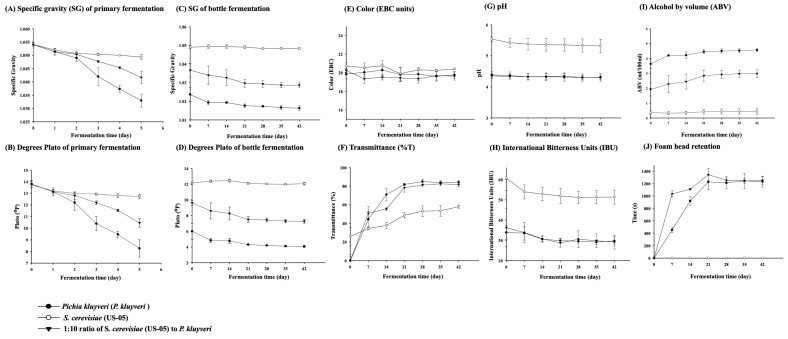
The potential health impacts of moderate alcohol consumption have long been debated. The COVID-19 pandemic has heightened public awareness of health concerns, creating a clear market opportunity for low-alcohol craft beer development. This study investigated the possibility of low-alcohol craft beer by co-fermentation with different ratios of () and (SC) according to the established quality indexes. Specifically, this study was conducted to identify the low-alcohol craft beer quality by fermentation kinetics, growth kinetics, apparent attenuation (AA), real attenuation (RA), residual sugar content, alcohol by volume (ABV), and volatile organic compounds. This study demonstrated that the co-fermentation of SC and in a 1:10 ratio produced an ABV of 2.98% (/). In addition, high concentrations of isoamyl acetate and phenyl ethyl acetate revealed banana, rose, apple, and honey flavors, respectively. Overall, this study revealed that the fermentation of and SC by co-fermentation and the fermentation process by adjusting the yeast composition developed a craft beer with low alcohol content and rich aroma while establishing the quality indicators.
适度饮酒对健康的潜在影响长期以来一直存在争议。新冠疫情提高了公众对健康问题的关注度,为低酒精精酿啤酒的发展创造了明显的市场机会。本研究根据既定的质量指标,通过将不同比例的()与(SC)共同发酵,研究了低酒精精酿啤酒的可能性。具体而言,本研究旨在通过发酵动力学、生长动力学、表观衰减(AA)、实际衰减(RA)、残余糖含量、体积酒精含量(ABV)和挥发性有机化合物来确定低酒精精酿啤酒的质量。本研究表明,SC与按1:10比例共同发酵产生的ABV为2.98%(/)。此外,高浓度的乙酸异戊酯和乙酸苯乙酯分别呈现出香蕉、玫瑰、苹果和蜂蜜的风味。总体而言,本研究表明,通过共同发酵对和SC进行发酵,并通过调整酵母组成的发酵过程,在建立质量指标的同时,开发出了一种酒精含量低且香气浓郁的精酿啤酒。