Ramunno Anna, Vitale Rosa Maria, Amodeo Pietro, Crescenzi Carlo, Panti Alice, Fiorenzani Paolo, De Luca Michele, Spizzirri Umile Gianfranco, Restuccia Donatella, Aiello Francesca, Fusi Fabio
Department of Pharmacy, University of Salerno, 84084 Fisciano, SA, Italy.
Institute of Biomolecular Chemistry-National Research Council (ICB-CNR), 80078 Pozzuoli, NA, Italy.
Molecules. 2024 Dec 2;29(23):5693. doi: 10.3390/molecules29235693.
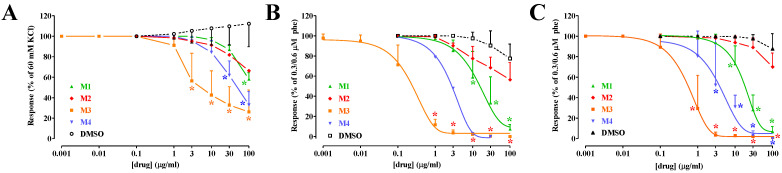
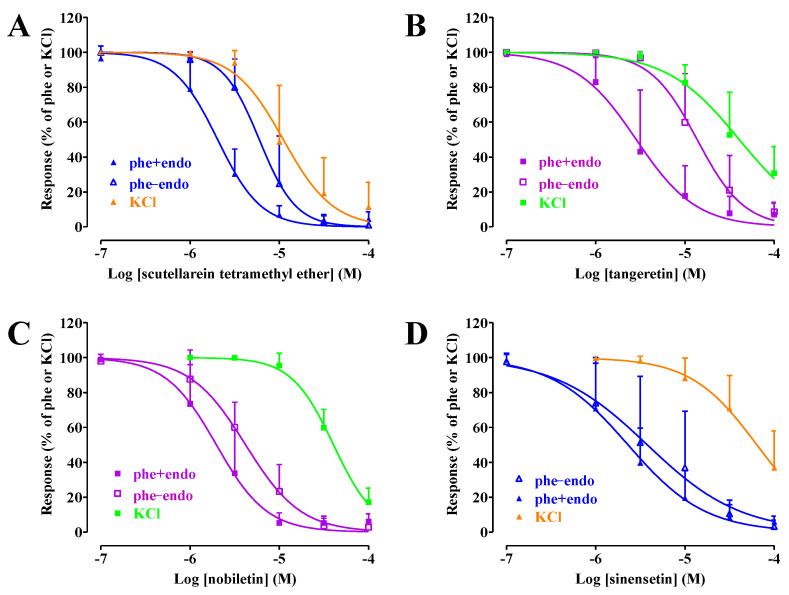
The huge amount of citrus peel produced worldwide represents an economic burden for society. However, this agricultural by-product is a rich source of natural molecules, potentially endowed with interesting pharmacological activities. In this regard, we decided to investigate if the polymethoxyflavones contained in citrus peel waste could be exploited as novel vasorelaxant agents. A hydroalcoholic blond orange () peel extract, obtained by ultrasonication, was partitioned in dichloromethane. Column chromatography allowed for the isolation of four polymethoxyflavones, namely, scutellarein tetramethyl ether, nobiletin, tangeretin, and sinensetin, identified by nuclear magnetic resonance (NMR) spectroscopy and UPLC-HRMS/MS and confirmed by multivariate curve resolution of NMR fractional spectra. The four molecules showed interesting in vitro vasorelaxant activity, at least, in part, due to the blockade of smooth muscle Ca1.2 channels. Molecular modeling and docking analysis elucidated the binding mode of the polymethoxyflavones at the homology model of the rat Ca1.2c subunit and provided the structural basis to rationalise the highest activity of scutellarein tetramethyl ether in the set and the dramatic effect of the additional methoxy group occurring in nobiletin and sinensetin. In conclusion, citrus peel can be considered a freely available, valuable source of vasoactive compounds worthy of pharmaceutical and/or nutraceutical exploitation.
全球产生的大量柑橘皮给社会带来了经济负担。然而,这种农业副产品是天然分子的丰富来源,可能具有有趣的药理活性。在这方面,我们决定研究柑橘皮废料中含有的多甲氧基黄酮是否可以开发为新型血管舒张剂。通过超声处理获得的水醇性金色橙子皮提取物用二氯甲烷进行分配。柱色谱法分离出四种多甲氧基黄酮,即黄芩素四甲醚、川陈皮素、橘皮素和甜橙黄酮,通过核磁共振(NMR)光谱和超高效液相色谱-高分辨质谱/质谱鉴定,并通过NMR分数光谱的多元曲线分辨得到确认。这四种分子至少部分地由于对平滑肌Ca1.2通道的阻断而表现出有趣的体外血管舒张活性。分子建模和对接分析阐明了多甲氧基黄酮在大鼠Ca1.2c亚基同源模型上的结合模式,并为解释该组中黄芩素四甲醚的最高活性以及川陈皮素和甜橙黄酮中额外甲氧基的显著作用提供了结构基础。总之,柑橘皮可被视为一种免费可得的、有价值的血管活性化合物来源,值得进行药物和/或营养保健品开发。